
Could the strategic timing of your property divestment be the primary factor in preserving your equity as we approach a new era of Australian fiscal policy? With the median house price in Atwell now reaching A$995,000, many investors are asking how much they will actually owe upon sale and how they can legally minimise that liability before the 2027 removal of the 50% Capital Gains Tax discount. You’ve spent years cultivating your portfolio, and the prospect of wealth erosion through upcoming regulatory shifts is a concern we deeply understand. When you evaluate the total costs of selling a house Atwell, ensuring your tax strategy is meticulously refined becomes essential for your long-term success.
This guide provides a sophisticated framework to master these complexities, allowing you to protect your assets and optimise your exit strategy within the 2026 market. We will explore the nuances of the 50% discount eligibility, provide a precise method for calculating your cost base, and offer the clarity needed to choose the right moment to sell in the thriving Cockburn area. You’ll gain the confidence to treat tax as a strategic variable, ensuring you’re prepared for the transition to the new indexation system while securing your financial legacy.
Key Takeaways
- Master the distinction between contract and settlement dates to ensure your exit strategy aligns perfectly with current fiscal regulations.
- Elevate your financial position by identifying every eligible inclusion for your cost base, including the specific costs of selling a house Atwell, to effectively minimise your tax liability.
- Secure your wealth by understanding the 50% CGT discount eligibility and the strategic application of the main residence exemption for transitioning assets.
- Align your portfolio with the rapid capital growth of the Cockburn region and the high-demand dynamics of Success WA to optimise your market entry and exit.
- Adopt a sophisticated perspective on residential sales with Regal Gateway Property that focuses on maximising your gross gain through curated marketing and professional precision.
The Architecture of Capital Gains Tax: Navigating the 2026 Australian Landscape
Understanding the fiscal architecture of your property portfolio is the first step toward securing your financial legacy. In its simplest form, Capital Gains Tax (CGT) is the levy applied to the profit realised upon the disposal of an asset, such as a residential investment property. Within the Australian framework, CGT isn’t a standalone tax. Instead, any net capital gain is integrated into your assessable income for the financial year in which the sale occurs. This integration means your marginal tax rate directly influences the final liability, making the timing of your exit a critical strategic decision. When calculating the total costs of selling a house Atwell, sophisticated investors view CGT as a manageable variable rather than an unavoidable erosion of wealth. For a broader historical context, the evolution of Capital Gains Tax in Australia highlights how these regulations have transitioned from simple profit levies to complex strategic instruments.
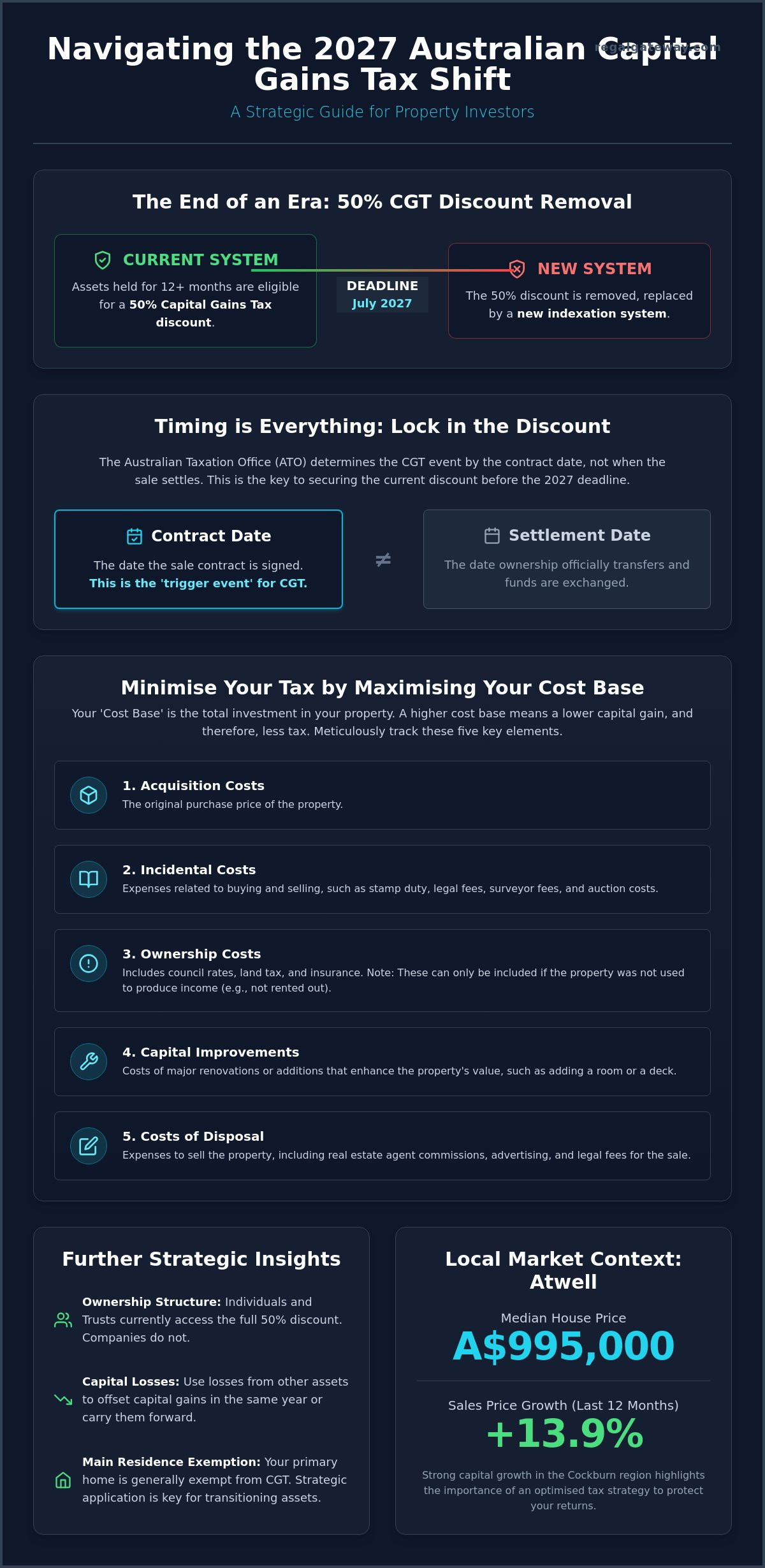
The most significant detail for your 2026 planning is the ‘trigger event’. The ATO identifies the date of the contract, not the date of settlement, as the point when the gain is realised. This distinction is paramount as we approach the July 2027 legislative shift. If you sign a contract on 30 June 2027, you may still access the current 50% discount, even if the funds don’t clear until the following financial year. Conversely, if you’ve experienced a loss on another asset, that capital loss becomes a strategic tool. You can use it to offset gains within the same year or carry it forward to protect future profits from tax exposure.
CGT vs. Income Tax: A Crucial Distinction
The ATO distinguishes between those who invest for long-term growth and those who trade property for profit. If you’re “flipping” houses frequently, the authorities may categorise your profits as ordinary income rather than capital gains, which removes access to the 50% discount. Your ownership structure also dictates your tax efficiency; individuals and trusts currently enjoy the 50% discount, while companies do not, and SMSFs receive a one-third reduction. A CGT event A1 occurs when you dispose of a property to another entity, typically at the moment you enter into a binding contract of sale.
The 2026 Regulatory Environment
The passing of the Treasury Laws Amendment (Tax Reform No. 1) Act 2026 has set a clear expiration date for the current regime. For the remainder of the 2026 calendar year, the 12-month holding rule remains your most powerful ally for wealth protection. Holding an asset for at least one year ensures you remain eligible for the 50% discount before the system transitions to indexation in 2027. Despite these shifting sands, property investment in the Cockburn region remains a robust choice. With Atwell seeing a 13.9% sales price growth over the last 12 months, the capital gains often far outweigh the tax obligations. When you consider the costs of selling a house Atwell, the potential for high-tier returns in areas like Success WA continues to attract discerning investors who value long-term stability over short-term tax hesitation.
Constructing the Cost Base: Meticulous Record-Keeping for Maximum Benefit
Constructing a robust cost base is an exercise in financial precision that separates the casual investor from the strategic wealth builder. By meticulously documenting every expense associated with your asset, you ensure that your taxable capital gain remains as lean as possible. The ‘Cost Base’ serves as the total sum of your investment, encompassing everything from the initial acquisition to the final divestment. When you calculate the costs of selling a house Atwell, remember that every dollar added to your cost base is a dollar shielded from tax. This isn’t merely about collecting receipts; it’s about building a comprehensive narrative of your property’s value. If you are evaluating the cost of digital tools to assist with this documentation, you can find out more about Tiered Monthly SaaS Subscription Fees for platforms that simplify portfolio oversight. According to the ATO guide to CGT on rental property, there are five distinct elements you must track to maximise your fiscal benefit.
The 2026 standards require a deep understanding of how these elements interact with your overall return. While the acquisition price is the most obvious component, the incidental expenses often provide the most significant opportunities for optimisation. In the event that a property is sold for less than its acquisition value, the concept of a ‘Reduced Cost Base’ applies. This specific calculation excludes certain elements, such as ownership costs, to determine the exact capital loss you can use to offset other gains in your portfolio. This level of detail ensures your financial position remains resilient regardless of market fluctuations.
Elements of the Cost Base
- Acquisition Foundation: The initial purchase price and associated costs, including A$ Stamp Duty and legal fees.
- Incidental Divestment Costs: The total costs of selling a house Atwell, which include professional agent commissions, premium marketing campaigns, and sophisticated property staging.
- Ownership Costs: Rates, land tax, and interest on loans, provided these were not already claimed as immediate income tax deductions during the period the property was rented.
- Capital Improvements: It’s essential to distinguish between ‘repairs’-which restore an asset to its original condition and are deductible immediately-and ‘improvements’ that enhance the property’s value and are added to the cost base.
- Title Preservation: Any costs incurred to defend your legal ownership or title to the property.
The Role of Professional Property Management
Securing professional property management Atwell ensures a seamless paper trail that simplifies tax time significantly. An elite management service oversees annual depreciation schedules, which are indispensable for tracking capital works over the life of the investment. We recommend storing digital copies of all records for at least five years after the CGT event occurs to ensure total compliance and ease of access during an audit. If you’re seeking to understand how your current holding costs might translate into future tax advantages, consulting with a dedicated property strategist is a prudent next step to ensure your records reflect the true value of your asset.
Strategic Exemptions and the 50% CGT Discount
Navigating the path to a tax-efficient exit requires a deep understanding of the exemptions designed to reward long-term commitment. For the discerning investor, the 50% CGT discount is not merely a tax break; it’s a fundamental pillar of wealth preservation. This provision allows individuals and trusts to reduce their taxable capital gain by half, provided the asset has been held for at least 12 months. When you assess the total costs of selling a house Atwell, this discount stands as the single most impactful reduction available to eligible sellers. By effectively halving the profit added to your taxable income, it ensures that a significant portion of your capital growth remains within your control, ready to be redeployed into your next venture, such as a strategic acquisition in the Brisbane market facilitated by Anna O’Neill Buyer’s Agent.
Beyond the standard discount, the “Main Residence Exemption” offers a sophisticated avenue for those transitioning their private retreat into an enduring asset. The Six-Year Rule, or Absence Rule, is particularly potent for the mobile workforce. It allows you to treat a property as your primary residence for up to six years while it generates rental income, provided you don’t nominate another home as your main residence during that period. This rule remains a cornerstone of the Australian Taxation Office guidelines on CGT, offering a window of opportunity to generate yield without immediately forfeiting your tax-free status. Many investors ask if the tax hit is worth selling now. The answer lies in the net-after-tax return. With the high growth rates currently seen in the Cockburn area, the realised gain, even after tax, often represents a superior outcome compared to holding an asset through shifting regulatory landscapes.
The 50% Discount: A Reward for Patience
Patience pays. If you divest a property at 11 months, you’re liable for tax on 100% of the gain at your marginal rate. Waiting just two additional months to reach the 13-month mark can save you tens of thousands of dollars. It’s vital to remember that while individuals and trusts are granted this access, companies are ineligible for the discount. This distinction makes the choice of ownership structure a primary factor in your long-term success. Your strategy must account for these timing nuances to ensure the costs of selling a house Atwell don’t overshadow your hard-earned profit.
Transitioning from Home to Investment
The moment a home becomes an investment, the “Market Value Substitution Rule” takes effect. This rule resets your cost base to the property’s market value on the day it first produces income. Obtaining a professional appraisal at this exact juncture is vital; it prevents you from paying tax on the capital growth that occurred while you lived there. To ensure your baseline is accurate for the 2026 market, understanding what’s my property worth is the first step in a curated exit strategy. For dual-purpose properties, partial exemptions are calculated based on the number of days the property was your home versus the days it was an investment, ensuring a fair and precise fiscal outcome.
Local Market Implications: CGT Strategies for Atwell and Cockburn Property Owners
The City of Cockburn has evolved into a premier investment corridor, where capital growth trends in 2026 are currently outpacing many national averages. With Atwell experiencing a 13.9% increase in median house prices to A$995,000 and Cockburn Central surging by 15.5% to A$912,500, the dilemma between holding for further appreciation or selling to realise gains has never been more nuanced. When you evaluate the costs of selling a house Atwell, you must weigh these against the sheer velocity of the local market. High-demand pockets like Success WA act as powerful catalysts for the entire region, significantly influencing the optimal window for triggering a capital gain.
Local expertise is the bridge between a standard transaction and an elite financial outcome. Maximising your sale price in this low-vacancy environment, which currently sits at a remarkable 0.4% in Atwell, provides the necessary buffer to comfortably absorb your CGT outlay. By securing a premium result through a curated sales process, your tax liability becomes a smaller percentage of your total wealth realisation. This strategic approach ensures that the costs of selling a house Atwell are justified by the exceptional net return on your investment.
Suburban Growth Spotlights: Atwell to Wandi
Infrastructure developments in Hammond Park and the master-planned communities of Treeby have fundamentally altered the regional value proposition. These enhancements drive long-term cost base strategies by supporting sustained demand and land value appreciation. Local demand frequently creates prestige premiums for high-specification homes that can easily outweigh minor tax concerns. Selling in a low-stock market like Cockburn provides a distinct strategic advantage, allowing sellers to dictate terms that align with their broader financial objectives and exit timelines.
Timing the Market for Tax Efficiency
The 30 June financial year end remains the most critical date on your strategic calendar. A contract signed in May might push your total income into a higher tax bracket for the current year, whereas a July sale could distribute that liability into a future period where your other income streams might be lower. Consulting with a specialist who understands these local market peaks allows you to align the best selling conditions with your specific tax window. To explore how your property fits into this high-growth landscape, we invite you to connect with our strategic advisory team for a bespoke market analysis that prioritises your net wealth.
The Regal Gateway Property Approach: Orchestrating a Sophisticated Exit Strategy
At Regal Gateway Property, we view the sale of your investment property not as a mere closing of a file, but as the orchestration of a sophisticated exit strategy designed to honour your years of stewardship. As your concierge in high-stakes residential transactions, we recognise that the costs of selling a house Atwell represent a significant investment in your future liquidity. Our bespoke marketing plans are meticulously curated to maximise your gross gain. This ensures that even after accounting for fiscal obligations, your net return remains at an elite level. By treating every property as an enduring asset with a unique story, we attract the type of discerning buyer who values quality and is prepared to pay a premium for it.
The synergy between professional property management and a successful sales transition is where our expertise truly shines. Because we’ve maintained a meticulous paper trail of repairs, improvements, and depreciation throughout the tenancy, we enter the sales phase with a complete financial narrative. This data-driven foundation allows us to present a transparent and compelling case to potential purchasers, while simultaneously providing your tax professionals with the precise figures they need to calculate your final liability. We believe that a successful divestment is one where every detail is polished to perfection, leaving nothing to chance.
Beyond the Transaction: A Wealth Partnership
Our commitment to transparency and meticulous detail is the hallmark of every sell my house Cockburn WA campaign we undertake. We don’t operate in isolation. Instead, we work in close synergy with your financial advisors to ensure the timing and structure of your sale align perfectly with your broader wealth objectives. By meticulously managing the various costs of selling a house Atwell, we protect your equity throughout the divestment process. This collaborative approach allows us to manage the complexities of CGT with professional finesse. The Regal Gateway Property difference is rooted in our deep local connections and an unwavering adherence to elite standards, providing you with a sense of security that only a trusted advisor can offer.
Your Next Steps Toward Realisation
Preparing your investment property for a 2026 sale requires a proactive mindset and an eye for strategic value. The transition from a tenanted asset to a market-ready residence is a journey we manage with care, leveraging the records and maintenance history established through our property management services. To attract premium buyers, we utilise resources like our definitive living in Atwell WA lifestyle guide, which frames your property within the context of an aspirational community. This narrative-driven approach highlights both physical attributes and the lifestyle potential of the home, justifying a higher price point. When you’re ready to explore the possibilities of your portfolio, we invite you to a private consultation for a bespoke 2026 market appraisal, where we can begin the process of realising your property’s true potential.
Securing Your Financial Legacy in a Shifting Market
As the landscape of Australian property taxation prepares for its most significant transition in recent history, your ability to act with foresight and precision will define the longevity of your wealth. Masterful navigation of the 2026 market involves more than just understanding the 50% discount; it requires a holistic view of how the various costs of selling a house Atwell integrate with your broader financial goals. By meticulously constructing your cost base and timing your divestment to align with both local market peaks and fiscal windows, you ensure your exit is as prosperous as it is seamless.
Regal Gateway Property, a boutique agency led by Samantha Francis, offers over a decade of local market mastery within the City of Cockburn. Our proven track record is built on a foundation of professional excellence and a concierge-level commitment to our clients’ success. We invite you to Request Your Bespoke 2026 Market Appraisal to gain the clarity needed for your next strategic move. Your journey toward a more prosperous future begins with a single, well-informed decision, and we are here to ensure that every step you take leads toward an elevated standard of living.
Frequently Asked Questions
How is capital gains tax calculated on an investment property in Australia?
Capital Gains Tax is determined by subtracting your property’s cost base from the final sale price to establish the gross capital gain. Once this figure is reached, any eligible discounts or capital losses are applied before the net gain is added to your assessable income for that financial year. This integration ensures your tax liability is calculated at your marginal rate, reflecting your overall fiscal position and investment success.
Does the 50% CGT discount apply to all investment properties?
The 50% CGT discount is exclusively available to individuals, trusts, and certain superannuation funds that have held the asset for more than 12 months. It’s a strategic reward for long-term commitment that effectively halves the taxable portion of your profit. Companies are notably ineligible for this provision, which is why choosing the correct ownership structure is vital for your long-term wealth preservation and portfolio growth.
Can I avoid CGT by moving back into my investment property before selling?
Moving back into an investment property doesn’t retroactively eliminate the CGT liability accrued during its time as a rental asset. Instead, you’ll likely receive a partial exemption based on the proportion of time the property served as your primary residence versus its time as an income-producing asset. This pro-rata calculation ensures that only the growth associated with its investment phase is subject to taxation, protecting your private equity.
What expenses can I include in my cost base to reduce CGT?
You can include a wide array of expenditures in your cost base, ranging from the initial purchase price and stamp duty to the specific costs of selling a house Atwell, such as professional agent commissions and premium marketing. Capital improvements that enhance the property’s value, such as structural renovations or high-end kitchen upgrades, are also essential inclusions. Keeping meticulous records of these outlays is the most effective way to protect your equity from unnecessary erosion.
Is CGT different for foreign residents selling property in Australia?
Foreign residents face a more rigorous tax environment, as they’re generally ineligible for the 50% CGT discount for assets acquired after 8 May 2012. Additionally, a Foreign Resident Capital Gains Withholding tax of 12.5% often applies to properties with a market value of A$750,000 or more. This amount is withheld at settlement and paid directly to the ATO, serving as a significant instalment toward the final tax liability you’ll incur upon divestment.
What happens if I make a capital loss on my investment property?
A capital loss occurs when the reduced cost base of your property exceeds the proceeds from its sale. While you can’t use this loss to reduce your ordinary taxable income, it serves as a powerful strategic tool to offset current or future capital gains within your portfolio. This allows you to carry the loss forward indefinitely, providing a sophisticated fiscal shield for your future property realisations and wealth transitions.
How does the “six-year rule” work for CGT exemptions?
The six-year rule allows you to treat a property as your main residence for up to six years while it’s being used to produce rental income. This exemption is only valid if you don’t nominate another property as your primary residence during that same period. It’s a sophisticated provision that offers significant flexibility for investors who may need to relocate while still wishing to preserve their tax-free status and long-term capital growth.
Do I need a formal valuation for CGT purposes when I start renting out my home?
A formal valuation is essential when you first transition your home into an investment property to satisfy the Market Value Substitution Rule. This appraisal resets your cost base to the current market value, ensuring you aren’t taxed on any capital growth that occurred while you lived in the residence. Without this professional baseline, you risk a much higher tax liability based on the original purchase price rather than its value as an investment asset.