
In the refined landscape of Western Australian real estate, the conclusion of a lease is not merely a logistical end point but a strategic transition that defines the security of your financial future. When you’re ending a tenancy agreement WA, the distinction between a stressful departure and a graceful exit lies in your command of the regulatory environment. We understand the inherent anxiety surrounding final inspections and bond recovery, especially as the market stabilizes following years of historic volatility.
This guide provides a sophisticated roadmap through the complexities of the Residential Tenancies Act 1987, incorporating the essential 2026 updates to notice periods and dispute resolution. You’ll learn how to navigate the 30-day requirements for fixed-term expirations and the nuances of the new Commissioner-led bond process. By the end of this article, you’ll possess the professional intelligence needed to secure a dispute-free transition and protect your investment with absolute confidence.
Key Takeaways
- Master the essential nuances of the Residential Tenancies Act 1987 to ensure your transition is underpinned by legal precision and asset security.
- Navigate the specific statutory timelines, including the critical 30-day and 60-day windows required for ending a tenancy agreement WA with professional poise.
- Understand the strategic financial obligations involved in early lease terminations and the landlord’s mandatory duty to mitigate losses in the 2026 rental market.
- Learn the meticulous art of the final inspection and Property Condition Report to facilitate a seamless, dispute-free bond recovery process.
- Discover how bespoke property management serves as the ultimate facilitator for curated excellence, protecting your interests during every stage of the exit strategy.
The Legal Landscape: Understanding Tenancy Termination in Western Australia
Success in the Western Australian property market requires more than just an eye for location; it demands a mastery of the legislative framework that governs your investment. The Residential Tenancies Act 1987 serves as the foundational bedrock for all rental interactions in the state, providing the structure through which rights and responsibilities are balanced. Understanding The Legal Landscape of Tenancy is essential for any landlord who views their property as a significant financial asset rather than a mere building. Overseeing this complex environment is the Department of Energy, Mines, Industry Regulation and Safety (DEMIRS), which acts as the regulatory guide for ensuring compliance and transparency.
Fixed-Term vs. Periodic Agreements
The definitive nature of a fixed-term contract offers a sense of stability and predictable cash flow. However, it’s a common misconception that these agreements simply vanish on their expiry date. Without specific action, a fixed-term lease often transitions into a periodic status, which fundamentally alters the notice requirements for both parties. Periodic tenancies offer strategic advantages for those requiring lifestyle flexibility, yet they demand a more agile approach to management. Choosing the right agreement type is a visionary decision that impacts your long-term exit strategy and your ability to pivot as market conditions evolve.
The Crucial Role of Written Notice
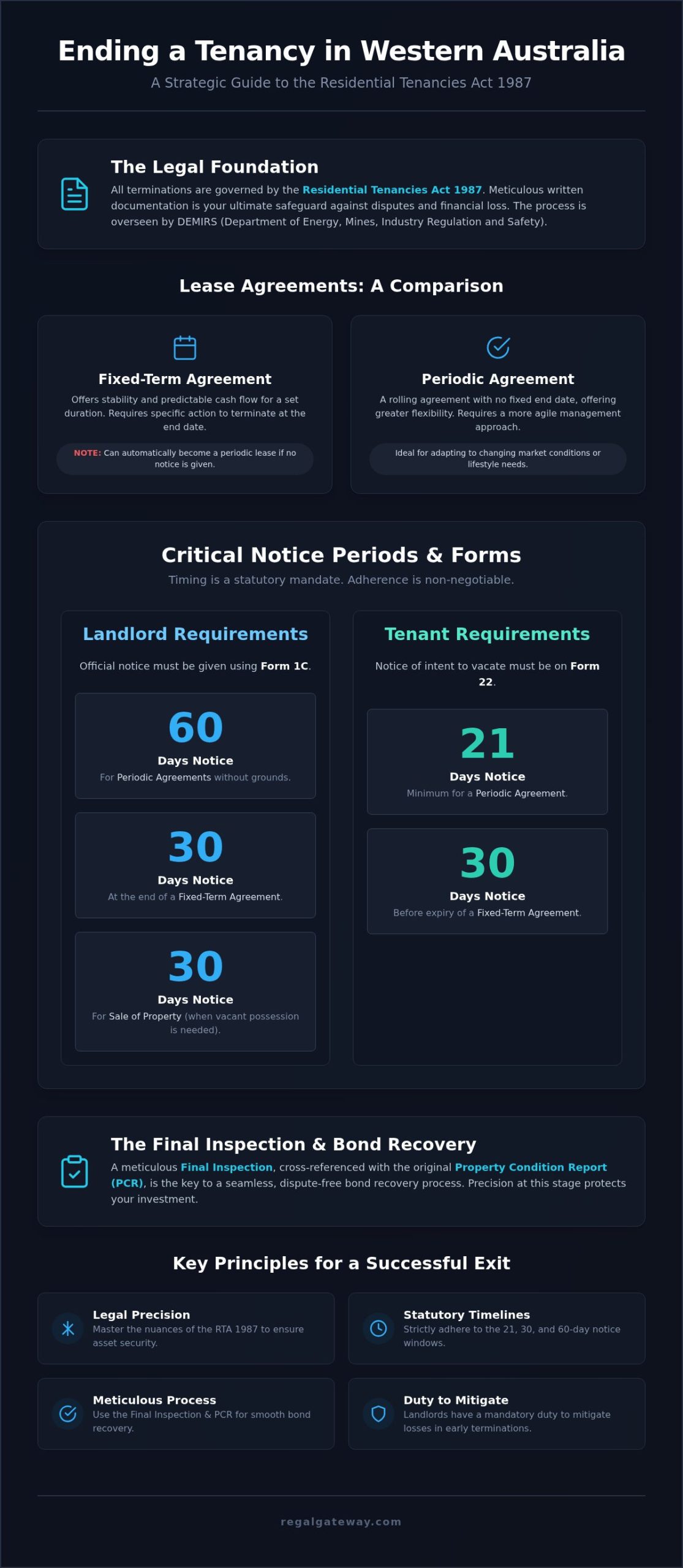
Verbal intentions carry no weight in the professional management of high-end assets. To ensure a legally sound transition, all parties must use standardized forms that leave no room for ambiguity. Landlords typically issue a Form 1C, while tenants provide a Form 22 to signal their intent to vacate. These documents serve as the official record of your timeline, and the method of service is just as critical as the form itself. Whether you’re delivering notice via registered post, hand delivery, or a pre-agreed electronic method, ensuring the notice is legally received is the only way to guarantee your compliance with the Act. This level of precision reflects the poise and care required to maintain an elite standard of property ownership.
Notice Periods: A Strategic Timeline for Landlords and Tenants
Precision is the cornerstone of any high-stakes real estate transition. In the context of ending a tenancy agreement WA, timing isn’t merely a suggestion; it’s a statutory mandate that requires meticulous calculation to protect your interests. Whether you’re a landlord preparing an asset for sale or a tenant transitioning to a new private retreat, understanding the specific windows of communication is essential for a poise-filled exit. These timelines are the guardrails that prevent administrative friction and ensure financial continuity for all parties involved.
Landlord Notice Requirements
For owners managing periodic agreements, the 60-day non-grounds notice remains a vital strategic tool for regaining possession. It allows for a deliberate and measured transition, though it’s vital to stay attuned to 2026 legislative shifts regarding “no grounds” terminations. If you’re nearing the conclusion of a fixed-term lease, you must provide a 30-day written notice to ensure the agreement doesn’t inadvertently roll into a periodic state. In scenarios involving the sale of a property where vacant possession is a contractual necessity, the notice period is condensed to 30 days. This requires a sophisticated approach to communication to ensure the sale proceeds without the shadow of a legal dispute.
Tenant Notice Requirements
Residents looking to adopt a higher standard of living elsewhere must adhere to their own set of professional protocols. A tenant on a periodic lease is required to provide a minimum of 21 days’ written notice. For those concluding a fixed-term arrangement, the expectation is 30 days’ notice provided before the lease expiry date. Adhering to the Official WA Government Guidelines ensures these timelines are met with legal precision, shielding you from the anxiety of unintended rent liabilities.
Accuracy in “counting days” is perhaps the most overlooked element of a seamless exit. You’ve got to account for the method of service, adding specific allowances for postal delivery to ensure the notice period officially commences on the correct date. Failure to calculate this correctly can result in expensive lease extensions. Engaging an expert for meticulous property management ensures these technical details are handled with the poise and expertise your investment deserves. This deliberate care is what separates a standard transaction from an elite property experience, allowing you to focus on your next strategic move while we secure the present.
Breaking the Lease: Navigating Early Terminations and Hardship
Life is rarely a linear progression, and there are moments when even the most carefully constructed plans require a sudden pivot. When you’re ending a tenancy agreement WA before the fixed term has concluded, you’re entering the territory of a break-lease scenario. This process requires a delicate balance between fulfilling contractual obligations and managing the practicalities of an unexpected transition. While Western Australia doesn’t have a prescribed break-lease fee or a rigid formula, the legal framework allows landlords to recover actual losses incurred, provided they take active steps to mitigate those losses. It’s a situation that demands professional poise and a clear understanding of the 2026 market dynamics.
Financial Obligations in a Break-Lease
In the current 2026 market, where the Perth vacancy rate sits at approximately 2%, the duration of a break-lease period is often significantly shorter than in previous years. Landlords have a statutory duty to find a replacement tenant promptly, which serves to protect the outgoing resident from prolonged rent liabilities. In high-demand areas like Atwell, Aubin Grove, and Success, properties are often leased within a median of 16 days. This fast-moving environment means the financial impact of an early exit is frequently lower than anticipated. Calculating reasonable costs involves accounting for advertising expenses and a pro-rata portion of re-letting fees. For those seeking the most seamless exit, negotiating a mutual termination remains the most sophisticated path, allowing both parties to conclude the relationship with mutual respect and transparency.
Special Legal Protections
The 2026 legislative landscape provides essential safeguards for those facing exceptional circumstances. Understanding the nuances of Navigating Early Terminations becomes a matter of urgent protection in cases of family and domestic violence. Under WA law, a tenant can issue a Form 2 to terminate their interest in a lease immediately, providing a critical pathway to safety without the burden of standard notice periods or financial penalties. Similarly, if a property becomes uninhabitable due to unforeseen damage or safety concerns, an early exit is legally justified. For landlords, handling these sensitive terminations requires a high degree of emotional intelligence and professional discretion. It’s about more than just compliance; it’s about maintaining a standard of excellence within the management of your real estate assets. For those facing extreme personal difficulty, the Magistrates Court of WA remains the ultimate venue for seeking hardship relief, ensuring that the law remains a tool for stability and justice.
The Final Inspection and Bond Recovery: A Meticulous Close
The final stage of the leasing lifecycle is an exercise in absolute precision. When ending a tenancy agreement WA, the “Outgoing Inspection” serves as the definitive audit of the property’s condition, ensuring the asset has been maintained to the standards established at the commencement of the term. Central to this process is the Property Condition Report (PCR). This document is not merely a formality; it is the essential benchmark for a successful exit. By conducting a meticulous room-by-room assessment, both parties can distinguish between fair wear and tear, which is a natural consequence of time, and intentional or negligent damage that requires rectification. This distinction is vital for preserving the integrity of the investment and the security of the bond.
In the sophisticated 2026 rental environment, the digital platform managed by the Bond Administrator has streamlined the disposal process. However, the technology only works as well as the data provided. A clear, well-documented exit strategy is the only way to facilitate a rapid return of funds and a clean break for all involved.
Preparing for the Outgoing Inspection
A seamless transition requires proactive preparation. For residents, this involves a comprehensive checklist that includes professional steam cleaning, meticulous garden maintenance, and the organized return of all keys and security fobs. It’s advisable to compare the current state of the home against the original PCR well before the final walk-through. Capturing high-resolution photographic evidence and detailed notes allows you to address minor repairs or scuffs in advance. This level of foresight prevents the friction of last-minute deductions and reinforces your reputation as a tenant of distinction. It’s about presenting the property as the private retreat it was intended to be.
Bond Disposal and Dispute Resolution
The formal path to fund release begins with the Joint Application for Disposal of Bond. When both parties agree on the outcome of the inspection, the process is swift and efficient. Disagreements, however, can occur. Under the reforms implemented in March 2026, the Commissioner for Consumer Protection now resolves most bond disputes, significantly reducing the reliance on the Magistrates Court. To ensure you’re protected from the outset, we recommend reviewing our Property Management Atwell guide for expert dispute prevention strategies. This resource provides the technical foundation needed to navigate the final stages of a tenancy with poise.
Protecting your investment requires a dedicated partner who understands the nuance of every inspection. If you’re seeking a concierge-level approach to your real estate portfolio, we invite you to explore our bespoke property management services.
The Regal Gateway Advantage: Curating a Superior Exit Strategy
At Regal Gateway Property, we perceive the conclusion of a lease not as an administrative chore, but as a pivotal moment of transition that requires the hand of a sophisticated guide. While the legalities of ending a tenancy agreement WA provide the framework, it is our meticulous execution that ensures your real estate remains an enduring asset. Our philosophy is rooted in the belief that every property is a private retreat and a vehicle for wealth, requiring a bespoke approach that balances technical expertise with a concierge-like warmth. By positioning ourselves as the essential link between a current lease and your next strategic move, we allow you to navigate the complexities of the 2026 market with absolute poise.
Strategic Asset Protection
Our methodology for asset protection is characterized by a proactive stance that eliminates the risk of end-of-lease surprises. In the boutique enclaves of Atwell, Aubin Grove, and Success, maintaining the high-end appeal of your investment is paramount for securing maximum market value. We conduct detailed inspections that go beyond simple compliance, focusing instead on preserving the strategic value and aesthetic integrity of the home. This level of care ensures that your property is always prepared for its next chapter, whether that involves premium tenant selection and screening or a transition to the sales market. For owners considering a change in portfolio direction, our insights into Selling Your House in Cockburn WA provide a visionary roadmap for realizing maximum capital appreciation post-tenancy.
Seamless Tenant Transitions
A truly sophisticated exit strategy extends a higher standard of service to the outgoing resident. We provide concierge-level support to vacating tenants, guiding them through the meticulous requirements of the final inspection to ensure the property is returned in exemplary condition. This collaborative approach fosters a sense of security and respect, which is essential for a dispute-free bond recovery. Leveraging our extensive local network, we identify and secure premium replacement tenants with a speed that reflects the high demand of the current Perth market. Our measured and reassuring rhythm ensures that the transition between tenancies is virtually imperceptible, maintaining your cash flow and peace of mind.
We invite you to adopt a higher standard of real estate management where tradition, stability, and excellence converge. By choosing a partner who values your investment as much as you do, you gain access to an exclusive world of curated property expertise. We formally welcome you to experience the Regal Gateway advantage, where we facilitate not just a successful exit, but a more prosperous future for your entire portfolio.
Securing Your Real Estate Legacy through Strategic Transitions
Mastery of the legislative landscape is the primary vehicle for ensuring your property remains a source of enduring prosperity. You’ve now gained the professional intelligence required to navigate the 2026 notice periods and the technical nuances of bond disposal with absolute poise. Whether you’re managing a standard periodic transition or ending a tenancy agreement WA under complex circumstances, success is always defined by meticulous documentation and a visionary approach to asset management.
As a boutique agency led by Director Samantha Francis, Regal Gateway Property offers more than just administrative oversight; we provide a partnership rooted in over a decade of excellence. Our expert local knowledge of Atwell and the wider City of Cockburn allows us to curate bespoke strategies that protect your capital and ensure lifestyle continuity. We invite you to discover the Regal Gateway standard of Property Management and experience the peace of mind that comes with elite representation. Your next chapter in the Western Australian property market deserves a foundation of excellence and the support of a trusted advisor.
Frequently Asked Questions
How much notice does a landlord have to give a tenant in WA?
A landlord must provide a minimum of 60 days’ written notice to end a periodic tenancy without a specific reason. For fixed-term agreements, a 30-day notice is required before the lease expiry date to prevent the agreement from transitioning into a periodic status. These statutory windows allow for a measured and professional transition that respects the lifestyle continuity of the residents.
Can a tenant break a fixed-term lease early in Western Australia?
Yes, a tenant may terminate a fixed-term lease early, though they’re typically responsible for the landlord’s actual financial losses incurred by the departure. This liability often includes rent until a new resident is secured and a pro-rata portion of re-letting costs. In the 2026 market, the landlord’s duty to mitigate loss ensures the property is returned to the market promptly to minimize these costs.
What happens if a tenant doesn’t move out on the vacate date?
If a resident remains in the property beyond the agreed vacate date, the landlord must apply to the Magistrates Court for an order of possession. It’s essential to handle such transitions with professional poise, as landlords cannot personally remove a tenant or their belongings without a court order. This legal framework ensures that the recovery of the asset is handled through sophisticated, established channels.
Does a fixed-term lease automatically end on the expiry date in WA?
A fixed-term lease does not conclude automatically on its expiry date; it requires a minimum of 30 days’ written notice from either party to terminate. Without this formal communication, the agreement seamlessly transitions into a periodic tenancy under the same terms. This requirement ensures that both parties have a clear, documented timeline for the next stage of their property journey.
What is considered ‘fair wear and tear’ at the end of a tenancy?
Fair wear and tear refers to the natural deterioration of an asset that occurs through ordinary daily use without negligence or accidental damage. Examples include the slight thinning of carpet in high-traffic areas or minor scuffing on floorboards over several years. Distinguishing these from actual damage is a critical element of ending a tenancy agreement WA with the precision required for full bond recovery.
How long does a landlord have to return a bond in WA?
Once a bond release request is initiated through the Bond Administrator’s digital platform, the other party has 14 days to respond or dispute the claim. Following the reforms of March 2026, the Commissioner for Consumer Protection now resolves the majority of disputes, moving at a pace that prioritizes administrative efficiency. This streamlined process ensures that funds are returned or allocated with minimal friction.
Can a landlord end a periodic tenancy to sell the house?
A landlord can terminate a periodic tenancy with 30 days’ notice if a contract of sale has been signed and vacant possession is a requirement for settlement. This condensed timeline allows the owner to transition the asset toward capital realization with confidence. It’s a strategic tool used to ensure the property is presented as a pristine, ready-to-occupy retreat for the incoming purchaser.
What forms are required to end a tenancy agreement in WA?
Landlords must typically use Form 1C to provide notice, while tenants should use Form 22 to formally signal their intention to vacate. These standardized documents are the only way to ensure your notice is legally recognized within the sophisticated Western Australian property market. Using the correct paperwork provides the clear, written evidence necessary to safeguard your investment and your future lifestyle plans.