
Could the final signature on a vacate notice be the most critical moment in your investment’s lifecycle? For the discerning property owner, the process of ending a tenancy agreement WA represents far more than a simple vacancy; it’s a sophisticated transition that requires meticulous stewardship to preserve the integrity of a high-value asset. You likely understand that the closing stages of a lease often bring a heightened sense of vulnerability, particularly regarding the potential for bond disputes or the evolving complexities of the Residential Tenancies Act.
This definitive 2026 guide provides the clarity you need to navigate these legal waters with the grace of a seasoned professional. We’ll examine the precise notice periods and DMIRS standards that define a successful conclusion, ensuring your transition is seamless and your financial interests remain secure. From the strategic nuances of final inspections to the realization of fair compensation and full bond recovery, you’re about to discover how a disciplined approach transforms a standard exit into an opportunity for renewed excellence and long-term stability.
Key Takeaways
- Understand your core obligations under the Residential Tenancies Act 1987 to ensure every phase of the transition is legally sound and professionally executed.
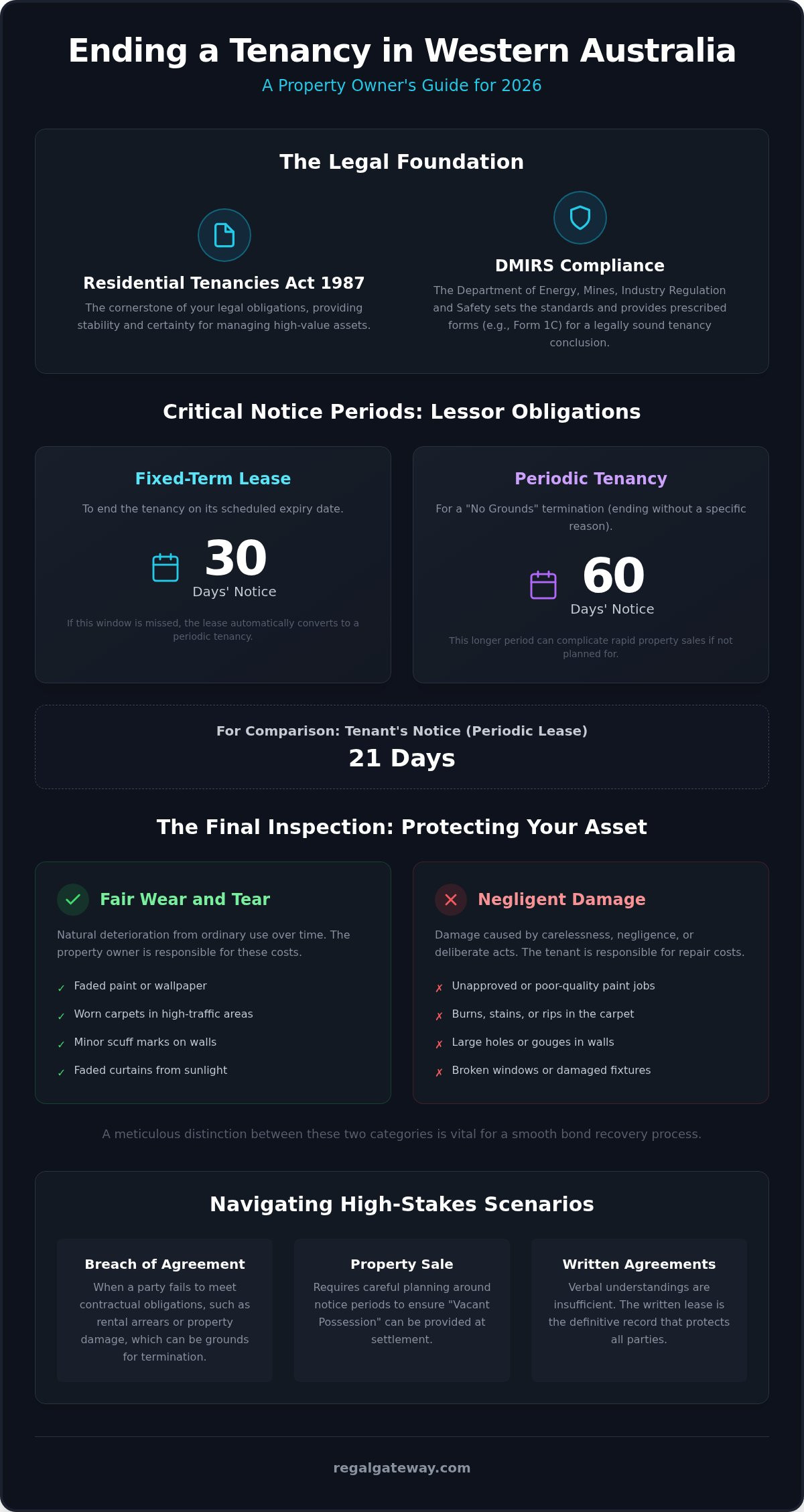
- Master the specific timelines required for ending a tenancy agreement WA, including the essential 30-day notice for fixed-term leases and the 60-day requirement for periodic arrangements.
- Navigate high-stakes scenarios such as property sales or tenant breaches with strategic precision, protecting your investment’s value during periods of significant change.
- Learn to distinguish between fair wear and tear and negligent damage during the final inspection to facilitate a smooth bond recovery process.
- Discover how bespoke property management provides the local intelligence and meticulous oversight necessary for a seamless transition between high-value tenancies.
Understanding the Legal Framework of WA Residential Tenancies
In Western Australia, the regulatory architecture governing your investment is anchored by the Residential Tenancies Act 1987. This legislation isn’t merely a set of rules; it’s the fundamental framework that ensures the stability and prestige of the Australian residential rental market within our state. Whether you’re a seasoned investor or a first-time owner, recognizing the Act as the cornerstone of your legal obligations is essential for the successful stewardship of your property. It provides the certainty required to manage high-value assets with professional poise.
The relationship between the Lessor and the Tenant is defined by clear rights and responsibilities that become particularly acute during transitions. When you’re ending a tenancy agreement WA, the Department of Energy, Mines, Industry Regulation and Safety (DMIRS) serves as the primary regulatory body. They provide the essential standards and prescribed forms, such as the Form 1C, that transform a simple move-out into a legally recognized conclusion. Absolute compliance with these standards isn’t just about following the law; it’s the only reliable path to securing your financial interests and avoiding the friction of bond disputes.
The Sanctity of the Written Agreement
For sophisticated property transitions, verbal understandings are entirely insufficient and legally precarious. The written lease agreement is the definitive record of the expectations and timelines agreed upon at the commencement of the tenancy. Before you initiate any termination action, you must review your specific lease terms with meticulous care to ensure every step aligns with the original contract. Maintaining a detailed paper trail from day one ensures that every decision is backed by evidence, providing a sense of security and professional poise if a disagreement ever reaches a formal hearing.
Key Legal Terminology for 2026
Understanding the lexicon of property law allows you to act with confidence and authority. A “No Grounds” termination refers to ending a periodic lease without a specific reason, whereas a “Breach of Agreement” occurs when a party fails to meet their contractual obligations, such as property damage or rental arrears. If you’re selling your asset, you’ll likely encounter the “Vacant Possession” requirement, which mandates the property be completely empty of occupants and their belongings at the time of settlement. A Notice of Termination is the formal legal instrument for lease conclusion.
Notice Periods and Procedural Requirements in Western Australia
Precision in timing is the hallmark of professional property management. When ending a tenancy agreement WA, the “Counting Days” mechanism is perhaps the most frequent source of legal friction for the unprepared. You cannot simply date a notice and assume it’s valid; you must account for the specific method of service. If a notice is sent via post, you’re required to add the designated delivery days to the notice period. Under WA law, the day the notice is served and the day the notice expires are excluded from the total count. This level of architectural precision in your documentation ensures your notice is legally robust and beyond reproach.
For a fixed-term lease, the Lessor must provide at least 30 days’ notice to conclude the agreement on its scheduled expiry date. If this window is missed, the lease doesn’t simply vanish; it automatically transitions into a periodic arrangement, which carries different obligations. In a periodic tenancy, the Lessor must provide a 60-day notice period for a “no grounds” termination. Tenants have a different set of requirements, typically following the official guidelines for ending a tenancy by providing 21 days’ notice for periodic leases. Balancing these timelines requires a proactive stance to maintain the momentum of your investment strategy.
Fixed-Term vs. Periodic Agreements
Choosing between lease structures is a significant strategic decision for any property owner. A fixed-term lease provides revenue certainty and a defined conclusion, which is particularly advantageous when planning for residential property sales or major renovations. Allowing a lease to lapse into a periodic state can inadvertently complicate a future sale, as the 60-day notice period for Lessors may not align with rapid settlement timelines. Sophisticated stewardship often involves renewing fixed-term agreements to maintain maximum control over the asset’s availability and market positioning.
Essential Documentation: Form 1C and Form 22
The validity of your property transition rests entirely on the accuracy of your formal paperwork. The Form 1C is the Lessor’s primary legal instrument for the formal termination of a tenancy, and it must be completed with meticulous care. Even a minor clerical error, such as an incorrect date or a missing signature, can invalidate the document and force you to restart the entire notice period. Conversely, tenants utilize Form 22 to formally signal their intent to vacate. Ensuring these documents are executed with professional poise prevents administrative delays and protects the prestige of your investment portfolio.
Navigating Complex Scenarios: Breaches, Sales, and Hardship
The conclusion of a lease is not always a linear progression; it often involves intricate variables that require a sophisticated touch. When ending a tenancy agreement WA due to a breach, the Lessor must adhere to a strict 14-day remedy period. This timeframe allows the Tenant to rectify the issue, whether it’s property maintenance or unauthorized occupants, before formal termination proceeds. Acting with professional poise during these sensitive moments ensures that your reputation as an elite property owner remains untarnished, even when the situation demands firm legal action.
Managing Non-Payment of Rent
If rental arrears occur, the process becomes even more time-sensitive. You can issue a breach notice the day after rent is due, but the subsequent 14-day window for rectification is a legal necessity before moving toward termination. While the law provides a clear path to the Magistrates Court for a formal order, we often find that concierge-level negotiation yields a more efficient result. By maintaining open, professional dialogue, you can often secure a voluntary vacancy that preserves the asset’s condition and avoids the protracted timelines of a formal hearing.
The Sale of a Tenanted Asset
Transitioning a high-value asset during a sale requires a delicate balance between your contractual obligations to a buyer and the existing rights of your tenant. Ensuring “Vacant Possession” by the settlement date is paramount, often necessitating a 30-day notice if the contract of sale stipulates the property must be empty. It’s essential to consult the WA Government Tenancy Termination Rules to verify that every inspection and signage request respects the tenant’s privacy rights. Offering strategic incentives, such as professional cleaning vouchers or a flexible move-out date, can foster the goodwill needed for a seamless sales transition.
In rare circumstances, a Lessor may seek to end a lease early due to extreme personal hardship. However, the legal threshold for this is exceptionally high and requires a court order to be valid. You must also remain vigilant against any action that could be perceived as retaliatory. Issuing a “No Grounds” notice in response to a tenant exercising their legal rights can lead to significant reputational and financial risk. True excellence in property management lies in navigating these complexities with a focus on stability, transparency, and legal integrity.
The Meticulous Vacate Process and Final Inspection
The final inspection is the ultimate audit of your property’s condition, representing the precise moment where the strategic vision of your investment meets the reality of daily living. When ending a tenancy agreement WA, you must compare the home’s current state against the original Property Condition Report (PCR) with an uncompromising eye for detail. This isn’t merely a walkthrough; it’s a forensic comparison that safeguards your asset’s value and ensures the transition is handled with professional poise. Distinguishing between fair wear and tear and negligent damage requires a nuanced understanding of luxury materials. While slight fading on a curtain might be acceptable, a chip in a bespoke cabinetry finish or a stain on premium wool carpet is a clear breach of the expected standard. The handover of keys and security devices serves as the final, formal act of the tenancy, signaling the return of the property to your exclusive control.
The Property Condition Report (PCR) Strategy
A robust PCR remains your most potent evidence in the event of a bond dispute. By 2026, the industry standard has evolved to require high-definition photographic evidence that captures the property’s pristine state at the commencement of the lease. This level of meticulous documentation removes ambiguity and sets a clear expectation for the tenant. To ensure a seamless transition for the next occupant, professional cleaning should be viewed as a baseline requirement rather than an optional extra. Our property management team ensures these standards are met with concierge-like precision, protecting the prestige of your investment portfolio and minimizing the potential for friction during the vacate process.
Resolving Bond Disputes with Poise
The bond disposal process begins with the Joint Application for Disposal of Security Bond, a document that must reflect a fair and transparent assessment of any necessary deductions. The bond is held by the Bond Administrator, not the Lessor. If negotiations regarding repairs or cleaning reach an impasse, professional mediation offers a dignified path forward that preserves time and resources for both parties. Should a resolution remain elusive, the Magistrates Court serves as the final adjudicator for unresolved claims. Approaching these disputes with professional poise ensures that even the most complex transitions are resolved with minimal friction and maximum financial security for your high-value asset.
The Regal Gateway Advantage: Professional Stewardship in Atwell
Atwell landlords understand that the conclusion of a lease is not merely a vacancy but a pivotal moment for asset repositioning. Regal Gateway Property provides the bespoke stewardship required to transform this transition into a strategic advantage for your portfolio. By leveraging over a decade of local market intelligence, we ensure that ending a tenancy agreement WA is handled with the meticulous care your high-value investment deserves. Our proactive approach to tenant screening and relationship management minimizes friction from the outset, allowing you to focus on the long-term vision for your property while we manage the granular details of the transition with professional poise.
Strategic Asset Management in the City of Cockburn
In high-demand suburbs such as Hammond Park, Success, and Aubin Grove, the local market requires a sophisticated touch to maintain elite performance levels. We coordinate with a curated network of elite contractors to facilitate rapid property rejuvenation post-tenancy, ensuring your home is restored to its most aspirational state with minimal downtime. This seamless process allows you to integrate your exit strategy with a capital appreciation plan that maximizes the asset’s market value and long-term prestige. Our focus on transparency ensures you’re informed at every stage of the rejuvenation, providing a foundation of trust and market intelligence that is essential for high-stakes transactions.
Your Trusted Advisor for Lease Conclusions
Complex property matters demand the insight of a sophisticated guide who values tradition, stability, and excellence. Our clients benefit from direct access to Director Samantha Francis for high-stakes decisions, ensuring that every lease conclusion is met with professional poise and deep market intelligence. This concierge-level property management team acts as the essential link to a more prosperous future, treating your investment as a private retreat and an enduring asset rather than a mere physical structure. We invite you to adopt a higher standard of property stewardship by requesting a comprehensive rental appraisal to align your asset with the modern trends and strategic opportunities of 2026.
Embracing the Future of Your Investment Portfolio
Mastering the nuances of ending a tenancy agreement WA ensures that your property remains an enduring asset rather than a source of administrative friction. By prioritizing absolute compliance with the Residential Tenancies Act and maintaining a forensic attention to detail during the final inspection, you protect both your financial interests and the long-term prestige of your investment. This strategic transition is the bridge between a successful past and a more prosperous future for your portfolio. It’s about more than just a vacancy. Every lease conclusion represents the continued realization of an elevated lifestyle.
As an independently owned boutique agency, Regal Gateway Property combines expert local knowledge of Atwell and Cockburn with a transparent, trust-based approach to property management. We provide the professional poise required to navigate complex legal landscapes, ensuring every lease conclusion is a seamless realization of excellence. Excellence is our standard. Secure your investment with Regal Gateway’s elite property management services. Your journey toward superior asset performance is a path we’re honored to guide you through with meticulous care.
Frequently Asked Questions
How much notice must a landlord give a tenant to move out in WA?
The notice period required depends entirely on the structure of the existing agreement. For a fixed-term lease reaching its natural conclusion, a Lessor must provide a minimum of 30 days’ notice. If the arrangement is periodic, the standard requirement for a “no grounds” termination is 60 days. These timelines are essential for maintaining the strategic flow of your investment and ensuring every transition is handled with the professional poise expected in a high-end market.
Can a tenant end a fixed-term lease early in Western Australia?
While a fixed-term lease is a binding legal commitment, a tenant may request an early conclusion under specific circumstances. This process, often referred to as “breaking the lease,” typically requires the tenant to compensate the Lessor for lost rent and marketing costs until a suitable new occupant is secured. Navigating these requests requires a sophisticated touch to balance your financial security with the practical realities of the tenant’s changing circumstances while maintaining asset stability.
What happens if a tenant refuses to leave after the notice period expires?
If a tenant remains in possession after the notice period has concluded, you must seek a formal order from the Magistrates Court. It’s vital to remember that a Lessor cannot personally remove a tenant or their belongings. Instead, a bailiff must be appointed to execute the court’s order. This path requires patience and a disciplined adherence to the law to ensure the eventual recovery of your asset is legally beyond reproach and professionally managed.
Is a 30-day notice enough to end a fixed-term tenancy in WA?
A 30-day notice is the correct legal standard for ending a tenancy agreement WA, provided the notice period concludes on or after the lease’s expiry date. If you fail to issue this notice in time, the lease will automatically transition into a periodic arrangement, which significantly alters your future notice requirements. Acting with foresight ensures you retain maximum control over your property’s availability for future tenancies or potential asset repositioning within the City of Cockburn.
What is the difference between a Form 1A, 1B, and 1C?
These forms serve distinct roles in the formal lifecycle of a lease and require meticulous completion. Form 1A and Form 1B are utilized specifically for termination due to non-payment of rent, with 1B providing a slightly different remedy path for the Lessor. Form 1C is the more general instrument, used for ending a tenancy for reasons such as the expiration of a fixed term or the sale of the property. Selecting the correct document is a critical step.
Can I sell my house while a tenant is still living there?
You certainly can sell your property while it’s tenanted, though it requires a concierge-level approach to manage the tenant relationship. You must respect their privacy rights regarding inspections and photography while ensuring the asset is presented at its most aspirational. If the buyer requires vacant possession, you must provide the tenant with at least 30 days’ notice, provided the contract of sale is already signed and the necessary legal conditions are met for ending a tenancy agreement WA.
How is the security bond returned at the end of a WA tenancy?
The return of the security bond is finalized through a Joint Application for Disposal of Security Bond form, which both parties must sign once the final inspection is complete. This document instructs the Bond Administrator on how to distribute the funds. If the property has been maintained with excellence, the process is seamless. Any deductions for damages beyond fair wear and tear must be clearly documented to ensure the transition remains transparent and professional for all parties.
What constitutes “Fair Wear and Tear” under WA tenancy law?
Fair wear and tear refers to the natural deterioration that occurs through ordinary daily use, such as the slight fading of paint or the thinning of carpet in high-traffic areas. This is distinct from negligent damage, which includes avoidable issues like deep gouges in timber flooring or broken fixtures. Distinguishing between these two requires a meticulous eye and a thorough comparison against the original Property Condition Report to protect the enduring value of your high-end asset.