
What if tenancy problems that cost landlords the most time start with a small process gap? A missed record, inconsistent applicant screening or delayed maintenance response can turn a manageable issue into a dispute. For WA owners searching “mistakes landlords make WA,” the common thread is often not a lack of care, but uncertainty about obligations and the systems needed to manage them well.
It’s understandable to find tenancy requirements challenging to keep up with, particularly when rules can change and local details matter. A consistent approach to tenant selection, communication, documentation and property upkeep can help protect the tenancy and support the care of your investment.
This guide covers preventable errors WA landlords should watch for, with practical ways to organise records, respond to maintenance concerns and keep communication clear. It also considers when self-management may suit your availability, and when local property management could ease the administrative load. The aim is to help you spot gaps early and make considered decisions with greater confidence.
Key Takeaways
- Many mistakes landlords make WA stem from unclear processes. Review each stage, from advertising and tenant selection to records, communication and property upkeep.
- Check current requirements against the Residential Tenancies Act 1987 (WA) and Consumer Protection WA guidance, rather than relying on assumptions or outdated information.
- Compare self-management with professional property management by considering the time involved and how consistently you can manage communication and records.
- Use a repeatable checklist to prepare the property, organise tenancy documents and revisit official guidance as part of ongoing management.
- If administration or maintenance coordination is becoming difficult to sustain, ask a property manager how inspections, reporting and tenant communication are handled.
Common mistakes WA landlords make before and during a tenancy
Most preventable tenancy problems don’t begin with bad intentions. They often grow from unclear processes: rushed property preparation, assumptions left unwritten or records that are difficult to find later. When considering the mistakes landlords make WA, ask not only what went wrong, but where a consistent step could have helped.
Where landlord oversights tend to begin
Small gaps can appear at every stage. An advertisement that leaves out important property details may attract mismatched enquiries. Rushed tenant selection can lead to inconsistent applicant assessments, while incomplete records make it harder to refer back to the property’s condition or what was agreed. During the tenancy, unclear communication about a reported issue or an unanswered message can create frustration, even when neither party intended a dispute.
Set a deliberate sequence: prepare the home, check that the advertising is accurate, apply consistent screening criteria, and keep tenancy documents and communications organised. Record maintenance requests, the response and any follow-up needed. These habits won’t prevent every disagreement, but they can make expectations clearer and help you respond with an accurate account of events. General landlord-tenant law principles offer background on the relationship between owners and renters; they aren’t a substitute for checking current Western Australian requirements.
Why local context matters for Cockburn-area rentals
A maintenance plan should reflect the individual property, not assumptions about a suburb. A home in Atwell may have different upkeep priorities from another nearby property, depending on its age, fittings, outdoor areas and maintenance history. The same is true across Cockburn suburbs such as Aubin Grove, Hammond Park and Success. Inspect the home’s actual condition, note existing issues and record follow-up instead of relying on memory.
Build repeatable habits around five areas:
- Advertising: Use clear, accurate descriptions and current property information.
- Tenant selection: Apply a consistent screening process and retain relevant records.
- Documentation: Keep tenancy documents, property-condition records and maintenance history together.
- Communication: Confirm key discussions in writing and track requests through to a response.
- Ongoing upkeep: Review the property’s condition and organise maintenance based on its specific needs.
These steps make a tenancy easier to oversee and provide a sounder basis for decisions. The next step is to check applicable WA requirements rather than rely on habit or advice intended for another jurisdiction.
WA tenancy compliance mistakes: verify requirements instead of relying on assumptions
For WA landlords, compliance errors can start with a familiar but unreliable shortcut: using an old template, relying on remembered advice or assuming a process hasn’t changed. This section provides general information, not legal advice. Requirements may change, and the right process can depend on the circumstances, so check current official WA guidance before acting. Key sources include the Residential Tenancies Act 1987 (WA) and Consumer Protection WA.
Records, condition reports and bond administration
Clear, dated records give both parties a shared point of reference. Keep tenancy documents, property-condition information, relevant communications and maintenance records organised so you can see what was noted and when. For bond administration, consult Consumer Protection WA’s current guidance on the applicable process and requirements. Avoid relying on an old checklist or another landlord’s experience, as their circumstances or the information they followed may differ from yours.
Good recordkeeping supports clearer communication, but it can’t guarantee that a disagreement won’t arise or determine its outcome. Its practical value is that it helps you respond with an accurate account of events rather than relying on memory.
Notices, access and changing tenancy requirements
Notice wording, property access and rent changes are areas where outdated forms or informal advice can create uncertainty. Before taking one of these steps, consult current WA guidance and confirm that it applies to your situation. Don’t assume a previously used template remains suitable, or that information from another state reflects Western Australian requirements.
Use official WA sources as your reference point: check the relevant provisions of the Residential Tenancies Act 1987 (WA) and Consumer Protection WA’s rental guidance. If you need help applying the law to a specific situation, seek qualified legal advice rather than relying on general information.
A simple verification routine can make compliance a deliberate step rather than a memory test:
- Identify the action: Clarify whether you’re considering a notice, access arrangement, bond matter or rent change.
- Check current WA sources: Review the relevant legislation and Consumer Protection WA guidance for that action.
- Confirm the process: Make sure you understand which requirements and documents apply before proceeding.
- Keep a record: Note what you checked and file related communications or documents with the tenancy records.
Revisit official guidance whenever a relevant tenancy action arises, rather than relying on what you remember from a previous occasion. Landlords looking to make administration more consistent can compare their current processes with local property management support and confirm directly which services and arrangements are available for their property.
Self-managing versus professional property management in WA: where mistakes can multiply
Choosing between self-management and professional support is a practical decision, not a test of whether you’re a capable landlord. Consider whether you have the time and systems to manage tenant communication, records, maintenance coordination and changing requirements consistently. Weigh management fees against the responsibilities you’ll retain and the time you’ll invest, rather than assuming either approach is automatically better.
| Consideration | Self-management | Professional property management |
|---|---|---|
| Time | You handle enquiries, tenancy administration and follow-up yourself. | An agency may take on agreed management tasks, with responsibilities clarified in advance. |
| Process consistency | You create and maintain your own systems for screening, records and routine tasks. | Established processes may help organise tasks, though practices and service scope vary. |
| Communication | You respond to tenant matters and keep a record of relevant exchanges. | Ask how communication is handled, documented and shared with you. |
| Maintenance and records | You coordinate issues and keep property and tenancy documents organised. | Depending on the agreement, tasks may include maintenance coordination and regular inspections. |
When self-management may suit a WA landlord
Self-management may suit owners who have reliable availability, feel confident checking current WA requirements and can coordinate maintenance while keeping communication and records organised. A simple routine can help: document important exchanges, keep tenancy and property records together, and track issues through to follow-up. Self-management isn’t inherently unsuitable; it calls for an honest assessment of the time and consistency you can commit.
When professional support may be worth considering
Managing multiple properties, having limited availability or coordinating tenant selection, leasing, rent collection, maintenance and inspections can prompt owners to consider professional support. Regal Gateway Property provides these property-management services, with scope and arrangements to confirm directly. Ask prospective managers how they handle reporting, inspections, maintenance coordination and tenant communication, and which decisions remain yours.
Professional management doesn’t remove every risk or guarantee a particular rental outcome. It can provide a defined structure for agreed responsibilities. The best fit is the approach that keeps the work manageable and processes clear. Review how your current arrangements are working, then compare them with the specific services and terms a local property manager can offer.
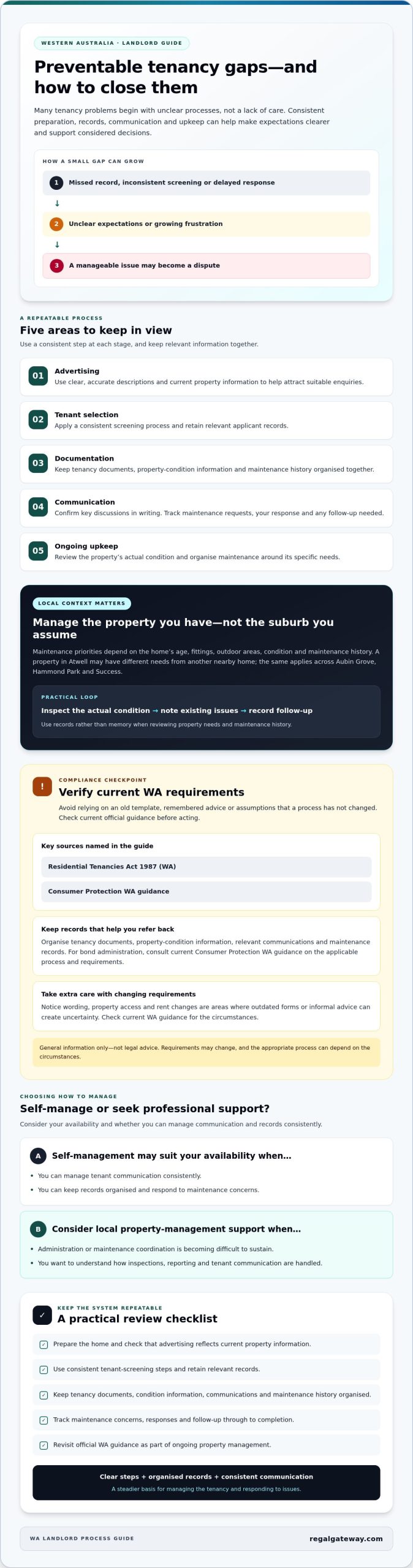
A practical WA landlord checklist for preventing avoidable tenancy mistakes
A dependable checklist turns good intentions into repeatable steps. Keep it with your property records, adapt it to the home and review it as the tenancy progresses. Since requirements can change, build official-rule checks into the process rather than treating compliance as a one-time task.
Before advertising and approving an applicant
- Prepare the property: Review its condition, note maintenance needs and organise any work before presenting it to prospective tenants.
- Check the details: Confirm the advertisement and property information are accurate, clear and consistent.
- Use a consistent application process: Apply objective screening criteria fairly, keep relevant records and check current requirements before making decisions. A Tenant Screening Checklist for Atwell Landlords can help you structure this stage.
- Organise the tenancy file: Gather the documents and property-condition information you’ll need to refer to during the tenancy.
During the tenancy and at key transitions
- Keep a dated record: File important tenant communications, inspection information, maintenance requests and details of completed work.
- Check before acting: Consult current official WA guidance when dealing with notices, property access, bond matters or agreement changes. Don’t rely solely on memory or a form used for an earlier tenancy.
- Track maintenance: Record what’s been reported, the response and any follow-up still required. Plan upkeep around the property’s condition and maintenance history.
- Review open matters: At renewals and handovers, check outstanding maintenance, update tenancy records and confirm the file reflects the current state of the property.
- Refresh your process: Revisit relevant official guidance whenever a new tenancy action arises, and update your working checklist if the information or process has changed.
This routine won’t prevent every issue, but it can make responsibilities easier to track and help you respond with clear, organised records. It also gives you a practical way to assess whether self-management remains manageable as your circumstances or the property’s needs change.
If you’d like to discuss how property management could support administration, tenant communication and maintenance coordination for your rental, talk with Regal Gateway Property about your management needs.
When WA landlords should consider local property-management support
Self-management may become harder to sustain when tenant enquiries compete with work or family commitments, maintenance requests are difficult to coordinate, or property records and updates start falling behind. These are useful signals to review your systems, not proof that you’ve managed poorly. They can help clarify whether another management approach better suits your availability and property needs.
Professional property management can provide an organised framework for agreed tasks, but it won’t guarantee a particular tenancy outcome or remove every risk. Compare the proposed service with the work you currently handle, and decide whether its responsibilities, communication arrangements and terms suit you.
Questions to ask before appointing a property manager
Before making a decision, ask how tenant enquiries and maintenance requests are received, recorded and followed up. Clarify what owner updates and reporting to expect, how inspection findings are documented, and which decisions remain yours. Review the proposed scope, communication arrangements and applicable terms so you understand what the service includes and how responsibilities are shared.
A locally informed next step for Cockburn-area landlords
Regal Gateway Property is based in Atwell and provides residential property management across Atwell, Aubin Grove, Wandi, Hammond Park, Success, Treeby and Mandogalup. Its property-management services include tenant selection and screening, leasing, rent collection, maintenance coordination and regular inspections. Confirm the proposed scope and arrangements for your property directly.
For further local context, explore the Property Management Atwell guide alongside your own priorities and questions. If administration, maintenance coordination or tenant communication is becoming difficult to manage consistently, contact Regal Gateway Property to discuss your property-management needs in Atwell or the wider Cockburn area.
Set up a more confident approach to managing your WA rental
The mistakes landlords make WA owners can often prevent begin as small gaps in preparation, records or communication. Clear processes help you keep tenancy information organised, follow up maintenance and check current Western Australian requirements before acting. Regularly reviewing your approach can also help you decide whether self-management still fits your time and responsibilities.
For some owners, a property manager may offer a more consistent framework for agreed tasks, though the right choice depends on your property, priorities and availability. Regal Gateway Property is based in Atwell and serves the City of Cockburn and surrounding suburbs, with property management that includes rent collection, maintenance coordination and regular inspections.
To compare your current process with local support, discuss your property-management needs with Regal Gateway Property.
Frequently Asked Questions
What are the most common mistakes landlords make in WA?
Common mistakes include unclear advertising, inconsistent tenant screening, incomplete tenancy or condition records, delayed communication and maintenance follow-up, and relying on outdated information about requirements. These issues don’t automatically lead to a dispute, but they can make expectations harder to manage and events more difficult to document. Use consistent processes, keep important communication in writing, and check current WA guidance before taking steps involving notices, access, bonds or rent changes.
Can a landlord manage a rental property themselves in Western Australia?
Yes, a landlord can choose to self-manage a rental property in Western Australia. The decision depends on whether you can consistently handle tenant communication, maintain clear records, coordinate maintenance and check current requirements. Consider the time involved as well as your confidence in managing each responsibility. If your circumstances change or administration starts to fall behind, review whether professional property management would better suit your availability.
What records should WA landlords keep during a tenancy?
Keep an organised, dated record of tenancy documents, property-condition information, relevant tenant and owner communications, inspection records, maintenance requests and completed work. Store bond-related documents and records of notices or agreement changes as well, checking current official guidance on what applies. A clear file can help you recall what was reported, agreed or followed up, but it can’t guarantee that disagreements won’t arise or determine their outcome.
What happens if a WA landlord does not follow current tenancy requirements?
The consequences depend on the requirement and the circumstances, so it’s not possible to assume one outcome applies to every case. A process or document that doesn’t meet current requirements may create uncertainty, delay or disagreement, and could have legal implications. Check the Residential Tenancies Act 1987 (WA) and Consumer Protection WA guidance before acting. For advice about a specific situation, speak with a qualified legal professional rather than relying on general information.
How can landlords avoid disputes with tenants in WA?
Set clear expectations from the outset, communicate professionally, and keep a dated record of important discussions and decisions. Respond to maintenance concerns with a clear follow-up process, and document inspections and work completed. Before handling notices, access, bonds or rent changes, verify current WA requirements instead of relying on old templates or informal advice. Good organisation can support constructive communication, though it can’t prevent every disagreement.
When should a landlord in Cockburn consider using a property manager?
Consider professional support if tenant communication, administration or maintenance coordination is becoming difficult to manage consistently, or if your availability has changed. Regal Gateway Property is based in Atwell and serves Atwell, Aubin Grove, Wandi, Hammond Park, Success, Treeby and Mandogalup. Ask a prospective manager what their service includes, how inspections and owner updates are handled, and which responsibilities remain yours before deciding whether the arrangement fits your property.
Where can WA landlords check current rental requirements?
Start with the Residential Tenancies Act 1987 (WA) and current guidance from Consumer Protection WA, the Western Australian government agency that provides rental information. Check the relevant material before each action involving matters such as notices, access, bonds or rent changes, since relying on memory or an old template can create avoidable uncertainty. General information isn’t legal advice; consult a qualified legal professional if you need guidance for your circumstances.