
A polished screening report is a starting point, not a verdict. Digital tenant screening can help Western Australian landlords organise useful evidence, but a result alone may not reveal the context behind an applicant’s rental history, finances or documents.
It’s understandable to value a faster, more consistent process while still having questions about which checks are relevant, how personal information should be handled and whether an automated result could miss something important. The soundest decision comes from weighing tenancy-related evidence carefully, not handing the choice to software.
This guide explains how digital screening works, what common checks can and can’t tell you, and how to approach privacy and fairness when assessing an application. It compares digital checks with manual assessment and professional property management, so you can build a consistent, evidence-led process for your rental. In Atwell and surrounding Cockburn suburbs, tenant selection is part of a broader property-management process, where local knowledge and careful review help put each application in perspective.
Key Takeaways
- Use digital tenant screening to organise relevant application evidence, not to make the final decision for you.
- Separate gathering information, verifying details and assessing suitability so each stage has a clear purpose.
- Compare applicants against consistent, tenancy-related criteria, while allowing for context a report may not capture.
- Keep information requests relevant and explain clearly how applicant details will be handled.
- Consider whether a self-managed workflow suits your time and record-keeping needs, or whether screening within a property-management relationship is a better fit.
What digital tenant screening means for a Western Australian landlord
Digital tenant screening is the organised review of an applicant’s tenancy-related information through online processes and relevant checks. A screening report is evidence to consider, not the final tenancy decision. Gathering information, verifying details and assessing suitability are separate steps. A digital workflow can keep them orderly, but it can’t guarantee a risk-free tenancy.
A report may flag details for closer review, but it can’t fully explain an applicant’s circumstances or replace a considered assessment. Background checks cover different types of information; this overview of what a background check includes provides general context, not a checklist of checks every landlord should use. The relevance of any information depends on the application process and applicable requirements.
What information can a digital screening process help organise?
Depending on the process, a landlord may organise application details, rental history and supporting information such as references or documents submitted by an applicant. Some workflows may also include relevant checks, but screening services don’t all use the same databases or gather the same information.
Keep the purpose clear: information should help assess the tenancy application, not accumulate simply because a form or platform makes it easy to request. Review what has been provided, verify material details where appropriate, and note gaps that may need clarification before reaching a conclusion.
How does screening fit into the Atwell rental process?
For a rental home in Atwell or elsewhere across the City of Cockburn, a structured review helps you compare applications against the same tenancy-related considerations. Clear communication about the information requested and how it will be used can also make the application process more straightforward for prospective tenants.
Local understanding adds context to the paperwork, while a consistent process keeps the decision grounded in evidence rather than a quick impression. Tenant selection and screening are most useful as part of the wider leasing and property-management process, not as a stand-alone software outcome. For a broader view of managing a local rental, read the Atwell property management strategy.
How digital tenant screening works, from application to review
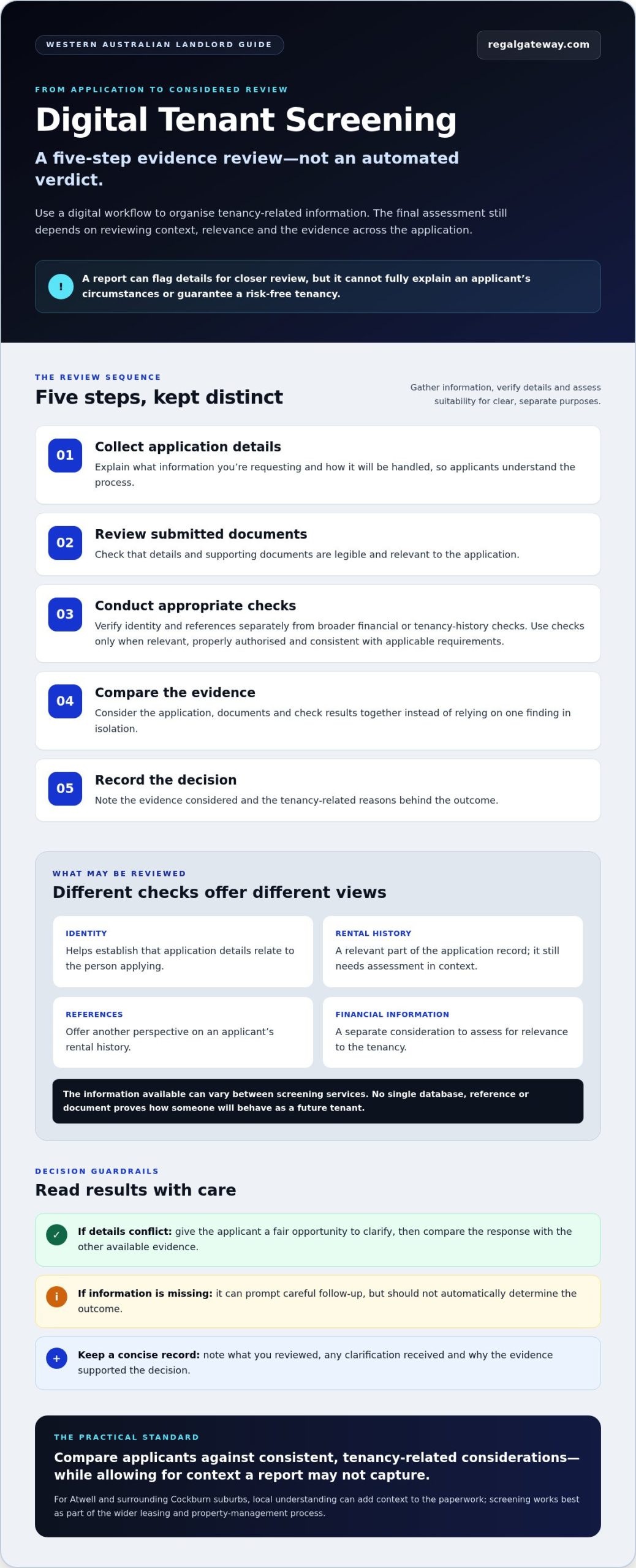
A reliable review is a sequence of considered steps, not a single score or report. Digital tenant screening can help organise the process, but you still need to understand what each piece of information shows and how it relates to the application.
- Collect application details: Explain what information you’re requesting and how it will be handled, so applicants understand the process.
- Review documents: Check that submitted details and supporting documents are legible and relevant to the application.
- Conduct appropriate checks: Verify identity and references separately from broader financial or tenancy-history checks. Use checks only where they’re relevant, properly authorised and consistent with applicable requirements.
- Compare the evidence: Consider information across the application, documents and check results instead of relying on one finding in isolation.
- Record the decision: Note the evidence considered and the tenancy-related reasons behind the outcome.
If a tenancy database forms part of the process, consult the Department of Mines, Industry Regulation and Safety’s WA rules for tenancy databases for relevant guidance. The checks and information available can vary, so tell applicants what you’re requesting and how their details will be used.
Which checks may form part of an application review?
Depending on the application and relevant requirements, review areas may include identity, rental history, references and financial information. Identity verification helps establish that application details relate to the person applying; reference checks offer another perspective on rental history. Financial information is a separate consideration and should be assessed for its relevance to the tenancy.
No single database, reference or document proves how someone will behave as a future tenant. Each check offers a limited view, so assess its source, relevance and consistency with the rest of the application.
How should a landlord interpret screening results?
A screening result is one input to a tenancy decision, not a substitute for a reasoned assessment. If details conflict, give the applicant a fair opportunity to clarify them and compare the response with the other available evidence. Missing information can prompt careful follow-up, but it shouldn’t automatically determine the outcome.
Keep a concise record of what you reviewed, any clarification received and why the evidence supported the decision. This creates a consistent basis for assessing applications and communicating outcomes. Landlords in Atwell who want screening as part of a broader leasing process can read about Regal Gateway Property’s property-management approach.
Digital tenant screening versus manual review: what landlords gain and what they still need
Digital and manual review aren’t opposing choices. A digital workflow can bring application materials together, while careful human assessment considers how the evidence fits each application. The value lies in combining organised information with consistent judgement, not assuming a tool makes a decision more accurate or removes uncertainty.
| Consideration | Digital workflow | Manual review |
|---|---|---|
| Organisation | Can store application information and documents together, depending on the process. | Requires a clear filing method to keep each applicant’s material accessible. |
| Speed | May make information easier to access and compare; timing depends on the workflow and information available. | Review time depends on the volume and complexity of applications. |
| Consistency | Structured fields can support a shared set of review criteria. | A documented checklist can help apply the same criteria across applicants. |
| Context | Provides information for consideration but may not explain the circumstances behind it. | Allows a reviewer to consider relevant context and seek clarification where appropriate. |
| Human review | Still needs a person to assess the significance and relevance of results. | Places the assessment directly with the landlord or property manager. |
Where digital screening can make landlord decisions clearer
When applications arrive through different channels, a structured digital record can keep forms, supporting documents and check results associated with the right applicant. It can also make like-for-like comparisons easier, provided you use the same relevant criteria for each application.
That structure doesn’t eliminate delays, mistakes or risk. Information may need verification, and a blank field or inconsistent detail should prompt a considered review rather than an assumption. Where you use a tenancy database, refer to the government’s WA rules for tenancy databases for relevant guidance.
Why human judgement still matters in tenant selection
A result can identify information to examine, but it can’t independently weigh its relevance or determine whether an explanation resolves a concern. A property manager can review material in context, apply the same criteria across applications and document the reasoning behind the recommendation. Manual review benefits from the same discipline: a clear process helps reduce arbitrary differences between decisions.
At Regal Gateway Property, tenant selection and screening are part of the broader property-management process. Landlords can read more about how digital records and personal assessment work together in Regal Gateway Property’s local management approach.
Privacy, Fairness & Compliance: WA Tenant Screening
Applicant information deserves the same care as any other sensitive part of a rental decision. Ask only for details relevant to assessing the application, explain why they’re requested and handle them in a way that limits unnecessary access. Digital convenience doesn’t remove a landlord’s responsibility to handle information fairly and consider each application with care.
Privacy obligations can depend on the landlord’s circumstances and the information collected. Before setting an application process, check the current scope of the federal Privacy Act 1988 and relevant Western Australian requirements, including the Equal Opportunity Act 1984. This is general information, not legal advice; check current guidance before relying on a particular interpretation.
What should landlords consider before collecting applicant information?
Give applicants a clear explanation of what information you’re requesting, the purpose of each request and how it will be handled. Keep documents and records secure, and limit access to people involved in assessing or managing the application. These steps help keep the process transparent and discourage collecting information simply because a digital form makes it easy.
If you plan to use a tenancy database, check current WA Consumer Protection guidance before conducting a search. The guidance states that applicants must receive written notice naming the databases to be checked, using Form 18A. Requirements can change, so confirm the current process and any related obligations with the relevant authority.
How can screening decisions remain consistent and fair?
Set relevant criteria before reviewing applications, then apply them consistently. For example, assess information related to an applicant’s ability to meet tenancy commitments and rental history, rather than making assumptions based on personal characteristics. Don’t treat incomplete information as proof of unsuitability. Where clarification is appropriate, give the applicant a fair opportunity to respond and assess that response on the same basis as comparable information from others.
Keep a concise record of the criteria used, evidence considered and reasoning behind the decision. A consistent record supports a more transparent process and can help you identify whether an irrelevant factor influenced your assessment. For decisions involving tenancy databases, consult current WA Consumer Protection guidance and verify applicable requirements under the Residential Tenancies Act 1987 before acting.
Thoughtful digital tenant screening is as much about responsible handling and fair assessment as it is about collecting information. Regal Gateway Property’s management approach places tenant selection within a considered local property-management process.
Choosing a digital screening approach for your Cockburn-area rental
The right approach depends less on the software and more on how you prefer to manage leasing. Consider how many applications you expect, how much time you can set aside to review them, how confident you are in keeping accurate records, and whether local support would be valuable. A useful process brings organised information, consistent criteria and informed human review together.
A self-managed digital workflow gives you direct control over application records and the review. Screening within a property-management relationship places tenant selection alongside broader leasing responsibilities. Neither option removes the need for a considered decision; the difference is who coordinates the work and how much of the process you manage yourself.
When may a digital-first workflow suit a landlord?
If you’re comfortable coordinating applications, checking relevant information and maintaining clear records, a digital-first process may suit your preferred way of working. It can keep materials together and support a structured review, particularly when you have time to follow up on gaps and compare applications consistently. You remain responsible for weighing the evidence and making the tenancy decision. A platform can support your workflow, but it can’t guarantee a suitable tenant or remove the work involved in careful assessment.
When can local property-management support help?
Professional support can help if you have limited time, want assistance maintaining a consistent review process, or prefer tenant selection to sit within the wider leasing and property-management relationship. For Cockburn-area landlords, local knowledge can help place an application decision in the context of managing a rental in Atwell, Aubin Grove, Wandi, Hammond Park, Success, Treeby or Mandogalup. Screening still depends on relevant evidence and careful judgement, not a digital result alone.
Regal Gateway Property includes tenant selection and screening within its property-management services, connecting applicant review with the broader leasing process. The right approach is one that suits your capacity while keeping assessment organised, fair and grounded in evidence. Explore property management with Regal Gateway Property.
Make your next tenancy decision with confidence
Digital tenant screening can bring application information into a clearer process, but a report is only one part of the decision. The strongest approach combines relevant checks with consistent criteria, careful handling of applicant information and human judgement that considers the evidence in context.
Whether you manage applications yourself or prefer support, keep the process organised and the reasoning behind your choice clear. Screening works best as part of considered property management, helping you move from an application to a tenancy decision with greater confidence, not a promise of a risk-free outcome.
Regal Gateway Property was established in 2013 and is led by Director Samantha Francis, with local property-management knowledge across Atwell and the wider Cockburn area. Tenant selection and screening form part of its property-management services, connecting applicant review with the broader leasing process.
Explore property management with Regal Gateway Property to take a thoughtful next step for your rental. A consistent process and the right support can help you make an informed choice for your property.
Frequently Asked Questions
What is digital tenant screening?
Digital tenant screening is the organised review of rental applicants’ information using online processes and relevant checks. It can bring application details and supporting documents together, making them easier to review against consistent criteria. The process may vary, so understand what information is included and why. A screening report doesn’t make the final decision; consider it alongside the full application and relevant context before choosing a tenant.
Is digital tenant screening reliable?
It can help organise information, but its usefulness depends on the accuracy, relevance and completeness of what’s reviewed. A digital result isn’t a guarantee or a complete picture of an applicant. Check details against supporting documents, follow up on relevant inconsistencies and assess each application using the same criteria. A careful review supports a more informed decision without treating a report or score as conclusive evidence of future tenancy behaviour.
What information can tenant screening check?
Depending on the application process and applicable requirements, screening may involve identity details, rental history, references and relevant financial information. The checks used can differ, so understand what’s being collected and its purpose. Consider each piece of information in context: a database entry, reference or document can provide useful evidence, but none can establish with certainty how a tenancy will unfold.
Can a landlord use a tenant database in Western Australia?
Tenant databases may be used in Western Australia, subject to applicable rules governing their use and the information recorded. Requirements can depend on the circumstances and current law, so don’t rely on a database result alone or assume the same process applies in every case. Before using a database or acting on its contents, check current WA Consumer Protection guidance and relevant tenancy legislation, including any requirements for notice or handling information.
Does digital tenant screening replace a property manager?
No. Digital tools may help organise applications and relevant checks, but they don’t replace careful assessment, communication or informed decision-making. A property manager can place screening within the broader leasing process and consider information in context. Regal Gateway Property provides tenant selection and screening as part of property management for landlords in Atwell, Aubin Grove, Wandi, Hammond Park, Success, Treeby and Mandogalup. The right level of support depends on your time and preferences.
How can landlords keep digital tenant screening fair?
Use relevant criteria consistently for every application, handle personal information carefully and avoid assumptions based on protected characteristics or incomplete records. Consider the full application rather than relying on one result, and keep a clear record of the evidence and reasoning behind your decision. Before setting screening procedures, check current Australian and Western Australian requirements, since legal obligations can depend on the information collected and the circumstances.
What happens if a digital screening report contains incorrect information?
Pause before relying on information that appears inaccurate, inconsistent or incomplete. Compare it with the application and supporting material, then follow a fair process to clarify relevant details with the applicant. Record what you reviewed and keep the decision grounded in accurate, tenancy-relevant evidence rather than treating the report as definitive. If the issue involves a tenancy database or legal requirements, check the current WA process before taking further action.