
A repair update goes unanswered, rent records seem unclear, and you’re left wondering what’s happening inside your investment property. If you’re asking how to deal with a bad property manager WA, start by separating a frustrating experience from specific service failures you can document and address.
It’s reasonable to expect clear communication and accountable day-to-day management, particularly when maintenance, tenant matters or financial records need attention. Before deciding to end the relationship, review your management agreement, keep a dated record of concerns and give the agency a clear opportunity to respond. A measured approach can help you determine whether the problem is fixable or whether a change is the more prudent choice.
This guide explains how to assess management concerns, organise useful evidence and raise a complaint through appropriate Western Australian channels. It also outlines what to consider before changing agencies, including your management authority and the practical steps involved in a smooth handover. With a clear process, you can make a decision based on your property’s needs and support its ongoing management.
Key Takeaways
- Assess repeated, specific service gaps rather than treating one delayed reply or a personality clash as proof of poor management.
- Learn how to deal with a bad property manager WA by recording concerns, supporting documents and key dates before raising a complaint.
- Compare direct resolution, agency escalation, external options and changing managers to decide which next step fits the issue.
- Review your management agreement and plan any transition carefully to support continuity for the property and its tenancy.
- Use communication, inspections, rent administration and maintenance coordination as practical measures when considering property management in Cockburn and Atwell.
How to Deal with a Bad Property Manager in WA: Recognise the Real Issue
Unanswered messages, a rent statement that raises questions or maintenance that appears to be going nowhere can unsettle any landlord. But one delayed reply or isolated oversight doesn’t, by itself, establish a persistent service problem. The key question is whether there’s a clear, recurring gap between what you agreed the property manager would do and what the records show has happened.
Property management is the operation, control, maintenance, and oversight of real estate and physical property. For a landlord, that work may involve communication, rent administration, inspections and maintenance coordination. Assess a concern against your written instructions, management agreement and communication history, rather than assuming every matter should be handled within the same timeframe.
What counts as a pattern of poor property management?
A pattern is a series of documented failures to meet agreed expectations. One missed update may be an oversight. Recurring missed updates after you’ve requested progress, rent records that remain unexplained, or the same maintenance request left unresolved despite follow-up may point to a broader issue. Look for dates, commitments and outcomes, not just a disappointing interaction or personality clash.
Compare what happened with the management agreement, your written instructions and earlier messages. An outcome you dislike isn’t automatically evidence that an agreed task was neglected. For example, a repair quote may be higher than expected, but the relevant question is whether the manager followed the agreed process for obtaining or approving it. Urgent safety risks or active property damage need prompt attention. Applicable repair duties and timeframes depend on the circumstances, so check current WA requirements rather than assuming every delay has the same legal significance.
Which concerns should a WA landlord take seriously?
Sort concerns by the part of the service they affect. Missing rent statements or unclear entries are administration issues. Arrears follow-up concerns how rent matters are being managed. Inspection gaps relate to agreed inspection arrangements and reporting. Maintenance concerns may involve delays in passing on a request, arranging work or updating you. For each issue, identify the task, the relevant agreement or instruction, and the response or action that followed.
A useful initial red-flag check includes:
- Repeatedly missed updates or commitments, with no clear explanation.
- Rent statements or arrears records that remain unclear after you request clarification.
- Inspection reports that appear inconsistent with agreed arrangements or omit material observations.
- Maintenance requests with no recorded progress, decision or communication about next steps.
These signs are prompts to review the evidence, not automatic proof of misconduct or a legal breach. Record what you expected, what happened and whether the issue recurred. This helps you decide whether a conversation, a formal complaint or a closer review of the management arrangement is proportionate, while keeping the focus on the property and tenancy rather than frustration alone.
Build a Clear Evidence File Before Raising a WA Property Management Complaint
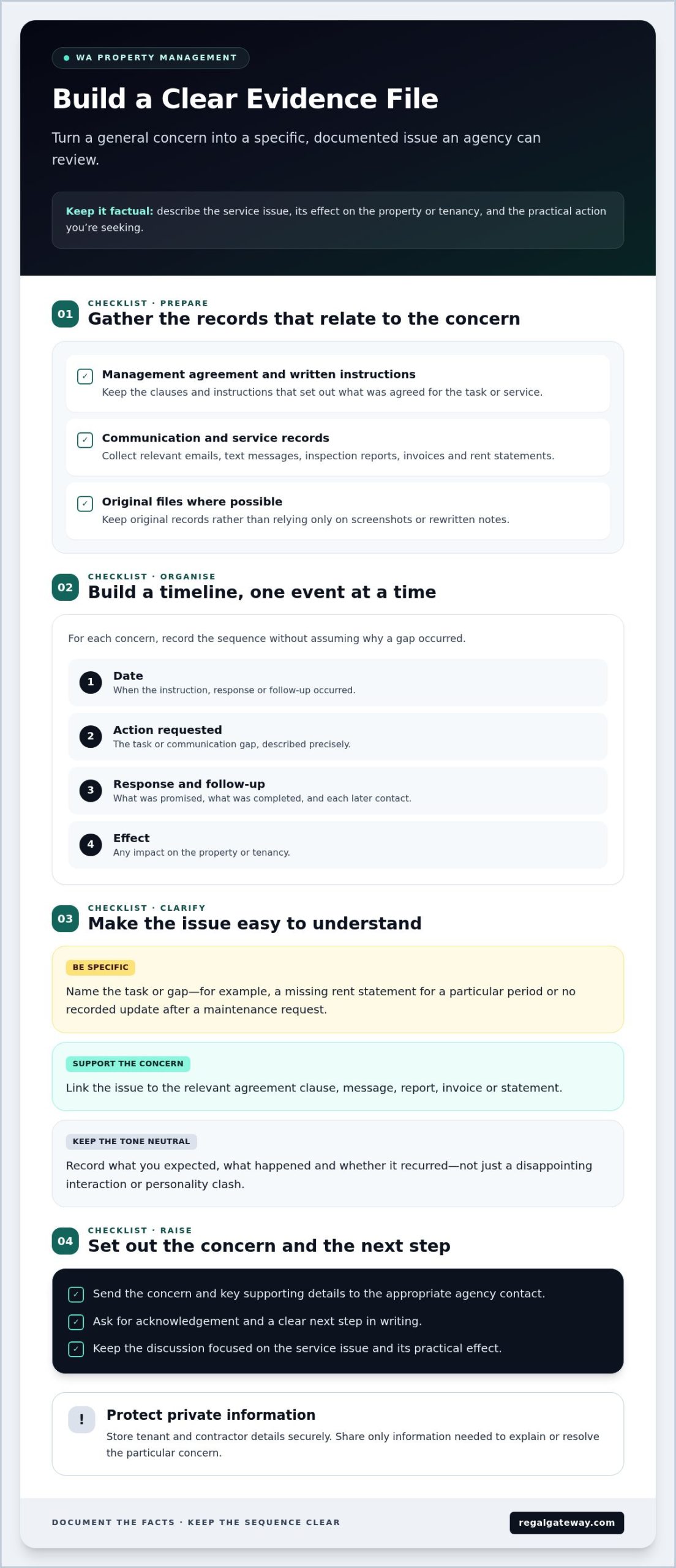
A clear record turns a general sense that something is wrong into a concern the agency can investigate. Before raising a WA property management complaint, gather the relevant documents and describe events in neutral language. Keep the discussion focused on the service issue, its effect on the property or tenancy, and the practical action you’re seeking.
What records help explain a property manager’s performance?
Keep relevant emails, text messages, inspection reports, invoices, rent statements, written instructions and the clauses in your management agreement that relate to the issue. For each concern, note the date, the action requested, the manager’s response and any follow-up. Records made at the time preserve the sequence of events and make a complaint easier to assess.
Handle tenant and contractor details carefully. Store records securely and share only the information needed to explain or resolve the particular concern. Don’t circulate private details that aren’t relevant to the matter.
Build the file in this order:
- Define the concern. Describe the task or communication gap precisely, such as a missing rent statement for a particular period or no recorded update after a maintenance request.
- Collect the records. Gather the relevant agreement clause, messages, reports, invoices or statements. Keep original files where possible instead of relying only on screenshots or rewritten notes.
- Build a timeline. Record the date of your instruction, what action was promised, what was completed, each follow-up and any effect on the property or tenancy. Note gaps without assuming why they occurred.
- Request a written response. Send the concern and key supporting details to the appropriate agency contact. Ask for acknowledgement and a clear next step.
A simple issue log keeps the evidence consistent. Use one row or entry per event, with fields for date, issue or instruction, record or source, action promised, action completed, property or tenancy impact and follow-up needed. For example, write “maintenance request sent, email saved, update requested” rather than “manager ignored me”. The first records observable facts; the second assumes intent.
How should you raise the issue in writing?
Keep your message professional and specific. Identify the concern, give relevant dates, refer to the agreement or earlier instruction where useful, and explain the resolution you’re seeking. You might request an updated rent statement, confirmation of an inspection report or a status update on maintenance coordination. Ask the agency to acknowledge the message and outline the next step.
Avoid accusations, threats or legal conclusions unless you have verified advice supporting them. A measured written request creates a useful record and gives the agency an opportunity to clarify what happened. If reviewing your current arrangement prompts you to consider a different standard of day-to-day support, explore local property management as part of your assessment.
Compare Your Options: Resolve, Escalate or Change Property Managers
Once you’ve identified the concern, choose a response that fits its seriousness, persistence and effect on the property or tenancy. A specific service lapse may be resolved through a direct conversation; an unresolved pattern may call for agency-level escalation or independent guidance. There’s no single route for every landlord wondering how to deal with a bad property manager WA.
| Option | When it may fit | Evidence that helps | What remains uncertain |
|---|---|---|---|
| Direct resolution | The concern is specific, can be corrected and isn’t urgent. | Your written request, the relevant agreement clause and any response or follow-up. | Whether the explanation or proposed action will resolve the issue in practice. |
| Agency-level escalation | You’ve raised the matter with the manager but haven’t received an adequate response. | A concise chronology showing the concern, prior attempts to resolve it and the outcome sought. | Whether a senior contact can address the service gap or clarify the agency’s position. |
| External complaint or guidance | The issue may fall within an external body’s remit, or you need independent information about your options. | Relevant correspondence, agreement terms and records connected to the complaint. | Eligibility, process and available remedies depend on the issue and current guidance. |
| Change property managers | Problems recur, affect the property or tenancy, and agreed corrective steps aren’t completed. | Your service record, current management authority and details needed for a handover. | Termination terms, notice requirements and transition arrangements depend on the agreement and applicable rules. |
When is a direct conversation or agency escalation appropriate?
Start with the property manager when the issue is clear, can be addressed and isn’t urgent. Explain what needs attention and ask for a practical response. If a documented request receives no adequate answer, take the same concise record to the agency principal or senior contact. Routine dissatisfaction is different from a dispute requiring independent regulatory or legal guidance; the appropriate route depends on the facts.
When might changing property managers make sense?
Consider whether the same service failures have recurred, what effect they’ve had, and whether the agency completed agreed corrective actions. Before deciding, review the management authority for termination clauses, notice and handover responsibilities, and verify current WA requirements. A switch isn’t automatic or risk-free. Rent administration, property records, maintenance matters and tenant communication all need careful planning.
For external guidance, check current Consumer Protection WA information before lodging a complaint. Its role, complaint process and the available pathway depend on the issue, so don’t assume every disagreement is eligible for formal action or will produce a particular outcome. If a tenancy, legal or regulatory question is involved, seek guidance suited to that matter before taking a step that could affect your agreement or the tenant.
A Practical WA Plan for Escalating a Complaint and Protecting the Tenancy
Handle a complaint with the same care as any other decision affecting an investment property: calmly, in writing and with the tenancy’s day-to-day needs in view. If you’re considering how to deal with a bad property manager WA, use a stepwise approach that separates the service concern from the obligations that continue while it’s being addressed.
- Review the relevant documents. Read your management authority, written instructions and tenancy records connected to the issue. Note the agency’s internal complaint process and designated senior contact, if stated. The Residential Tenancies Act 1987 (WA) may be relevant where the concern touches tenancy rights or obligations, but check current legislation and guidance before relying on a specific provision.
- Send a documented complaint to the agency. Set out the concern, relevant events and the practical resolution you’re seeking. Keep the tone factual, attach only relevant material and retain a copy.
- Escalate if the response is inadequate. Where appropriate, take the matter to the agency principal or another senior contact. Explain what remains unresolved and ask what action the agency proposes.
- Check the appropriate external pathway. Consumer Protection WA is a relevant source of information for WA consumer and tenancy matters. Consult its current guidance to establish whether your concern falls within its remit, which complaint process applies and what steps or forms are current.
- Assess the response and next step. Compare the agency’s explanation and actions with your documented concern. Decide whether the matter is resolved, needs further internal attention, warrants external guidance or should inform a considered management transition.
How do you escalate a property management complaint in WA?
The right pathway depends on the complaint. A communication or service concern, an issue involving conduct during a tenancy and a question about the management authority may be treated differently. Begin with the agency’s internal process where appropriate, then use current official WA information to identify the relevant body, eligibility, submission method and next steps. Don’t assume a complaint will be accepted or produce a particular outcome. For a complex dispute, obtain independent legal advice suited to the facts before taking consequential action.
How can you protect tenants and property during a dispute?
Keep essential management functions operating while the complaint is reviewed. Make sure rent collection arrangements remain clear, maintenance requests continue to be handled and tenants receive necessary communication through the appropriate channel. Don’t involve tenants in the dispute or ask them to resolve disagreements between you and the agency. Their tenancy arrangements should remain separate from that relationship.
If a change of manager becomes necessary, plan the handover rather than treating it as an administrative afterthought. Identify current property and tenancy records, keys, pending maintenance, scheduled works and the tenant’s relevant contact details. Transfer personal information securely and only as needed for ongoing management, and confirm who is responsible for outstanding tasks during the transition.
For landlords reviewing day-to-day management in Atwell and Cockburn, discuss property management with Regal Gateway Property as one option for establishing a clear management arrangement.
Choose a More Accountable Property Management Arrangement in Cockburn and Atwell
If you’ve worked through how to deal with a bad property manager WA and are considering a change, carry the lessons forward into the next management relationship. Clear expectations help both parties understand how information will flow, which tasks are covered and how outstanding matters will be tracked. Before appointing an agency, consider how its approach to communication and day-to-day administration will support your property and its tenancy.
What should landlords expect from a new management relationship?
At the outset, agree on practical arrangements and make sure they’re reflected in your instructions and management authority. Consider questions such as:
- Communication: Which channels will you use for routine updates, and who is your main contact?
- Inspections: How will regular property inspections be recorded, and how will reports be shared with you?
- Rent administration: What rent statements will you receive, and how will questions about payments or arrears be handled?
- Maintenance: How will requests, coordination, decisions and progress updates be documented?
Clarity matters most when something doesn’t go to plan. Confirm who handles a concern if your usual contact is unavailable, what decisions require your approval and how open tasks will be recorded. Agreed responsibilities and escalation contacts reduce misunderstandings. Consistent records make it easier to see what has been completed and what still needs attention. Avoid relying on assumptions about response times or outcomes; set out a process you both understand.
How can Regal Gateway Property support Cockburn-area landlords?
Regal Gateway Property is an independently owned boutique agency based in Atwell, serving landlords across the City of Cockburn and nearby suburbs, including Aubin Grove, Wandi, Hammond Park, Success, Treeby and Mandogalup. Founded in 2013, the agency brings more than a decade of real estate experience to its local property management work.
Regal Gateway Property manages rental properties, including rent collection, maintenance coordination and regular property inspections, alongside tenant selection and screening. For a landlord comparing agencies, these are useful areas to discuss in concrete terms: how rent information is provided, how inspection records are shared and how maintenance matters are coordinated. The aim is an arrangement where responsibilities are clear and day-to-day management is visible to you.
A planned handover can help preserve continuity if you change agencies. Prepare current tenancy and property records, note any maintenance already in progress, identify upcoming inspections or scheduled work, and confirm how keys and necessary tenant information will be transferred securely. Keep tenant communication clear and focused on the tenancy, not the disagreement between agencies.
For a broader view of local landlord considerations, explore Atwell property management guidance. You can also learn more about Regal Gateway Property’s local agency profile as you consider the right management arrangement for your property.
Set a Higher Standard for Your Property’s Next Chapter
Your next decision can be more than a response to a difficult management experience. It can be an opportunity to shape a relationship around the clarity, stewardship and confidence you want for your investment. If you’re weighing how to deal with a bad property manager WA, let the evidence guide your timing and choices while keeping the tenant’s experience and the property’s ongoing needs in view.
A considered change begins with a clear sense of what matters to you as an owner and how you want to stay informed. Look for a management arrangement that aligns with your expectations and gives you confidence in how your property is being managed.
Regal Gateway Property is an Atwell-based boutique agency serving landlords across the City of Cockburn and surrounding suburbs. Founded in 2013, the agency brings more than a decade of real estate experience to its property management work. Explore property management with Regal Gateway Property and take a thoughtful next step towards a more assured ownership experience.
Frequently Asked Questions
What should I do first if I have a bad property manager in WA?
Start by identifying one specific concern and checking it against your management authority or written instructions. For example, if rent information for an Atwell property is unclear, request an explanation of the relevant entries rather than opening with a general accusation. Keep the exchange in writing and consider the property’s immediate needs separately. This measured first step can help you decide how to deal with a bad property manager WA without escalating prematurely.
Can I complain about a property manager in Western Australia?
Yes. You can raise a concern with the agency and, depending on the issue, seek guidance through relevant WA complaint channels. First distinguish a service complaint between you and the agency from a matter concerning a tenant’s rights or conduct during a tenancy. Consumer Protection WA provides official information about complaint options; check its current guidance for the right process, eligibility and next steps. A complaint doesn’t guarantee a particular outcome.
How do I change property managers in WA?
Begin by reading your management authority and identifying its termination process, notice provisions and handover responsibilities. Coordinate the end of the existing arrangement with the start of the next one, so rent administration, maintenance matters and tenant communication remain clear. Arrange the transfer of relevant records, keys and information about pending work. If you’re unsure how a term applies, obtain independent advice before giving notice or changing instructions.
Can I terminate a property management agreement immediately in WA?
Not necessarily. Whether you can end the arrangement immediately depends on the management authority’s terms and any applicable legal requirements. Don’t assume dissatisfaction alone cancels notice obligations or other agreed responsibilities. Read the termination clause carefully, check for provisions dealing with unresolved issues or breach, and get independent legal advice if the wording or circumstances are complex. Until the arrangement ends, keep essential management tasks and tenant communications orderly.
What evidence should I keep when complaining about a property manager?
Keep original emails and messages, statements, invoices, inspection documents, maintenance records and the relevant parts of your management authority. Save attachments with clear filenames and retain copies in a secure location. If you discuss the issue by phone, make a dated note of who spoke, the subject and any agreed next action. Avoid altering source documents, and limit access to tenant or contractor details that aren’t needed to explain the complaint.
Who regulates property managers in Western Australia?
Consumer Protection WA is the government source to consult about real estate industry licensing, conduct and complaint processes in Western Australia. REIWA is an industry body, not a government regulator, and its role is distinct from formal regulatory oversight. Because a concern may relate to agency service, professional conduct or a tenancy dispute, check current Consumer Protection WA guidance to identify the relevant authority and pathway for your circumstances.
What happens if my property manager does not respond to my complaint?
If the manager doesn’t respond, send a concise follow-up referring to your original message and asking for the agency’s position and next step. If that remains unresolved, use the agency’s escalation process, such as contacting its principal or designated senior representative. You can then check Consumer Protection WA guidance to see whether an external complaint route applies. Keep ongoing tenancy matters separate, and don’t assume silence establishes a breach or determines the outcome.
Should I change property managers over poor communication?
Consider changing managers if communication problems are persistent, affect important decisions or leave agreed tasks unresolved, rather than relying on one disappointing exchange. Look at whether a clearer process would provide reliable updates and whether the agency follows through after concerns are raised. If you decide to move on, review your authority and plan the handover. This can matter for landlords managing properties in Atwell, Aubin Grove, Wandi, Hammond Park, Success, Treeby or Mandogalup.