
A maintenance request arrives by email, an urgent fault needs immediate attention, and the owner is waiting to hear what happens next. Without clear routes and responsibilities, important details can slip between channels. A well-designed property management communication plan turns scattered updates into documented, role-specific decisions.
Owners and tenants need to know who handles each issue, how to raise it and what happens next. In Western Australia, communication expectations also sit alongside tenancy requirements, including rules for serving notices electronically. A considered plan supports responsive service and careful record-keeping.
This practical guide explains what to include and how to put a plan into practice for a residential property and its tenancy. Learn how to assign responsibilities, choose the right channel for routine maintenance and emergencies, record requests, and set update expectations. You’ll also find a reusable template and examples of how to adapt it to local property management, including in Atwell and surrounding Cockburn suburbs.
Key Takeaways
- A property management communication plan clarifies who handles each issue, which channel to use and how follow-up is recorded.
- Separate urgent issues from routine maintenance and ordinary tenancy correspondence so each request follows the right route.
- Choose the right balance of personal service and traceability by matching the communication method to the issue.
- Use a reusable template to record property contacts, issue categories, decision owners, next actions and follow-up.
- Regal Gateway’s Cockburn inspection process includes a first inspection 6 weeks after move-in, then routine inspections every 3 months with 7-14 days’ written notice.
What Is a Property Management Communication Plan, and Why Does It Matter?
An owner sends a maintenance request by email, a tenant follows up by phone, and a manager receives a separate message about the same issue. When updates are scattered across channels, it can be difficult to see who is responsible, what has already been agreed or what needs to happen next. That uncertainty can affect confidence, even when everyone is trying to act promptly.
A property management communication plan is a written guide that identifies who communicates, which channels to use, how issues are categorised, what records to keep and how follow-up is managed. Its practical purpose is to give everyone a reliable route from the first message to a clear next step.
The plan makes expectations visible before a problem arises. Owners can see which matters need their decision, tenants know how to raise a concern, and managers can coordinate information without relying on memory or searching unrelated conversations. As experienced property management firms like ARW Trading demonstrate, a documented process supports consistent service and helps clarify misunderstandings across tenancies, even though it can’t guarantee that every disagreement will be avoided.
Treat the plan as a working reference, not a script for every interaction. Make it specific enough to guide action while leaving room for the needs of the property and tenancy. A brief record of who received a request, what was decided and what happens next is more dependable than informal messages alone.
Who needs to be included in the communication plan?
Start with the people who have a role in decisions and updates. The owner is generally responsible for decisions requiring approval, including repairs and their costs. The tenant reports issues and provides relevant details. The property manager coordinates communication, records the request and explains the next step. Include a maintenance contact when a job needs assessment or work, and state that person’s role and communication route.
Specify who receives routine updates and who can make decisions, so requests aren’t left between parties. Include a contactable emergency contact for approval of emergency repairs, and record how that person can be reached. This gives the manager a defined point of contact if the owner can’t be reached when a decision is needed.
Which outcomes should the plan support?
Set out how requests are received, recorded, assigned and followed up. A useful record captures the issue, date received, responsible person, next action and any update given. These details show whether a request is awaiting a decision, being arranged or needs more information.
Distinguish urgent matters from routine maintenance and ordinary tenancy correspondence, then match each category to a suitable channel and process. Make the distinction easy to find, and keep communication professional and proportionate to the issue. For example, a tenant reporting a developing leak needs a clear way to flag urgency, while a non-urgent repair can use the standard request route.
Once these elements are written down, the plan becomes a practical reference for everyday decisions and unexpected situations. Organise the roles, channels and updates into a repeatable process that suits the tenancy.
Build the Plan Around Roles, Channels and Clear Updates
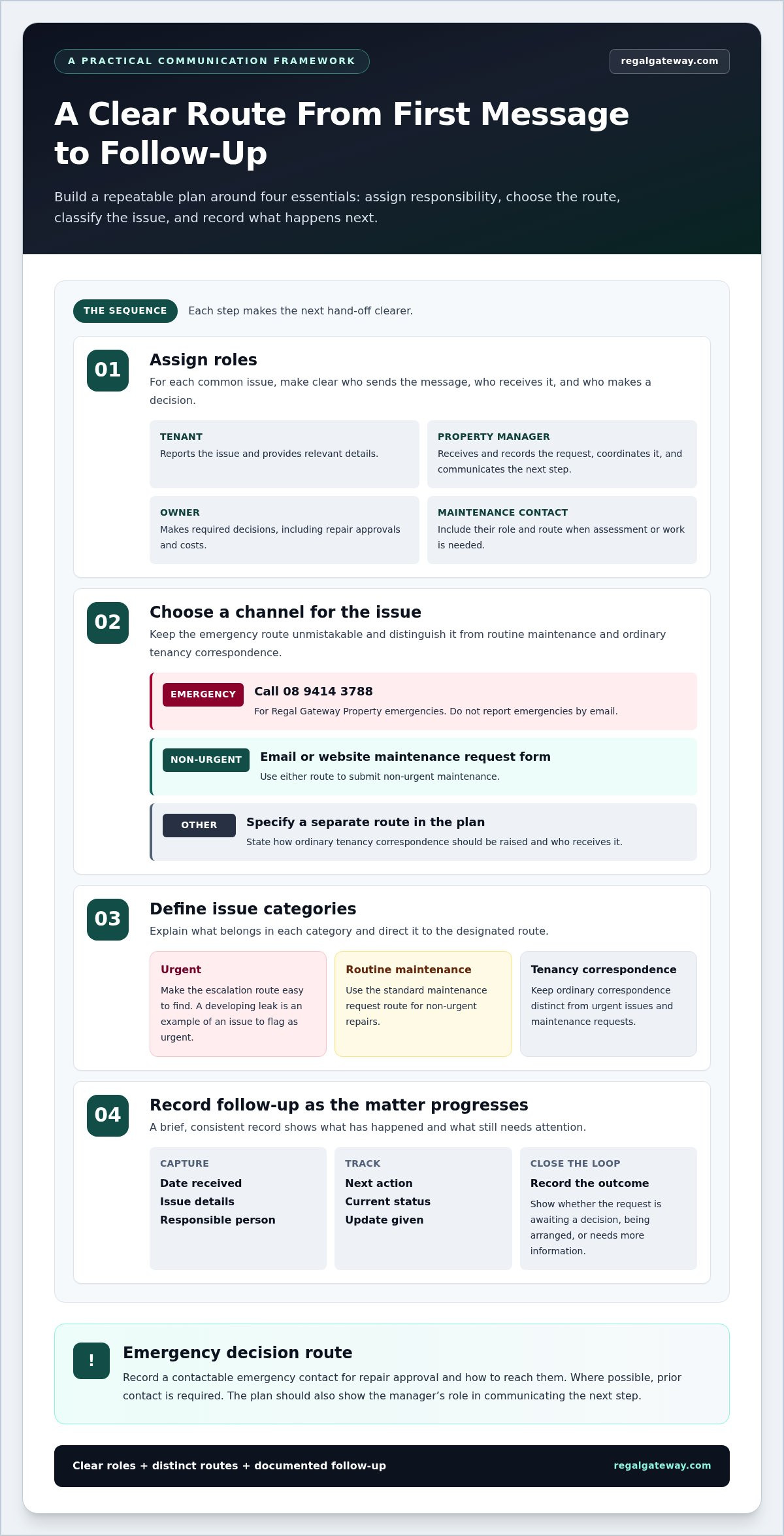
A useful plan should work when a message arrives, not just describe good communication in principle. Build it in a deliberate sequence: assign responsibility, select a channel for each type of contact, define issue categories, then record the action and follow-up. This gives owners, tenants and managers a consistent route from first report to resolution.
Give every communication route a named owner, so someone is accountable for receiving the message, taking the next step or passing it to the right decision-maker. That person may differ by issue. For a repair, for example, the tenant provides the details, the property manager records and coordinates the request, and the owner makes any required decision.
- Assign roles. For each common issue, identify who sends the message, who receives it and who makes any decision.
- Select channels. State how routine correspondence, maintenance requests and emergencies should be raised.
- Define categories. Explain what counts as urgent, routine maintenance or ordinary tenancy correspondence, and direct each type to its designated route.
- Record follow-up. Log the date, issue, responsible person, next action, current status and outcome as the matter progresses.
How should the plan assign responsibilities?
Make hand-offs explicit. For a maintenance request, the tenant provides the details, the manager records and coordinates the request, and the owner is responsible for repair costs and any required approval. Show how the manager will relay the owner’s decision and keep relevant parties informed. Not every request needs to follow the same approval path.
For emergency repairs, include a contactable emergency contact who can be reached for approval. Where possible, prior contact is required. Record the contact details and the manager’s role in communicating the next step, so an urgent matter isn’t left without a clear decision route.
How should the plan define channels and records?
Keep channels distinct and make the emergency route unmistakable. For Regal Gateway Property, report emergencies by calling 08 9414 3788, not by email. Submit non-urgent maintenance by email or through the website maintenance request form. For ordinary tenancy correspondence, specify the agreed channel rather than assuming everyone will use the same one.
Use one consistent property record to capture the issue, date received, person responsible, next action, status and outcome. This makes it easier to see whether a matter is awaiting information, owner approval or an update. Set expectations for how progress will be communicated, but don’t promise response times unless the service arrangement establishes them.
A clear route map is a practical foundation of a property management communication plan. Landlords looking for a consistent approach can explore property management support from a local agency serving Cockburn suburbs.
Compare Ad Hoc Messages, Direct Contact and a Documented Plan
Not every tenancy conversation needs a formal workflow. A brief message may be enough for a simple update, while a repair requiring owner approval needs clear ownership and a record of the decision. The useful distinction isn’t formal versus friendly. It’s whether the approach gives everyone enough clarity and continuity for the issue at hand.
A property management communication plan can preserve personal, direct contact while providing structure for matters that need coordination. Premium property management and hospitality providers like GuestLee rely on structured communication channels to deliver personal service while keeping maintenance and owner reporting transparent. Use this comparison to decide how much process each situation calls for.
| Approach | Strengths | Limitations | Best suited to |
|---|---|---|---|
| Ad hoc messages | Quick and informal, which suits a straightforward exchange. | Details can be spread across conversations, making responsibility and history harder to trace. | Simple, low-complexity updates that need no decision or escalation. |
| Direct contact | Personal and clear when the right people are speaking directly. | Others involved may not know what was agreed unless the outcome is shared or recorded. | A brief clarification or a conversation that helps resolve a question promptly. |
| Documented plan | Sets out who acts, which channel applies and where progress is recorded. | Can feel cumbersome if every minor exchange is treated as a formal process. | Maintenance, approvals, emergencies and other matters involving hand-offs or follow-up. |
When is a simple direct message enough?
For a straightforward update, such as confirming receipt of a routine document, a direct message through the agreed channel may be all that’s needed. Using an agreed channel also gives each person a dependable place to look for replies, rather than requiring them to check several inboxes or message threads.
Keep the personal touch. If a conversation includes a significant decision, commitment or change to the next step, add a concise note to the property file. That small record preserves the context without turning every exchange into paperwork.
When does a documented workflow add value?
Use a defined route when a matter requires owner approval, coordination with a maintenance contact or a record of actions taken. A non-urgent repair can follow the designated maintenance request process, with the issue assigned and its status updated. An emergency needs a separate, clearly signposted reporting route. It shouldn’t be treated as an ordinary maintenance message and left in the routine process.
Start with the essentials: contacts, channels, issue categories and record fields. Add detail only where the property or tenancy calls for it. A complex approval path may help with coordinated work, while a simpler arrangement can suit straightforward correspondence. The aim is a usable framework, not a manual that people won’t consult. Personal communication remains central; the documented process helps each conversation lead to a clear next step.
Use This Property Management Communication Plan Template
A template is useful when it reflects the people, channels and decisions for a specific tenancy. Use the framework below as a starting point, complete it with the relevant parties, and agree on response expectations rather than assuming one deadline suits every situation.
Complete and share the communication plan at the start of the tenancy, then update it whenever contacts, responsibilities or agreed processes change. Keep the current version accessible to the owner, tenant and property manager, and make sure everyone knows where to find it.
What fields should the communication template contain?
Start with the property address and tenancy details. Record current contact information for the owner, tenant, property manager and a contactable emergency contact for emergency-repair approval. Add a maintenance contact where relevant. For each issue category, identify the preferred channel, decision-maker, escalation route and record location.
Property and contacts
- Property address: [Enter address]
- Owner and preferred contact details: [Enter details]
- Tenant and preferred contact details: [Enter details]
- Property manager and contact details: [Enter details]
- Emergency contact for emergency-repair approval: [Enter name and contact details]
- Maintenance contact, if applicable: [Enter name and contact details]
Communication routes
- Routine questions: Channel [Enter]; decision-maker [Enter]; escalation route [Enter]; record location [Enter].
- Non-urgent maintenance: Channel [Enter]; decision-maker [Enter]; escalation route [Enter]; record location [Enter].
- Emergencies: Contact route [Enter]; decision-maker or emergency contact [Enter]; escalation route [Enter]; record location [Enter].
- Formal notices: Agreed service method and address [Enter]; responsible person [Enter]; record location [Enter].
Request and follow-up record
- Date recorded and issue summary: [Enter]
- Responsible person and next action: [Enter]
- Status and agreed response expectation, if applicable: [Enter]
- Outcome, closure date or next follow-up: [Enter]
Leave the response expectation field blank until the relevant parties have agreed what is appropriate for the arrangement. The template makes expectations visible; it doesn’t set universal response deadlines. For formal notices, record the service method agreed for the tenancy and use it in line with applicable requirements.
How can you put the template into use?
Walk through each route with the owner, tenant and manager. Confirm who receives each type of message and who can make decisions. Explain where requests and outcomes will be recorded, then keep the completed plan with the property records and somewhere relevant parties can access it. Review it when the management arrangement or contact details change.
For broader landlord guidance tailored to the local market, explore the Atwell property management guide. To put a clear communication framework into practice for your tenancy, speak with Regal Gateway about property management.
Apply the Plan to Regal Gateway’s Cockburn Property Management
A communication plan is easier to use when it reflects the actual processes for a tenancy. For landlords and tenants working with Regal Gateway Property in Atwell and surrounding Cockburn suburbs, inspection records and separate maintenance routes provide practical examples to include. Adapt the details to the property and tenancy rather than treating them as a universal template.
Use the details below to fill in the relevant fields in your own property management communication plan: who sends a message, which channel applies, who needs to act and where the outcome is recorded.
How do inspections and reports fit into the plan?
Regal Gateway’s first routine inspection takes place 6 weeks after the tenancy begins, followed by inspections every 3 months. Routine inspections require 7-14 days’ written notice, and the Western Australian limit is a maximum of 4 routine inspections per year. Record the inspection dates and notice process in the property communication schedule, so tenants know what to expect and the owner can follow the process.
Detailed inspection reports with photos are stored on file. In your communication plan, note who receives the report, where it is kept and how findings are shared. A consistent record gives the owner and manager a clear reference for the property’s condition and any follow-up, with the report accessible in the relevant tenancy file.
How should the plan route maintenance and emergencies?
Make the distinction unmistakable. Tenants should report emergencies by calling 08 9414 3788, not by email. Non-urgent maintenance can be reported by email or through the website maintenance request form. Listing these routes plainly helps prevent an urgent issue from being placed in the ordinary maintenance queue.
For an emergency repair, the plan should identify a contactable emergency contact for approval and explain what happens next: who makes contact, who records the issue and how the owner is updated. Where possible, prior contact is required. The property owner pays for repairs. Recording the date, issue, contact attempts, decision and follow-up creates a useful account of how the matter progressed.
These examples show how local processes can turn a general framework into a workable tenancy reference. Owners can also explore Regal Gateway’s Atwell property management guide for broader guidance. To discuss property management for your circumstances, contact Regal Gateway through the website.
Make Clear Communication Part of Your Property’s Ongoing Care
A communication plan works best when it stays useful in practice, not simply filed away after it’s written. As the tenancy progresses, notice where hand-offs are unclear or the next step is difficult to identify. Those moments can guide practical refinements and keep the plan aligned with how the property is managed and how its occupants communicate.
Think of the property management communication plan as part of the care you invest in your property. A clear, adaptable framework supports more confident decisions and a considered experience for everyone involved, while leaving room for personal communication when it matters.
For landlords seeking a locally informed approach to managing a residential property, explore Regal Gateway’s local property management support. A well-supported tenancy can begin with a clear conversation and grow from there.
Frequently Asked Questions
What should a property management communication plan include?
A property-specific plan should name the owner, tenant, property manager and any maintenance or emergency contacts, then assign responsibilities for receiving messages, approvals and updates. List channels and issue categories, along with record fields such as date, status, next action and follow-up owner. Keep the plan accessible and distinguish emergency instructions from routine correspondence. Agree on update expectations for the tenancy rather than assuming one response deadline suits every request.
How often should a property management communication plan be reviewed?
Review it whenever contact details, tenancy arrangements, management responsibilities or reporting processes change, and confirm that its listed channels still work. For example, if a management handover changes who receives maintenance requests, update the route and tell the relevant parties. An accurate, accessible plan is more useful than a lengthy document left untouched. Share important changes with everyone whose role or next step is affected.
Should landlords communicate directly with tenants or through a property manager?
Use the communication route agreed for the property, making clear who receives requests, shares updates and handles decisions. The appropriate arrangement depends on the property-management agreement and tenancy process, so direct contact isn’t automatically required or prohibited. If a landlord and tenant speak directly about a significant issue, ensure the decision or commitment is captured in the property record and shared with the manager where needed. Consistent hand-offs help prevent crossed messages.
Can a property management communication plan set legally binding notice periods?
No. Treat the plan as an operational guide, not a substitute for formal tenancy documents, legally required notices or the terms of an agreement. It can explain where communications are directed and who records them, but it can’t change statutory obligations or agreed terms. For a Western Australian tenancy, check current official guidance and follow the applicable formal notice process. Keep operational updates distinct from documents that must meet specific service requirements.
What should tenants do if a property maintenance issue becomes an emergency?
Use the emergency route stated for the property, not the channel for ordinary maintenance. For a property managed by Regal Gateway, call the 24-hour contact line on 08 9414 3788, not email. Tenants should also provide a contactable emergency contact for emergency-repair approval and follow the property’s instructions. Once reported, note the issue and any guidance received so the next communication can be directed to the appropriate person.
How can a landlord tell whether a communication plan is working?
Check whether requests reach the intended person, decision ownership is understood and important actions have a clear record and follow-up owner. Repeated queries for the same update, messages sent to the wrong channel or missing decision notes can signal that a route needs refining. For properties in Atwell, Aubin Grove, Wandi, Hammond Park, Success, Treeby and Mandogalup, use these practical observations to improve the process, not as formal performance targets or proof that disputes will be eliminated.