
A cupboard can be checked for cleanliness or damage, but a vacate inspection should assess the property, not search through a tenant’s personal belongings. A vacate inspection checklist for WA landlords should cover each room, fixtures and any maintenance concerns, with clear written notes and dated photos. The lessor or property manager must complete the end-of-tenancy property condition report within 14 days after the tenancy agreement ends and provide the tenant with a copy within 14 days.
It’s understandable to want a thorough inspection and a fair, well-documented bond process. The key is to compare the property’s condition with the original report and distinguish damage from fair wear and tear. This guide explains what to check, how to record evidence, how to give the tenant a reasonable opportunity to attend the final inspection, and how to prioritise maintenance issues. It also offers practical ways to handle disagreements calmly, so the handover is clear and the next steps are easier to manage.
Key Takeaways
- Compare the final property condition report with the entry report, and complete the end-of-tenancy report within the required timeframe.
- Pair dated photos with precise written descriptions, so the record captures both visible details and their context.
- Separate damage from fair wear and tear when assessing bond claims; according to Consumer Protection WA, a lessor must lodge a tenant’s bond with the Bond Administrator within 14 days of receiving it.
- Record maintenance issues clearly and prioritise them by urgency, arranging suitably qualified repairers where needed.
- Use a room-by-room bathroom check to spot overlooked cleaning details, including cabinet interiors, toilet surfaces, sinks, taps and mirrors.
Providing tenants with the final property condition report
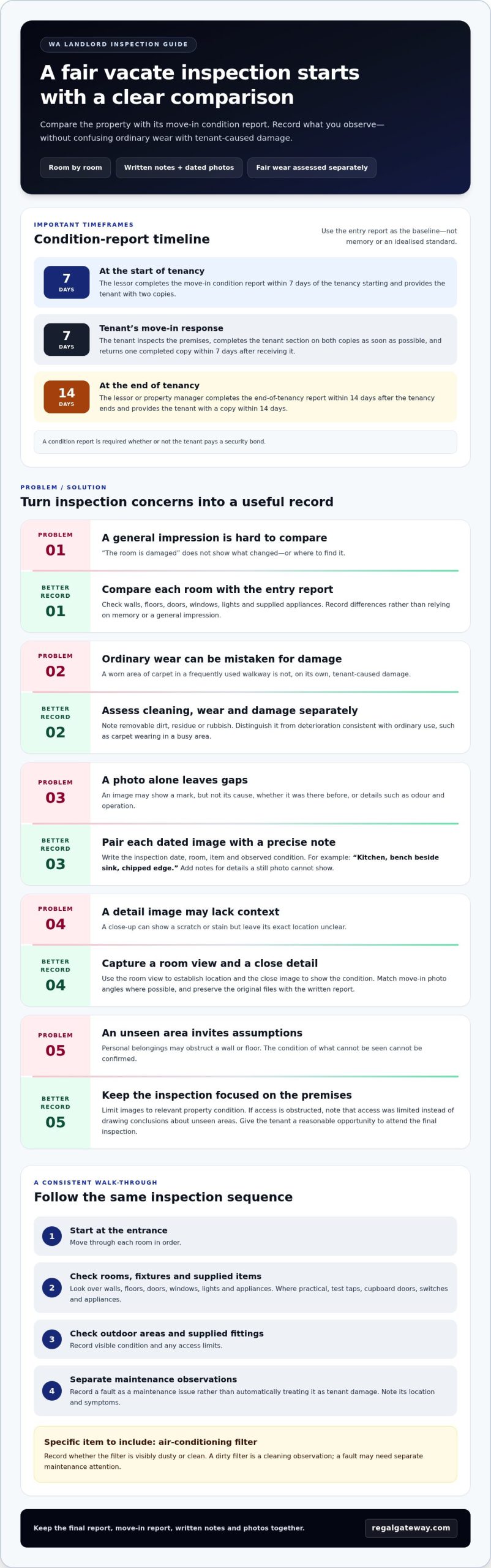
A WA vacate inspection checklist should cover each room, fixtures, cleanliness, damage and visible maintenance issues. Complete the end-of-tenancy property condition report within 14 days after the tenancy agreement ends, and provide the tenant with a copy within 14 days.
For carpet and professional cleaning, compare the vacated property with its original condition report and assess its actual cleanliness and condition. Ordinary wear, such as carpet wearing in frequently used areas, is fair wear and tear. Don’t treat that wear alone as tenant-caused damage.
Use the move-in condition report as the baseline, not memory or an idealised standard. In WA, the lessor must complete that report within seven days of the tenancy starting and provide the tenant with two copies. The tenant should inspect the premises, complete the tenant section on both copies as soon as possible, and return one completed copy within 7 days after receiving it. A condition report is required whether or not the tenant pays a security bond.
- Compare each room with the entry report. Check walls, floors, doors, windows, lights and supplied appliances, noting differences rather than general impressions.
- Record marks and damage precisely. Describe a stain’s location and appearance, or identify a chipped tile by room and position, so the tenant can compare the finding with the earlier record.
- Check fixtures and supplied items. Test taps, cupboard doors, switches and appliances where practical, then record faults as maintenance issues rather than automatically treating them as tenant damage.
- Assess cleaning separately from wear. Note removable dirt, residue or rubbish, while distinguishing it from deterioration consistent with ordinary use, such as worn carpet in a busy walkway.
- Inspect the air-conditioning filter. Record whether it is visibly dusty or clean; a dirty filter is a specific cleaning observation, while a fault may require separate maintenance attention.
Follow a consistent sequence: start at the entrance, move through each room, then check outdoor areas and supplied fittings. Record the date, room, item and observed condition. If the tenant reports a maintenance issue during handover, note its location and symptoms separately from cleaning observations. This creates a clear record without assuming who caused the problem.
Give the tenant a reasonable opportunity to attend the final inspection. Share the completed report and keep a copy with the move-in report, notes and photographs. A clear comparison helps explain proposed bond deductions and gives both parties a practical basis for resolving differences. If a notice period affects the handover date, record the agreed end date and inspection arrangements in the tenancy file.
Dated photos and inspection documentation
A photograph can show a mark, but it can’t explain its cause or whether it was there before the tenancy. Pair each image with a written description, the room, the item and the inspection date. In Western Australia, photographs and video recordings are recommended to be signed and dated by all parties. They do not replace accurate written descriptions of the property’s condition. A vacate inspection checklist for WA landlords should link each image to a specific written observation.
Keep records focused on the rental premises and relevant condition details. For example, photograph a chipped bench edge with enough surrounding context to identify its location, then write, “kitchen, bench beside sink, chipped edge”. Avoid focusing images on a tenant’s personal belongings. If belongings obstruct a wall or floor, note that access was limited rather than drawing conclusions about what cannot be seen.
- Capture a wide view and a detail. A room view establishes location, while a close image shows a scratch, stain or broken fitting clearly.
- Use consistent angles. Match the move-in image where possible, so a future comparison shows the same area rather than a different perspective.
- Record the date and room. Label each file with the inspection date and a clear location, such as “laundry, tub tap”.
- Describe what the image cannot show. Add notes about odour, operation or access, since a still photo cannot establish those details.
- Keep unedited originals. Preserve the original files and store them with the written condition report, rather than relying on cropped or annotated copies.
For a rental inspection during an active tenancy, follow the entry requirements. The lessor must use Form 19, Notice of proposed entry to premises, and give the correct notice. Routine inspections require 7 to 14 days’ written notice, and landlords may conduct a maximum of four rental inspections per year. Respecting the tenant’s privacy means limiting images to property condition and avoiding unnecessary capture of personal belongings or private documents.
Before taking photographs or video, explain which areas will be recorded and how the images relate to the inspection. The tenant and landlord should agree to photographs taken during an inspection and their accuracy. If they disagree about an image, record the disagreement alongside the relevant description rather than presenting disputed material as an agreed account.
Organise the file so each image is linked to a specific written observation. A simple record can include the date, room, item, condition, image filename and any tenant comment. For example, pair “bedroom, carpet, visible dark mark near doorway” with a matching image. For WA landlords, a vacate inspection checklist helps keep observations, supporting images and tenant comments together. Note whether the observation appears consistent with wear and tear or needs further assessment, without treating the photograph alone as proof of responsibility. A routine inspection report is evidence, not a breach notice by itself.
End-of-lease inspections and bond disputes
At the end of a Western Australian tenancy, the lessor should complete the final condition report, give the tenant a reasonable opportunity to attend, and assess the property against its documented starting condition. The tenant should return the property in the required condition, raise disagreements promptly and keep relevant records. Both parties can use the report, dated photographs and written comments to discuss proposed bond deductions.
For bond timing, distinguish lodging the bond from resolving its return. According to Consumer Protection WA, a lessor must lodge a tenant’s bond with the Bond Administrator within 14 days of receiving it. The final inspection itself does not establish an automatic return deadline in the available facts; the practical next step is to document the parties’ agreement or the specific items in dispute, supported by the condition reports and evidence.
Fair wear and tear is deterioration from ordinary use, not damage caused by neglect or misuse. For example, carpet wearing in frequently used areas through ordinary use is fair wear and tear in Western Australia. Compare the item’s entry condition, age and use with its vacated state, then record the specific difference. Describe and document a new stain or broken fitting rather than labelling it damage without a clear comparison.
- Keep the bond record complete. Retain the receipt, bond details, condition reports and relevant communications together.
- Separate rent from damage claims. A tenant’s bond cannot be used to cover outstanding rent, so record rent and property-condition matters distinctly.
- Describe each proposed deduction. Identify the room, item, observed condition and supporting evidence, rather than relying on a general claim about cleaning or damage.
- Record agreement accurately. Note which items both parties accept and which remain disputed, with each party’s comments and supporting documents.
For final-inspection entry, give the tenant a reasonable opportunity to attend. When a lessor needs to enter rental premises, the required entry process uses Form 19, Notice of proposed entry to premises, with the correct amount of notice. Keep the notice and inspection record with the final report. The notice period and entry requirements are distinct from the evidence needed to explain a bond claim.
If the tenant disputes a proposed deduction, return to the condition reports and compare like with like: the same room, fixture or surface, and its recorded condition at the tenancy’s start. Add dated photos and concise notes to clarify the issue. Respect the tenant’s right to quiet enjoyment during the tenancy, and keep end-of-lease communication focused on documented property condition, the agreement and the specific bond items under discussion. Clear records help both parties see where they agree and what remains unresolved.
After the final inspection, the parties should document their agreement on any deductions or identify the specific disputed items, supported by condition reports and evidence. The 14-day requirement applies to lodging the bond with the Bond Administrator after receiving it, not to returning it after the inspection.
Post-inspection reporting and maintenance triage
A WA landlord documents a final inspection by completing the end-of-tenancy condition report, recording observations clearly, and attaching relevant evidence. The lessor or property manager should complete the report within 14 days after the tenancy agreement ends and provide the tenant with a copy within 14 days. Keep the report, photos and repair follow-up together as one property record.
Write findings so another person can locate and understand each issue. “Bathroom, vanity, tap drips when turned off” is more useful than “plumbing problem”. Separate the observed condition from its suspected cause: describe what happened, where it occurred and whether it needs assessment. If the tenant is present, invite them to review the relevant entry and note any comments or disagreement.
- Match each photo to a report entry. Give the file a clear label, such as “laundry, ceiling stain”, and describe the same location in writing.
- Attach relevant supporting records. Include dated photos or video and any related maintenance communication, while keeping the material focused on the property condition.
- Record the tenant’s comments. Note whether the tenant agrees with an observation or disputes it, without replacing either account with an assumption.
- Track each repair through to follow-up. Record the issue, notification date, repair action and outcome, so outstanding work remains visible after handover.
Photographs and video do not replace accurate written descriptions. The tenant and landlord should agree to photographs taken during an inspection and their accuracy. Add captions identifying the room and item, and keep the original files with the report. If access or visibility was limited, record that fact rather than treating an unseen surface as inspected.
Triage repairs by the effect on essential services and the urgency of the reported issue. In Western Australia, a lessor must arrange repairs with a suitably qualified repairer within 24 hours after being notified that an essential service needs restoring. For urgent repairs, the lessor must arrange a suitably qualified repairer within 48 hours after notification. Record the notification and arrange the appropriate repair response.
For other maintenance issues, note the defect, its location, any immediate impact and the next action. A loose cupboard hinge and a reported loss of an essential service call for different priorities. Don’t label an issue resolved until the repair is complete and the outcome is recorded.
Keep notice records distinct from the final report. If a later visit requires entry, use Form 19, Notice of proposed entry to premises, and give the correct notice. For the initial condition report, the tenant should inspect the premises and complete the tenant section on both copies as soon as possible after receiving them, then return one completed copy within 7 days after receiving it. This tenant review creates a useful comparison record for the tenancy file.
Cleaning bathroom cabinets, toilet, sink, taps and mirrors
A rental property should be returned clean, with its vacated condition compared against the entry condition report and tenancy agreement. In the bathroom, assess visible cleanliness item by item rather than assuming every mark indicates damage or requires professional cleaning.
Start with the cabinets. Open each door and drawer, remove rubbish, and check shelves, handles and corners for residue, dust or personal items. Wipe the surfaces and note any damage separately, such as a loose hinge or swollen panel. Record a clean cabinet with an existing mark accurately rather than treating it as a new cleaning issue.
- Toilet: Scrub and disinfect the toilet surfaces, including the seat, lid, bowl, base and flush control; note visible residue after cleaning.
- Sink and taps: Wipe the basin, plug and tap handles, remove marks and water stains, then check for visible grime around joins.
- Mirror: Use glass spray to remove fingerprints and streaks, then inspect the reflection in good light.
- Cabinet exterior: Wipe doors, handles and exposed sides, taking care to record scratches or chips separately from dirt.
- Cabinet interior: Check shelves and drawer corners for dust, hair, spills or forgotten items, then note any remaining issue clearly.
- Floor and edges: Check around the toilet base, vanity and skirting for loose debris or visible residue.
Use the same inspection order each time: cabinets, toilet, sink and taps, mirror, then floor. This makes it easier to compare the property with the entry report and spot missed areas. Record a specific observation, such as “water marks remain around basin tap,” rather than writing only “bathroom dirty”. If a mark remains after reasonable cleaning, document its appearance and location before deciding whether it reflects a cleaning issue, wear and tear or damage.
Give the tenant a reasonable opportunity to attend the final inspection and discuss a bathroom observation. Keep the written report factual, and attach relevant dated images where they help show the condition. The final property condition report must be provided to the tenant within 14 days of the tenancy ending. Clear records support consumer protection by showing what was observed and how any concern was assessed, rather than relying on a broad cleaning demand.
Cleaning expectations should be assessed in the circumstances of the tenancy and against its recorded starting condition. Avoid turning ordinary signs of use into a cleaning charge, and separate repairs, such as a dripping tap, from removable dirt. For landlords seeking ongoing help coordinating property management and tenancy handovers, explore property management support.
Regal Gateway Property: Residential Property Sales
Regal Gateway Property can support your next property decision through Residential Property Sales or Property Management. If the vacated home is part of a longer-term rental investment, Property Management and Tenant Selection and Screening can support your plans for a future tenancy. If you’re considering a change of direction, Residential Property Sales gives you a way to discuss selling the property. Inspection records, maintenance notes and handover documents can help you organise the next stage, whether you plan to retain the property or sell. The right choice depends on your goals and the role the home should play in your portfolio. Contact Regal Gateway Property to discuss the next step for your residential property.
Set the next chapter in motion
A considered handover can help you decide what role the property should play next. You might retain it as a rental, prepare it for sale or refine your approach to future tenancies. The right direction starts with your wider property goals. A vacate inspection checklist for WA landlords helps bring the tenancy to a clear close, while your next decision can shape the property’s longer-term place in your plans.
Regal Gateway Property offers Residential Property Sales, Property Management, and Tenant Selection and Screening. Whether you’re considering a sale, ongoing management or support with selecting tenants, choose the next step to suit your priorities for the property.
Contact Regal Gateway Property today to discuss your residential property plans. A clear decision now can help you move forward with confidence.
Frequently Asked Questions
Can a landlord open cupboards during an inspection?
Yes, a landlord can check cupboards as part of assessing the property’s condition, but keep the inspection focused on the premises. In an occupied rental, avoid searching through personal belongings or handling private items. For example, note whether a cupboard door or shelf is damaged, rather than inspecting a tenant’s stored possessions. If belongings prevent a fair view, record that access was limited and discuss a suitable next step.
Can a property manager take photographs?
Yes. Photographs can document the property’s condition, and video may also help show context. Keep images relevant to the inspection, explain what is being recorded, and avoid unnecessary images of personal documents or belongings. In Western Australia, the tenant and landlord should agree to photographs taken during an inspection and their accuracy. Pair each image with a written description, since a photograph alone may not explain the observation.
Does the tenant have to be home?
No, a tenant doesn’t have to be home for a routine rental inspection if valid written notice has been given. That rule differs from the final inspection, where the lessor must give the tenant a reasonable opportunity to attend. For a final handover near Atwell, Aubin Grove or Hammond Park, arrange the inspection time clearly and keep a written record of the invitation and any response.
What should happen after the inspection?
Complete the final property condition report, note any tenant comments, and organise the supporting records so each finding can be traced to a room or fixture. The lessor or property manager should complete the report within 14 days after the tenancy agreement ends and provide the tenant with a copy within 14 days. Record repair actions separately, then update the file when a reported issue has been assessed or addressed.
Can a WA landlord deduct cleaning, damage or repairs from a tenant’s bond?
A bond may be relevant to cleaning or damage claims, but ordinary wear and tear isn’t the tenant’s responsibility. Compare the claimed issue with the entry condition report and consider whether the evidence shows tenant-caused damage or a cleaning concern beyond ordinary use. Keep repair costs separate from general maintenance, and don’t use the bond to cover outstanding rent. Clear records help explain the basis for any proposed deduction.
What should a WA landlord do if the tenant disagrees with the vacate inspection or bond deductions?
Respond to the specific disputed item rather than making a general demand. Compare the entry and final reports, share relevant dated evidence, and invite the tenant to provide their account in writing. Record which items are agreed and which remain disputed. The bond refund form needs both tenant and landlord signatures before it is forwarded to the Bond Administrator, so don’t describe an unresolved deduction as agreed.