
A referee’s name and phone number alone don’t prove they managed the applicant’s rental. For a tenant reference check in WA, get the applicant’s consent before contacting previous landlords. Then verify the referee’s connection to the property using independently sourced contact details and ask specific questions about the tenancy. Treat the answers as one part of a broader assessment, not a substitute for checking rental history.
It’s reasonable to want a clear picture of how an applicant cared for a home and met their obligations. A careful reference check can help, provided you establish who you’re speaking with and distinguish first-hand knowledge from a vague endorsement—a standard practice followed by professional services like Home Showings Property Management when vetting prospective tenants.
This article explains how to verify a rental referee, what to consider when applicants provide bank statements, how tenancy database checks work in WA, and which questions make a conversation with a previous landlord more useful. It also shows how consistent, relevant screening can help you assess applications carefully and make informed decisions.
Key Takeaways
- Confirm a referee’s identity and connection to the rental using independently sourced contact details, then ask questions that draw on their first-hand knowledge.
- Before searching a tenancy database, give the required notice; if a listing is found, understand the applicant’s notification and response rights.
- Use previous-landlord conversations to clarify rent-payment patterns, lease compliance and property care, rather than relying on a general endorsement.
- Keep applicant checks relevant, consistent and focused on necessary information, including when reviewing financial documents.
How do I check the rental referee really owns the property?
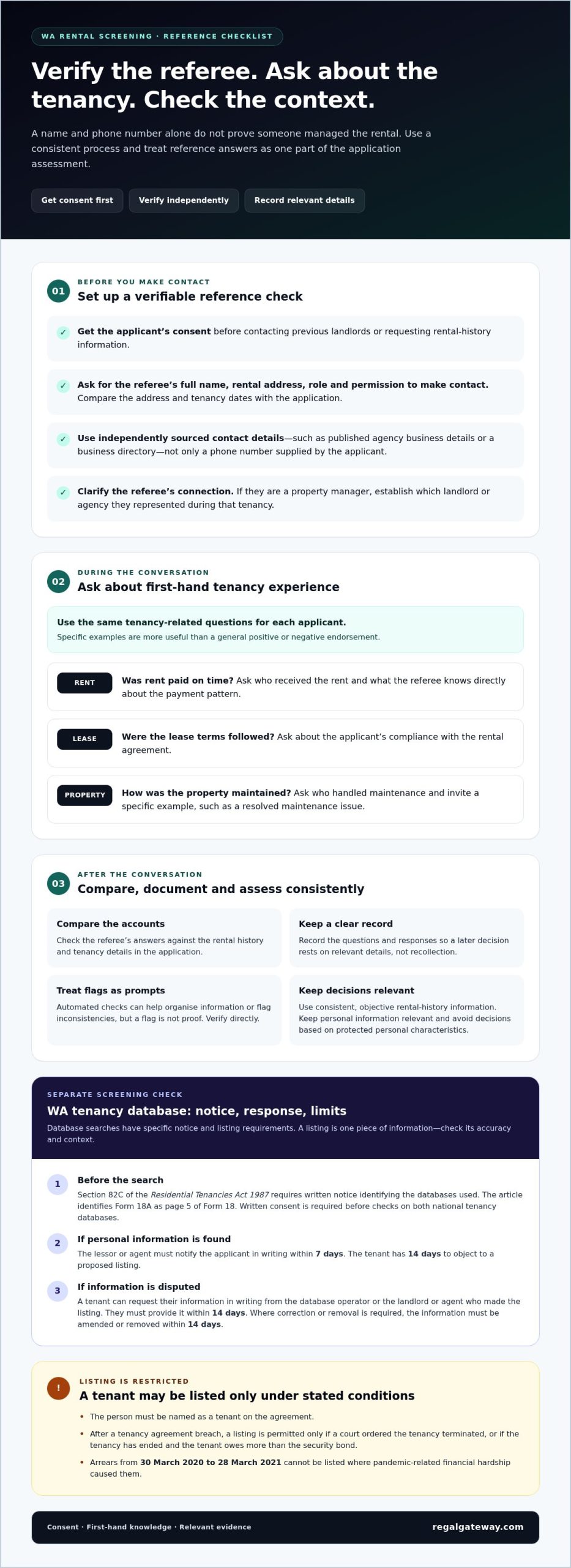
Ask the applicant for the referee’s full name, rental address, role and permission to make contact. Compare these details with the tenancy dates and address in the application. A landlord’s name alone doesn’t prove they owned or managed the property. Use independently sourced contact details, such as an agency’s published business details, rather than relying only on a number supplied by the applicant. A tenant reference check in WA is more reliable when the referee’s connection is clear.
Get the applicant’s consent before requesting rental history or contacting previous landlords, employers or other referees. Automated rental, employment and personal reference checks can help organise information or flag inconsistencies, but a flag isn’t proof. Verify the referee directly and ask for specific examples, such as who received rent or handled maintenance. Keep personal information relevant to assessing the application.
For a national tenancy database search, provide written notice about the databases used before searching. Section 82C of the Residential Tenancies Act 1987 requires this notice; Form 18A is identified as page 5 of Form 18. Written consent is required before checks on both national tenancy databases. If a search finds the applicant’s personal information, notify them in writing within 7 days. They have 14 days to object to a proposed listing.
A tenant may be listed after breaching a tenancy agreement only if a court ordered the tenancy terminated or, after the tenancy ends, the tenant owes more than the security bond. Arrears from 30 March 2020 to 28 March 2021 cannot be listed where pandemic-related financial hardship caused them. A person must be named as a tenant on the agreement to be listed.
Can a landlord reject a rental application based on a reference check in Western Australia? Yes. A landlord can consistently weigh relevant, objective rental-history information, but must avoid decisions based on protected personal characteristics. What references and documents should tenants provide when applying for a rental in WA? Provide accurate rental history, previous-landlord contact details, referee consent, and requested identity and income documents, such as proof of employment. A thorough tenant reference check in WA compares those documents with first-hand responses from referees.
Landlord checks of tenancy databases and previous landlords
In Western Australia, landlords and agents may check a prospective tenant’s name against a tenancy database and contact previous landlords. Before a search, section 82C of the Residential Tenancies Act 1987 requires written notice identifying the databases used. A tenant should know which database is involved, rather than discovering a listing after an application decision.
If a search finds the applicant’s personal information, the lessor or agent must notify them in writing within 7 days. A tenant then has 14 days to object after receiving notice of a proposed listing. The information must identify the reason accurately, completely and unambiguously. These requirements make disclosure part of the screening process, not an optional courtesy.
Listing is restricted. A tenant may be listed after breaching a tenancy agreement only if a court ordered the tenancy terminated or, after the tenancy ends, the tenant owes more than the security bond. The person must also be named as a tenant on the agreement. Arrears from 30 March 2020 to 28 March 2021 cannot be listed where pandemic-related financial hardship caused them.
Can WA landlords check a tenant’s rental payment history or tenancy database listing? Yes. With the required notice and consent for relevant checks, landlords may review rental history, contact previous landlords and search a tenancy database. A database entry is only one piece of information, so verify its accuracy and context before weighing it.
Tenants can request their personal information in writing from the database operator, or the landlord or agent who made the listing. That party must provide the information within 14 days. If details are wrong or outdated, request correction or removal; the information must be amended or removed within 14 days when required. Keep the request and response together to clarify any dispute.
Use these checks alongside consistent screening criteria, not as a substitute for examining the application. A structured applicant review process can help keep each decision focused on relevant rental information.
Contacting previous landlords and referees
For a fair reference check, get the applicant’s consent, verify each referee’s role, and ask consistent, tenancy-related questions. WA landlords should assess relevant answers alongside the application and use the same objective criteria for every applicant.
Contacting Previous Landlords
A previous landlord’s reference is a first-hand account of how the applicant handled a rental agreement. Ask whether rent was paid on time, lease terms were followed and the property was maintained. Confirm the address and tenancy dates with the referee, then compare their answers with the applicant’s rental history. Specific examples, such as a resolved maintenance issue, are more informative than a general positive or negative opinion.
Before making contact, get the applicant’s consent to request rental-history information. Verify the referee’s connection to the address using independently sourced agency contact details or a business directory. If the referee is a property manager, establish which landlord or agency they represented during that tenancy. Record your questions and their responses so a later decision rests on relevant details, not recollection.
Contacting Other Referees
Other referees, such as an employer, can clarify information relevant to an application, including employment details. Confirm the referee’s position and ask only questions connected to the information provided. Don’t treat a personal referee’s opinion of someone’s character as proof of rental conduct: they may not have observed the applicant living in a property.
What steps should WA landlords follow to conduct fair and lawful tenant reference checks? Get consent before seeking references, explain database searches through the required notice, verify referee identities and ask consistent questions about tenancy conduct. Collect only necessary personal information, store it securely and avoid criteria based on protected personal characteristics. This disciplined approach helps landlords compare rental history, income and agreement compliance without allowing an unrelated opinion to determine the outcome.
What information can WA landlords and property managers request from rental applicants?
WA landlords and property managers can collect information to assess an applicant’s suitability for a specific rental. Relevant information may include rental history, income, employment and credit history. Each request should have a clear screening purpose, rather than gathering personal details simply because they’re available.
Get the applicant’s consent before requesting rental-history or financial information. Explain what you need and how it relates to the application. For example, income evidence can help assess whether rent is affordable, while a previous landlord’s account may clarify payment patterns or property care. A bank statement may show income and regular commitments, but unrelated transactions can expose personal information that isn’t needed for screening.
Apply the same objective criteria to every applicant. Rental history, income and credit information can inform an assessment, but a higher rent-to-income ratio shouldn’t automatically determine the outcome. Consider the complete application and avoid criteria based on protected personal characteristics. This keeps the decision focused on tenancy-related factors, not assumptions about an applicant’s background or circumstances.
Criminal background checks should be relevant to the tenancy and conducted with the applicant’s permission. Any request for this information should have a clear connection to assessing the rental application. Collect only necessary personal information, limit access to people handling the application and store records securely. These practices help reduce unnecessary exposure of sensitive details while preserving information needed to explain a decision.
Applicants can make their applications easier to assess by providing consistent rental-history details, referee contacts, employment information and relevant income evidence. If a document includes unrelated personal transactions, they can ask whether a version showing only relevant information will meet the request. Explaining the purpose of each requested item helps both parties keep screening clear and proportionate.
For landlords seeking a more structured approach to reviewing rental applications, explore tenant screening support as part of a consistent property management process.
Regal Gateway Property: Residential Property Sales
Regal Gateway Property supports owners with tenant screening, ongoing property oversight and residential sales. If you’re preparing to lease a home, Tenant Selection and Screening and Property Management connect applicant assessment with the wider responsibilities of managing a property.
A structured reference check helps you weigh rental history, referee responses and application details consistently. If you’re considering a change in direction, Residential Property Sales can support the move from holding a property to bringing it to market. The right next step depends on your goals: leasing and management, tenant selection or sale.
Contact Regal Gateway Property to discuss the support that fits your residential property plans.
Make your next property decision with confidence
A tenant reference check in WA is one part of a wider decision about how you want to hold, manage or transition a residential property. Align your tenant-assessment approach with your priorities as an owner, whether you’re preparing a home for rent or considering a future sale.
Regal Gateway Property provides Tenant Selection and Screening, Property Management and Residential Property Sales. These services support different stages of a property’s lifecycle, from assessing rental applicants to overseeing a property or planning a sale. Choosing the right support can help you move forward with a clearer view of the decisions ahead.
For a conversation about your property plans, contact Regal Gateway Property. A considered next step can bring greater clarity to the path ahead.
Frequently Asked Questions
Can a private landlord access TICA or NTD?
A private landlord may check a prospective tenant’s name against a tenancy database in Western Australia, subject to applicable notice and consent requirements. Whether a landlord can access TICA or the National Tenancy Database directly depends on the database’s access arrangements. Before searching, give written notice identifying the databases to be used. Keep the notice and consent records with the application.
How long should screening take?
Screening time depends on how quickly the applicant provides information, referees respond and discrepancies are clarified. An application with complete rental history and reachable referees may be assessed sooner than one with missing dates or conflicting details. Explain which checks are outstanding, then assess applicants against the same criteria rather than rushing one application ahead of others.
What is a tenant reference check in Western Australia?
A tenant reference check in Western Australia assesses information relevant to an applicant’s proposed tenancy. It can bring together rental history, previous-landlord feedback, employment or income details, and tenancy-database information. The purpose is to help a lessor assess the application against consistent, tenancy-related criteria. It’s not simply a personal endorsement, and a database result alone doesn’t describe the full application.
What are the privacy and consent rules for tenant reference checks in WA?
Landlords should get the applicant’s consent before requesting rental-history information, contacting referees or conducting financial checks. Collect only personal information necessary for screening, keep it secure and use objective criteria. Before a database search, written notice must identify the databases to be used. These safeguards help applicants understand what information is being considered and how it relates to the rental decision.
How do landlords verify a tenant’s rental history and previous landlord references in WA?
Compare the applicant’s rental addresses and tenancy dates with the referee’s account, and resolve any differences before relying on them. Independently sourced contact details can help establish whether a referee is connected to the property or agency they name. Ask focused questions about rent payment, agreement compliance and property care. The same approach applies to applications in Atwell, Aubin Grove, Wandi, Hammond Park, Success, Treeby and Mandogalup.
What tenancy databases are used in Western Australia, and what are the rules for listing tenants?
The National Tenancy Database is one database used for rental screening; the landlord or agent must give notice naming the databases they use. A tenant can be listed after a breach only if a court ordered termination or, after the tenancy ends, the tenant owes more than the security bond. The person must be named on the tenancy agreement, and listing information must accurately explain its reason.