A property management service level agreement sets out the services, responsibilities and performance expectations agreed between a property owner and manager. A residential management agreement also explains each party’s obligations and how payment is structured. Service-level terms make standards more specific, covering matters such as maintenance requests, rent collection and owner reporting.
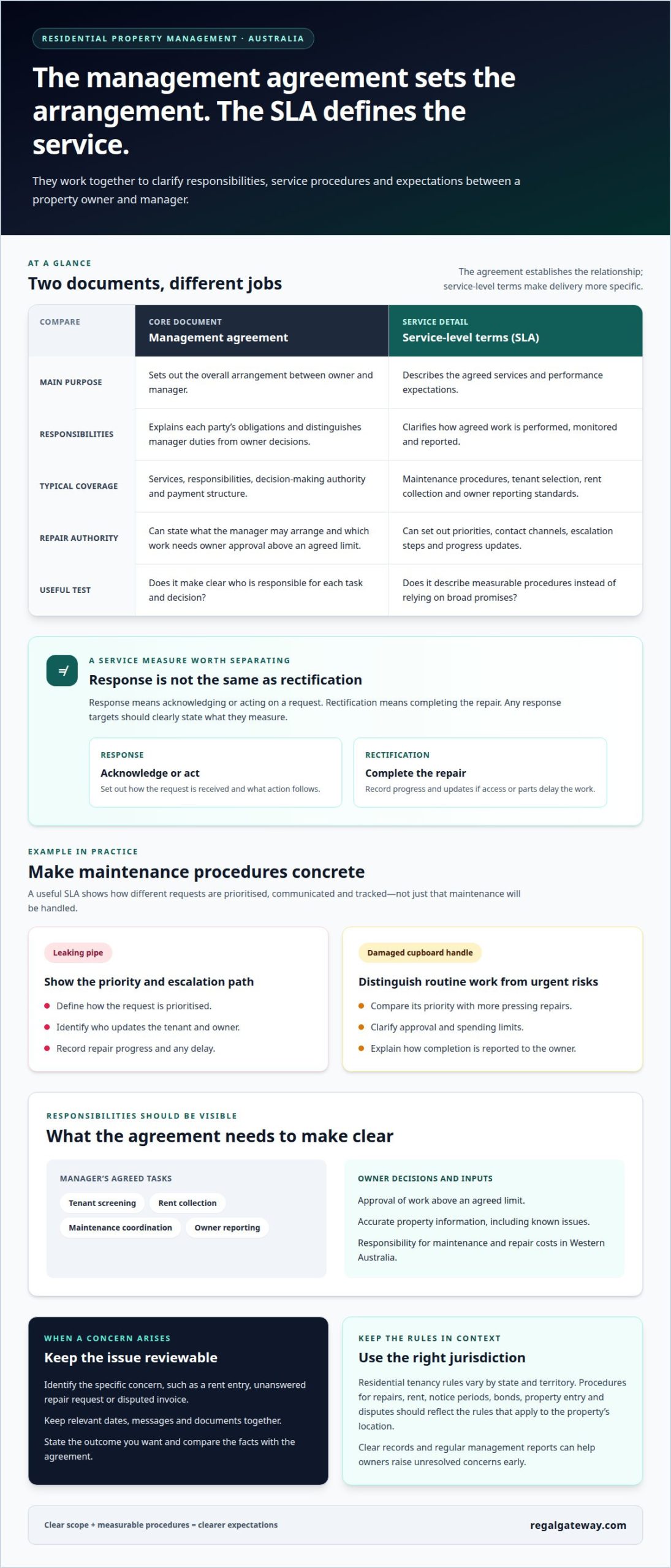
It’s reasonable to want one document to make responsibilities clear. The management agreement sets out the overall arrangement, while service-level terms clarify how the manager delivers and reports on the work. Together, they can help prevent misunderstandings about who handles each task.
This guide explains how these documents work together for residential property management in Australia. It covers service scope, repair authority, payment arrangements, complaints and disputes, with practical points for owners in Atwell, Aubin Grove, Wandi, Hammond Park, Success, Treeby and Mandogalup.
Key Takeaways
- Distinguish the core service agreement from service-level terms that clarify how the work is performed and assessed.
- Define the manager’s responsibilities, repair authority and spending limit to make the scope of service clearer.
- Understand how fees and payment arrangements fit into the management relationship, including what the agreement should explain.
- Use management reports and clear communication to raise concerns and help resolve disputes in line with the rules that apply to the property.
What is the difference between the service agreement and the service level agreement for residential work?
In Australia, a property management service level agreement (SLA) describes the services and performance expectations agreed between a property owner and a property manager. The residential management agreement sets out each party’s obligations and payment structure. SLA terms add detail on service standards, such as maintenance procedures, tenant selection and owner reporting.
With a property manager, an owner delegates agreed tasks such as coordinating maintenance and collecting rent. A self-managing owner handles these directly, including responding to tenant requests and arranging repairs. The choice depends on how much time and responsibility the owner wants to take on.
Before a tenancy begins, the agreement can describe tenant selection and screening. During the tenancy, it can set out procedures for rent collection, maintenance requests and owner reporting. Make sure it separates the manager’s day-to-day duties from decisions the owner retains, such as approving work above an agreed limit.
A useful SLA describes measurable procedures rather than relying on broad promises. For example, it can set out how a leaking pipe is prioritised compared with a damaged cupboard handle, who updates the tenant and owner, and how repair progress is recorded. Any response targets should be clear about what they measure.
Response and rectification are different measures: response refers to acknowledging or acting on a request, while rectification refers to completing the repair. The agreement can define priority levels, contact channels, escalation steps and how updates are provided if contractor access or parts delay the work. In Western Australia, property owners remain responsible for maintenance and repair costs.
Owners also have responsibilities. Provide accurate information about the property, including known issues that could affect its management. Disclosing a recurring leak, for example, gives the manager useful context when a tenant reports water damage and helps the parties agree on an appropriate response.
Section 18 of the Australian Consumer Law concerns misleading or deceptive conduct and is relevant to property management service providers, according to the Federal Register of Legislation. Clear, measurable wording helps owners and managers understand what the agreed service covers.
Property management complaints and disputes
If a concern arises, identify the specific issue, such as a rent entry, an unanswered repair request or a disputed invoice. Record relevant dates, messages and documents, along with the outcome you want. The manager can then compare the facts with the agreement, explain what action was taken and identify anything still unresolved.
Australian residential tenancy rules vary by state and territory. They address matters such as repairs, rent, notice periods, bonds, property entry and disputes. For example, an entry concern needs to be considered under the rules that apply to the property’s location. Management procedures should reflect the relevant jurisdiction rather than assume one national process applies everywhere.
Safety concerns require clear escalation arrangements. A report of exposed wiring, for instance, calls for prompt documentation, communication with the relevant parties and coordination of suitable repair work. Contract provisions can explain how urgent risks are reported, who authorises action and how updates reach the owner. These steps help distinguish a safety issue from a routine maintenance complaint.
Good record-keeping supports a fair review. Keep the tenant’s original request, subsequent messages, contractor notes, approvals and completion details together. For a repair dispute, those records can show when the issue was reported, what arrangements followed and whether the work resolved it. The Australian Consumer Law also applies to property management service providers, including rules on misleading or deceptive conduct, unfair contract terms and statutory guarantees.
For an owner and manager, a tailored complaints process should set out how concerns are received, assessed, answered and escalated. Regular management reports can help owners identify unresolved matters and raise questions early. Clear provisions also separate disputes about service delivery from tenancy disagreements, which may be governed by different state or territory rules. Owners considering delegated management can explore management arrangements for rental properties as a natural next step.
Defining property manager services and scope
An Australian property management agreement should identify the services, responsibilities, reporting and decision-making authority it covers. For example, it can distinguish routine tasks from decisions that remain with the property owner.
Service Scope and Inclusions
The service scope defines which management tasks are included and which fall outside the arrangement. A clear boundary helps the owner and manager understand who is responsible for each part of the property’s ongoing management.
A structured scope can group services by activity: tenant placement, rent administration, maintenance coordination and owner reporting. For a repair, it should show whether the manager arranges the work, the approval process, and the spending limit. It can also describe how progress and completion are reported, so the owner can follow the task from request to close.
Agreement Services and Responsibilities
The agreement should assign each management task to the manager or property owner. Clear responsibilities make the arrangement easier to understand and help prevent confusion about what the manager is authorised to do.
For example, the agreement can describe tenant screening, rent collection and maintenance coordination, as well as the owner’s responsibility to provide accurate property information and cover repair costs. State when the manager can act and when owner approval is needed. This is especially important if a contractor identifies work beyond the agreed repair authority.
Reporting provisions show how the agreed scope works in practice. A regular report might summarise rent activity, open maintenance requests and completed work. Specify the report format, information included and process for raising questions about an entry, so owners have a clear view of the manager’s work.
The agreement can also explain how procedures are tracked and reviewed. If tenant requests are logged, identify the records used to follow their status and completion. Record any changes to the services in writing, so both parties have a current reference as the property’s needs evolve.
Fees, costs and handling payments
Clear payment terms explain what the owner pays for management and related property costs. Set out the charges, when payment is due and how transactions are recorded before management begins.
Fees and Costs
The agreement should distinguish management charges from property expenses, such as repairs. Clear descriptions help owners understand their payment obligations and see which costs relate to the agreed management services.
The agreement can identify which services a fee covers, how it is calculated, and when it applies. For example, it can distinguish routine management from a separately authorised repair. It should also explain how third-party costs are documented, approved and reported, so the owner can see what each charge relates to.
Payment Arrangements and Terms
Payment procedures explain how and when management charges and property expenses are handled. Clear terms give both parties a shared reference and support accurate records.
The agreement can state when charges are due, how deductions are recorded and how the owner receives statements. If rent receipts are used to meet agreed charges, explain the sequence and show each transaction in the reporting. This helps owners reconcile rental income, management charges and authorised expenses.
Repairs need clear financial terms. The agreement should distinguish the manager’s authority to coordinate or approve work from decisions requiring the owner’s approval. Record approvals, invoices and completion details for each repair. The owner remains responsible for repair costs, including where urgent work is required.
Review payment terms alongside the scope of services. If an arrangement changes, update the written terms so fees, obligations and included work remain aligned. This gives the management relationship a sound financial foundation and helps prevent misunderstandings about charges. To discuss property management arrangements for your rental, contact Regal Gateway Property.
Regal Gateway Property: Residential Property Sales
Regal Gateway Property provides residential property management for owners in Atwell, Aubin Grove, Wandi, Hammond Park, Success, Treeby and Mandogalup. Its services also include Tenant Selection and Screening and Residential Property Sales.
For owners who want support with day-to-day rental management, Regal Gateway Property’s Property Management service covers ongoing administration, rent collection, maintenance coordination and regular inspections. Tenant Selection and Screening supports the process of placing a tenant, while Residential Property Sales is relevant when you are ready to sell a home or investment property.
Contact Regal Gateway Property to discuss the residential property service that aligns with your plans.
Shape the next chapter for your property
A clear property management service level agreement gives an owner and manager a shared framework for working together. Its value depends on how accurately the written terms reflect the property’s needs, the owner’s responsibilities and the level of involvement they want.
As your plans change, review whether the written arrangement still reflects the work you expect, the decisions you want to retain and how you prefer to receive updates. Discussing these priorities with Regal Gateway Property can help you decide whether ongoing management or a sale best suits your next step.
Regal Gateway Property works across residential property decisions, including management, tenant selection and screening, and sales. If you’re ready to discuss your property’s direction, contact Regal Gateway Property. A clear next step can help you approach your investment with confidence and care.
Frequently Asked Questions
Does a tenant benefit from an SLA without being a party to it?
Tenants can benefit from clear service procedures, even when the landlord and manager agree on the SLA. For example, the procedures can explain how to submit a maintenance request, receive updates and arrange access for repairs. The tenant’s rights and responsibilities remain governed by the tenancy agreement and the residential tenancy rules that apply to the property.
What Should Your Agreement Cover?
Cover the manager’s authority, decisions retained by the owner, communication channels, reporting, exclusions and how changes are recorded. Specify what the manager can arrange on the owner’s behalf and when approval is required. Explain how the parties will review or vary the arrangement so changes to the property or management responsibilities are documented.
What happens if a manager breaches the SLA?
Follow the breach and escalation process in the agreement. First, identify the unmet term, record relevant dates and communications, and raise the concern through the stated channel. The manager can explain the action taken and any proposed remedy. The consequences of a breach depend on the agreement and applicable law, so do not assume every missed service target has the same outcome.
What response times are typical in SLAs?
There is no single response-time target that suits every maintenance request or property. An SLA can distinguish emergency, urgent and routine reports, with separate acknowledgement and repair targets for each. A safety issue, for example, needs different handling from a minor cosmetic problem. Working hours, access and the nature of the repair also affect practical timeframes.
What response times and service standards should a property manager agree to?
Agree on standards that can be measured and reported, rather than broad promises. Set priorities for maintenance, define when the manager acknowledges a request, and describe how progress and delays are communicated. Include an escalation contact for unresolved issues, a reporting schedule, and a method for recording outcomes. These elements let owners assess service consistently across different requests and properties.
What Australian state and territory laws govern property management agreements?
Residential tenancy and property-agent rules depend on the state or territory where the property is located. They can cover repairs, rent, notices, bond handling, entry and disputes, so procedures should reflect the property’s jurisdiction. The Australian Consumer Law also applies to property management service providers. If you own properties in different jurisdictions, the relevant local requirements need to be reflected in each management arrangement.