In WA, landlords have 24 hours to organise repairs to essential services in a rental home. For other urgent repairs, they have 48 hours to organise a suitable repairer. These emergency repairs to a rental property in WA cover more than a loss of electricity, gas or water: a problem that could damage the premises, injure someone or cause undue hardship may also qualify.
When damage occurs, it can be hard to tell whether it needs emergency repairs, who must arrange the work and what to do if a rental home is affected by a disaster. The right response depends on the problem and the risk it creates.
This article explains what counts as an urgent repair under WA tenancy rules, how landlord and tenant responsibilities differ, and what deadlines apply. It also explores how disaster damage can affect a rental home and the next steps for landlords seeking to manage their property responsibly.
Key Takeaways
- Learn how to distinguish essential-service failures from other urgent problems that could cause harm, damage or undue hardship.
- Understand when tenants may arrange urgent repairs, what records they need to provide and when landlords are responsible for reasonable expenses.
- See why meeting repair obligations matters for landlord insurance, and how responsibility can depend on the cause of the damage.
- Find out how disaster damage can affect a rental property and what practical steps support a timely, considered response.
So, what is an ‘urgent repair’?
In Western Australia, an urgent repair is one classified as urgent under the Residential Tenancies Act. That classification determines how quickly the landlord must arrange action and whether the problem needs immediate attention.
Western Australian Urgent Repairs
Urgent repairs are problems that fall within the categories set by Western Australian tenancy law. For essential services, landlords have 24 hours to organise repairs. These services include electricity, gas and water, including hot water. A loss or failure affecting one of these services can disrupt basic use of the rental home, so tenants should report it promptly and clearly.
Other Urgent Repairs
Other urgent repairs are problems that could damage the premises, injure someone, or cause tenants undue hardship or inconvenience if left unresolved. The key consideration is the likely consequence of delay, not simply the inconvenience of a fault. For example, a leak that could cause further water damage may need urgent attention, as does a defect that creates a safety risk. In cases of active water penetration through damaged tiles or metal sheeting, prompt leak detection from services like hoptoitroofrepairs.com.au can stop structural damage from escalating.
Urgent and Non-Urgent Repairs
Non-urgent repairs are issues that don’t meet the legal tests for urgent action. A tenant must request these repairs in writing, such as by email or letter, so the landlord receives a clear description. A loose cupboard handle may be inconvenient without creating immediate danger or likely damage. By contrast, a fault that risks injury or harm to the property may be urgent.
Examples of Urgent Repairs
Examples of urgent repairs include essential-service failures and faults that threaten safety or the property. The Residential Tenancies Regulations 1989 list burst water services, gas leaks, broken hot water systems, sewerage leaks and dangerous electrical faults. Each example points to a practical risk, such as flooding, exposure to gas, loss of hot water, sewage escaping, or electrical danger. Describe the fault and its effects when reporting it.
Repair obligations and landlord insurance cover
In WA, responsibility for a repair depends on the fault, its cause and the action required. If the landlord does not act, the tenant’s next steps should reflect the health or safety risk.
Landlord and Agent Repair Obligations
Landlords and their agents must meet applicable repair obligations and arrange urgent repairs within the relevant deadlines. If the landlord does not respond, the tenant should follow up, allowing a reasonable response time in light of the risk. If there is still no action, the tenant may arrange an urgent repair through a qualified repairer. Non-urgent repairs must be completed within a reasonable time.
Responsibility also depends on the cause. Landlords are responsible for normal wear and tear, while tenants generally pay for damage caused by them, their guests or their pets, excluding fair wear and tear. A landlord is not required to fix an issue recorded as not working in the rental agreement.
Tenant Costs and Reimbursement
For urgent repairs, landlords must reimburse tenants for reasonable expenses if the tenant arranges repairs after the landlord fails to respond appropriately. The applicable limit is that costs must be reasonable. The tenant must use a qualified repairer and provide the repair details, costs, an invoice and an itemised receipt.
Keep copies of repair records and communications with the landlord or agent, including the initial report and any follow-up. A fault affecting an essential service may need faster action than a less immediate problem, so follow up in line with the health or safety risk.
Consequences of Failing to Complete Repairs
Failing to meet repair obligations can jeopardise a landlord’s insurance claim if compliance with applicable laws is a condition of cover. The landlord or agent should keep the tenant’s report, response records and repair documents to show how the issue was handled.
For tenants seeking reimbursement, clear evidence helps show what was repaired and what it cost. Keep the repairer’s invoice and itemised receipt with written contact records, then provide these details to the landlord.
WA repair response deadlines
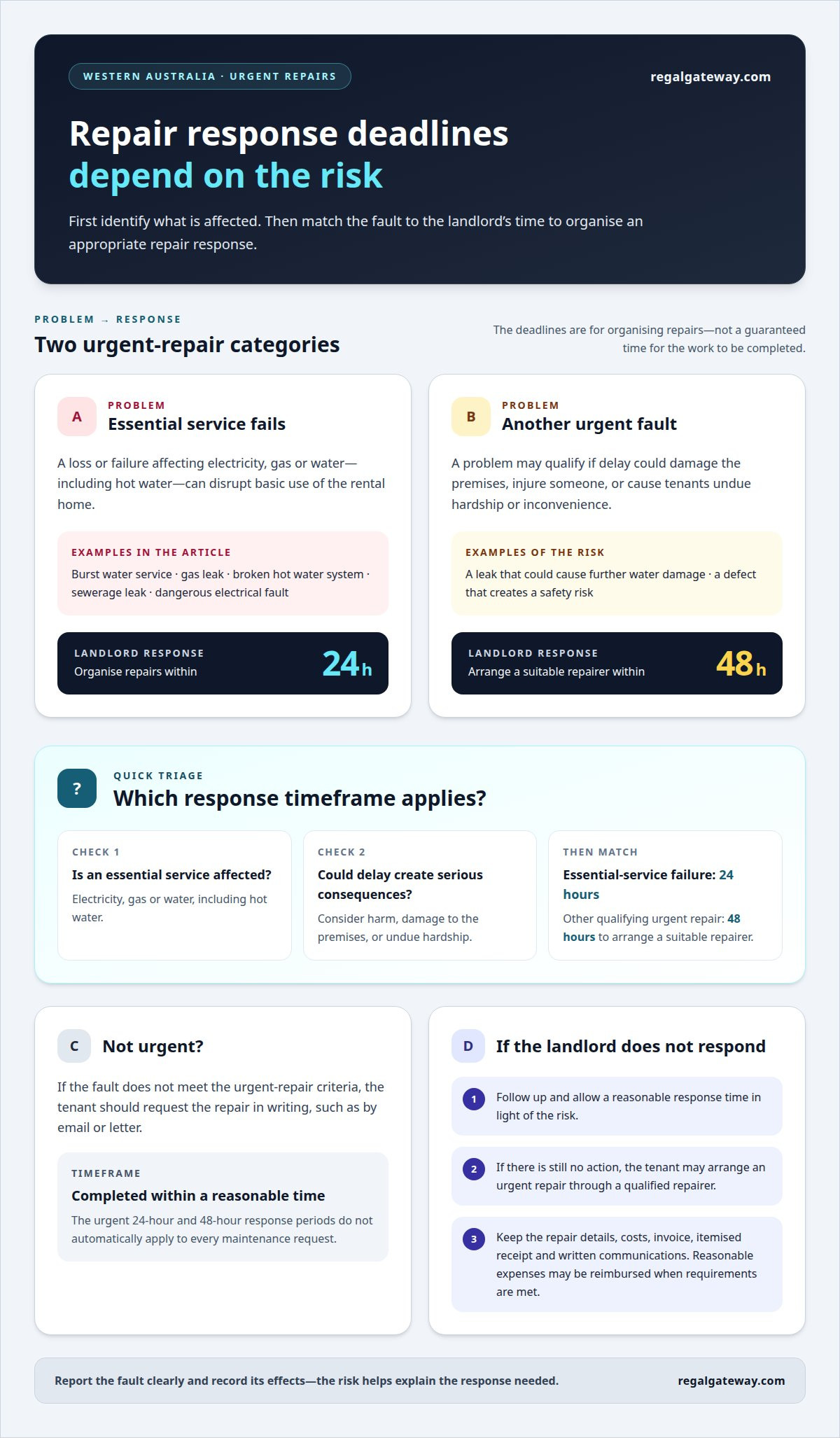
In WA, a repair response deadline is the period within which a landlord must organise action for an urgent fault. The applicable period is 24 hours for essential services, and 48 hours for non-essential urgent repairs arranged with a suitable repairer. These deadlines describe organising repairs, not a guaranteed completion time.
Classify the issue before arranging work. If the fault concerns an essential service, use the 24-hour response period; if another urgent issue qualifies, the 48-hour period applies. This distinction gives landlords and agents a practical triage step: identify the service affected, assess whether the issue is urgent, then arrange the appropriate repair response. Recording that assessment can help clarify why a particular deadline applied.
The 48-hour period applies to non-essential urgent repairs organised with a suitable repairer. For example, a fault that threatens damage to the premises but does not affect an essential service may fall into this category if it meets the urgent-repair criteria. The landlord’s task is to arrange a suitable repairer within the applicable timeframe, rather than treating the deadline as a fixed completion time.
Non-urgent repairs follow a different timeframe: they must be completed within a reasonable time. That means the 24-hour and 48-hour urgent response periods don’t automatically apply to every maintenance request. For a non-urgent issue, the tenant should make the request in writing, such as by email or letter, so the repair need is clearly recorded.
If a landlord or agent fails to initiate repairs or maintenance within a reasonable timeframe, tenants can contact Consumer Protection by emailing consumer@demirs.wa.gov.au or calling 1300 30 40 54. A useful sequence is to report the fault, retain the written request and follow-up, then explain the delay when contacting Consumer Protection. Include whether the issue affects an essential service, falls under the 48-hour urgent category, or is non-urgent. That detail helps distinguish the relevant response timeframe.
Disaster damage to rental properties
Disaster damage is harm to a rental home caused by an event such as a storm, fire or flood. In WA, landlords should assess immediate safety risks, arrange necessary repairs and respond to reports of damage. If a ceiling collapses, the tenant must tell the landlord or agent straight away, and the landlord must organise repairs as soon as possible.
Start by addressing immediate danger. Tenants should call 000 for fire, ambulance or police emergencies. For storm-related hazards, the State Emergency Services can be reached on 13 25 00; for electricity emergencies, Western Power can be called on 13 13 51. These contacts address urgent safety needs, while the landlord or agent must also be told about damage affecting the rental home.
A rental home is uninhabitable when staying there puts a tenant’s health or safety at risk. Only the local government authority can declare a home uninhabitable. If the tenant chooses to leave, they must give the landlord two days’ written notice; if the landlord requires the tenant to leave, seven days’ written notice using Form 1C is required. The inconvenience of temporary disruption doesn’t, by itself, establish that legal status.
For a disaster-related leak, electrical fault or damaged ceiling, report exactly what has happened and how it affects the home. This helps the landlord assess whether there is a safety risk, a threat of further damage or an effect on an essential service, then arrange an appropriate response. Keep a record of the report and repair communications, especially if the damage affects the home’s safety or habitability.
For water-related damage, tenants can call Water Corporation on 13 13 85. Clear communication helps separate immediate public-service or safety needs from repairs the landlord must arrange at the property. For considered support managing a rental property through damage and repair issues, discuss your property management needs.
Regal Gateway Property
Regal Gateway Property manages residential rental properties for owners across Atwell, Aubin Grove, Wandi, Hammond Park, Success, Treeby and Mandogalup. The team coordinates maintenance, including emergency and non-urgent repairs, and issues work orders to approved tradespeople. Owners remain responsible for repair costs, and the team will always try to contact the owner before proceeding with emergency repairs. If repair issues have prompted you to reconsider how your property is managed, contact Regal Gateway Property to discuss your needs. The agency also provides residential property sales and tenant selection and screening for owners considering their next steps.
Set a considered course for your property
Managing emergency repairs in a WA rental property is part of a wider decision about how you want to protect and plan for your asset. A clear approach to communication, maintenance and tenancy decisions can help you respond with greater confidence when circumstances change. It can also prompt a broader conversation about whether your current property strategy still fits your priorities.
Regal Gateway Property offers Property Management, Residential Property Sales, and Tenant Selection and Screening, supporting owners at different stages of their property journey. Whether you’re considering ongoing management, a sale or your next tenancy, the right next step depends on what you want your property to achieve. For tailored support, contact Regal Gateway Property and take a considered step towards your next property decision.
Frequently Asked Questions
What Are Emergency Repairs in a Rental Property?
Emergency repairs are urgent faults requiring prompt action because they affect essential services or risk harm, property damage or undue hardship. A gas leak, for example, can pose a safety risk, while a burst water service can damage the premises. Classification depends on the problem and the likely consequences of leaving it unresolved, not simply on how inconvenient it is.
Who Do You Call?
Contact your landlord or property manager first to report the fault and explain any immediate safety risk. For fire, ambulance or police emergencies, call 000. Tenants whose property is managed by Regal Gateway Property can report repair emergencies by calling 08-9414-3788; don’t email, as emails are checked on the next business day. Give the property address, describe the fault and explain whether anyone is at risk.
What counts as an emergency repair in a WA rental property?
A repair may be urgent if it concerns an essential service or could cause injury, damage to the premises, or undue hardship or inconvenience. Examples include a leaking sewerage pipe, a dangerous electrical fault or a broken hot water system. An inconvenient maintenance issue without a comparable risk may be non-urgent. Report what has failed and any resulting danger or damage to help clarify the situation.
What are a landlord’s emergency repair obligations in Western Australia?
A landlord must arrange urgent repairs within the applicable WA response period and meet their repair duties under tenancy law. When an agent manages the property, coordinating repairs is part of administering the tenancy. Failure to meet legal obligations may jeopardise an insurance claim. Keeping a clear record of the tenant’s report, the response and repair arrangements helps document how the issue was handled.
How quickly must a WA landlord arrange emergency repairs?
For an essential-service repair, the landlord has 24 hours to organise repairs; for a non-essential urgent repair, the period is 48 hours to organise a suitable repairer. These are organisation deadlines, not a guarantee that the work itself will be completed within those periods. Non-urgent repairs must be completed within a reasonable time, with the circumstances and nature of the fault shaping what is reasonable.
Can a WA tenant arrange emergency repairs without the landlord’s approval?
A tenant may arrange an urgent repair if the landlord does not respond after follow-up and a reasonable time suited to the health or safety risk. The tenant must use a qualified repairer, then give the landlord the repair details, costs, an invoice and an itemised receipt. Reasonable expenses must be reimbursed. For non-urgent work, the tenant needs the landlord’s written permission before arranging repairs.