
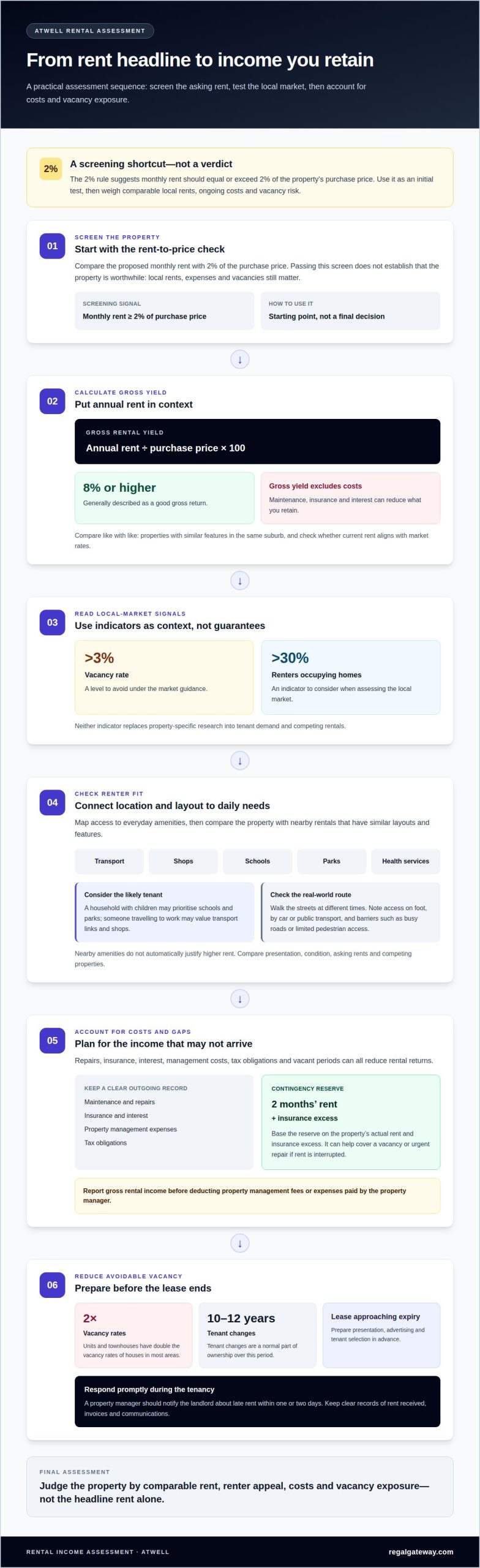
The 2% rule is a screening shortcut, not a verdict on an Atwell investment: it suggests monthly rent should equal or exceed 2% of the property’s purchase price. For optimizing rental income in Atwell, treat that figure as a starting point and weigh it against comparable local rents, ongoing costs and the possibility of vacancy.
Optimizing rental income Atwell landlords can achieve takes more than setting an advertised rent. A property’s location, appeal to likely tenants, and the costs of keeping it tenanted all affect the return you retain. Rent and bonds must also be managed in line with Western Australia’s rental rules.
This guide explains how to assess the 2% rule alongside rental yield, choose a location with practical renter appeal, and plan for bonds, rent, outgoings and vacancies. You’ll come away with a clearer way to judge whether a property’s income potential stands up beyond the headline figure.
Key Takeaways
- Assess rental returns alongside ongoing expenses and vacancy risk to understand the income you may retain.
- Compare a property’s access to everyday renter amenities with its likely appeal to suitable tenants.
- Track outgoings and plan for gaps between tenancies so unexpected costs are less disruptive.
- Judge property types and bedroom layouts against local renter demand rather than assuming one configuration will earn more.
1. What is a good rate of return on rental property?
There’s no single return that makes every Atwell rental property worthwhile. The 2% rule is a screening shortcut: monthly rent should equal or exceed 2% of the purchase price. Treat it as an initial test, not a substitute for examining local rents, expenses and vacancies.
Calculate gross rental yield by dividing annual rent by the property’s purchase price, then multiplying by 100. A return of 8% or higher is generally described as good, but gross yield excludes costs such as maintenance, insurance and interest. Compare like with like: use properties with similar features in the same suburb, and check whether current rent aligns with market rates.
Evaluate the local market before committing. Consider whether vacancy rates are above 3%, a level to avoid under the market guidance, and whether renters occupy more than 30% of homes. These indicators can inform your assessment, but neither replaces property-specific research into tenant demand and competing rentals.
For an Atwell property, map its access to public transport, shops, schools and healthcare. Compare that convenience with nearby rental listings and the property’s condition. A home close to daily amenities may appeal to different tenants than one offering extra space, so consider the likely renter before estimating income.
To reduce vacancy risk, contact tenants well before their lease expires and prepare marketing in advance. Set asking rent by comparing similar properties, rather than assuming a higher figure will improve your return. A longer vacancy can outweigh the extra rent sought. If a property is used privately or rented below market rate to family or friends, rental income and deductible expenses may be treated differently.
For Australian tax reporting, the Australian Taxation Office says co-owners report rental income and expenses according to legal ownership shares; owners with equal shares each report 50%. The Australian Taxation Office’s Taxation Ruling TR 2026/1 provides income tax guidance on rental property income and deductions for Australian individuals who aren’t in business.
Assess the income left after outgoings, not rent alone. For example, compare two Atwell properties with similar annual rent, then weigh their maintenance needs, interest costs and vacancy exposure. This fuller view makes rental yield a more useful measure of each property’s potential.
2. Choosing locations near renter amenities
In Atwell, assess a property’s location by considering the routines it supports. Map access to public transport, shops, schools, parks and health services, then consider how easily a tenant can reach them. Nearby amenities can make daily life more convenient, but their value depends on the renters the property is likely to attract.
Start with the likely tenant profile. A household with children may prioritise nearby schools and parks, while someone travelling to work may value transport links and everyday shops. These are practical comparisons, not assumptions about every renter. Consider how each property’s location matches the needs its layout and features are likely to serve.
Walk the surrounding streets at different times of day and note what is accessible on foot, by car or by public transport. Record useful destinations and barriers such as busy roads or limited pedestrian access. This helps distinguish an amenity that looks close on a map from one that fits renters’ daily routines.
Compare nearby rentals with similar layouts and features. Note which amenities they share, how their presentation differs and whether their asking rents reflect those differences. Don’t assume a nearby facility justifies higher rent without comparable listings to support it. A considered strategy accounts for location, condition and likely tenant demand.
Balance convenience against expenses and the property itself. A quieter street may suit renters seeking a calm environment, while a home close to shops may make errands easier. Neither feature guarantees stronger demand. Assess the whole setting, including access, upkeep and competing properties, before deciding whether the location supports your rental plan.
For a more structured assessment, organise observations into a simple comparison: transport, shopping, education, recreation and health services. This makes differences between Atwell properties easier to weigh without relying on a single feature. A considered Atwell rental strategy can connect location choices with the tenant profile and income goals you have in mind.
4. Managing outgoings and vacancies
In Atwell, repairs, insurance, interest, management costs, tax obligations and vacant periods can all reduce rental returns. Australian landlords must report gross rental income before deducting property management fees or expenses paid by their property manager. Assess income and costs separately.
Start by recording every outgoing, including maintenance, insurance and property management expenses. Track amounts and dates consistently, then review the records for recurring costs and maintenance needs. This gives landlords a clearer financial picture and helps distinguish routine spending from unexpected repairs.
Build a contingency fund equal to two months’ rent plus the insurance excess. It can provide a reserve for a vacancy or urgent repair if rent is interrupted. Base the reserve on the property’s actual rent and insurance excess, rather than an arbitrary amount.
Vacancies are a material risk: units and townhouses have double the vacancy rates of houses in most areas. Tenant changes are also a normal part of ownership over a 10–12 year period. Keep marketing preparations moving as a lease approaches expiry, so presentation, advertising and tenant selection can progress without avoidable delays.
During a tenancy, respond quickly to missed rent and maintenance concerns. A property manager should notify the landlord about late rent within one or two days, allowing the issue to be addressed promptly. Clear records of rent received, invoices and communications also support accurate financial tracking.
Review outgoings regularly instead of waiting until year-end. Compare recurring expenses across periods, identify repairs that could prevent further deterioration, and consider how each decision affects the property’s condition and future appeal. Lower immediate spending may not be an advantage if deferred maintenance leads to a bigger problem.
Tax treatment matters too. Record rental income and expenses accurately, and keep supporting documents for deductions claimed. Rent, costs and vacancy periods together determine the property’s net contribution, making disciplined record-keeping essential to sound rental management.
4. Which property types and bedroom counts earn the highest rental income in Atwell?
No property type or bedroom count automatically earns the highest rent in Atwell. Compare current local listings and recently advertised properties with similar layouts, condition and location. This shows what renters are being asked to pay for comparable homes, rather than relying on assumptions about larger houses or smaller dwellings.
Assess houses, units and townhouses separately. Their floor plans, outdoor areas, parking and upkeep differ, affecting tenant appeal and ongoing expenses. Compare properties within the same category first, then consider whether features such as a private courtyard or extra storage set one home apart from its closest alternatives.
Bedroom count is only one factor. A two-bedroom property may suit a smaller household, while a three-bedroom layout may provide space for a family or home office. A fourth bedroom can broaden how a home is used, but does not guarantee higher rent. Layout, presentation, location and renter demand also matter.
Use a consistent comparison process. Record each property’s type, bedroom count, condition, useful features and advertised rent. Separate genuine differences from marketing language. For example, compare two three-bedroom homes with similar access to amenities, noting whether one has better storage or an extra living area. Those details can help explain differences in asking rent.
Consider total rent and rental yield in relation to the property’s purchase price. A home with more bedrooms may command higher total rent, but a higher purchase price and additional upkeep can affect its overall return. Weigh expected rent against maintenance needs, likely tenant appeal and vacancy exposure before deciding which configuration suits your investment priorities.
For a clear Atwell assessment, shortlist comparable homes by property type and bedroom count, then refine the comparison using condition, layout and location. This evidence-led approach supports decisions about optimising rental income in Atwell without treating one configuration as a guaranteed leader. Explore Atwell residential property options as part of your investment review.
Regal Gateway Property
Regal Gateway Property can support Atwell owners with the practical work of buying and leasing a home. If you’re considering a purchase, our Residential Property Sales service can help with your next step. For an existing rental, Property Management and Tenant Selection and Screening support tenancy preparation and applicant selection.
Bring your priorities to the conversation, whether you’re considering a property type, assessing its likely rental appeal, or planning for costs and vacancies. This gives you a practical starting point to discuss how our services fit your residential property goals and the return factors covered above.
Contact Regal Gateway Property to discuss your Atwell rental property plans.
Shape your next property decision with confidence
Turn your investment priorities into a clear decision framework. Decide what matters most, whether dependable income, the property’s long-term appeal or a tenancy that suits your investment plans. This helps you assess opportunities consistently instead of being guided by one attractive feature.
Optimizing rental income in Atwell calls for an approach that adapts over time. Keep your criteria current as your circumstances and investment goals change, and use them to guide decisions about your next residential property. Regal Gateway Property supports Atwell and nearby communities, including Aubin Grove, Wandi, Hammond Park, Success, Treeby and Mandogalup, with residential property services to help you move from research to a considered next step.
Contact Regal Gateway Property today to discuss your Atwell property goals and take the next step with confidence.
Frequently Asked Questions
What is the 2% rule for rental income?
The 2% rule suggests that monthly rent should equal or exceed 2% of a property’s purchase price. To use it, multiply the purchase price by 0.02 to find the suggested monthly rent, then compare that figure with local asking rents. Treat the result as an initial screening measure, since it doesn’t account for expenses, vacancy periods or the property’s suitability for local renters.
What is a good rate of return on rental property?
A rental property return of 8% or higher is generally considered good, but the figure needs context. Ask whether you’re comparing gross yield, which excludes expenses, or a return that accounts for costs and vacant periods. A property with a strong headline yield may contribute less after outgoings, so compare investment options using the same calculation and assumptions.
What makes a successful landlord?
Successful property management combines sound financial organisation with responsive, consistent care. When a tenant reports a maintenance issue, record the details, arrange appropriate follow-up and communicate clearly about progress. Keeping tenancy documents, rent records and property decisions organised helps owners manage their responsibilities and respond thoughtfully as circumstances change.
What is the average weekly rent for houses in Atwell, WA?
Weekly house rent in Atwell depends on a home’s size, condition, layout and location relative to amenities. Estimate an appropriate asking rent by comparing houses with similar bedroom counts and features, then account for differences such as outdoor space or presentation. Asking rents provide a comparison point, while tenant interest helps show how the property is positioned in the local market.
What is the average weekly rent for units in Atwell, WA?
Weekly rent for an Atwell unit varies with its layout, condition, parking and access to amenities. Start with comparable units rather than houses, because property type and features affect renter appeal. Compare like with like, and consider whether the unit’s presentation or location distinguishes it from alternatives when setting the asking rent.
What rental yield can investors expect from property in Atwell?
Rental yield in Atwell depends on rent relative to the property’s purchase price, so no single figure applies to every home. Estimate gross yield by dividing annual rent by purchase price, then assess likely outgoings separately to understand the income remaining. Comparable properties can help frame the rent estimate, while condition and tenant demand also affect the result.