
A strong rental yield can still conceal a weekly cash shortfall. To assess an investment property, calculate gross rental yield by dividing annual rent by the property’s value and multiplying by 100, then estimate weekly cash flow by subtracting operating costs and loan repayments from rent received. A rental property cash flow calculator for Australia can bring these figures together, but the result depends on the assumptions entered.
It’s understandable to focus on the rent and purchase price first; they offer a clear starting point. Yet vacancy, maintenance, insurance, rates and finance costs also shape what may remain in your account each week. In Australian capital cities, houses typically have gross rental yields of 3% to 4%, but yield alone doesn’t show whether the property suits your finances.
This guide shows how to estimate rental yield, include key ownership costs and compare weekly cash flow under different assumptions. It also explains how to weigh a property’s income potential against the ongoing work of ownership, helping you make a more informed investment decision.
Key Takeaways
- Build a realistic rental income estimate by accounting for vacancy and ongoing property expenses, not just advertised rent.
- Compare interest-only and principal-and-interest repayments to understand how each loan structure affects cash available.
- Assess potential returns alongside vacancy, ownership costs and the assumptions behind future growth.
- Convert annual income and expenses into a weekly cash-flow view to see how the property may fit your investment plans.
How do you calculate rental yield?
Calculate gross yield as annual rent divided by purchase price, multiplied by 100. Pre-tax cash flow subtracts property expenses and loan repayments before tax; after-tax cash flow includes the tax effect of assessable rental income and eligible deductions.
Australian estimates separate operating performance from finance and tax outcomes. Use the steps below to assess each measure.
-
Estimate Rental Income and Property Expenses
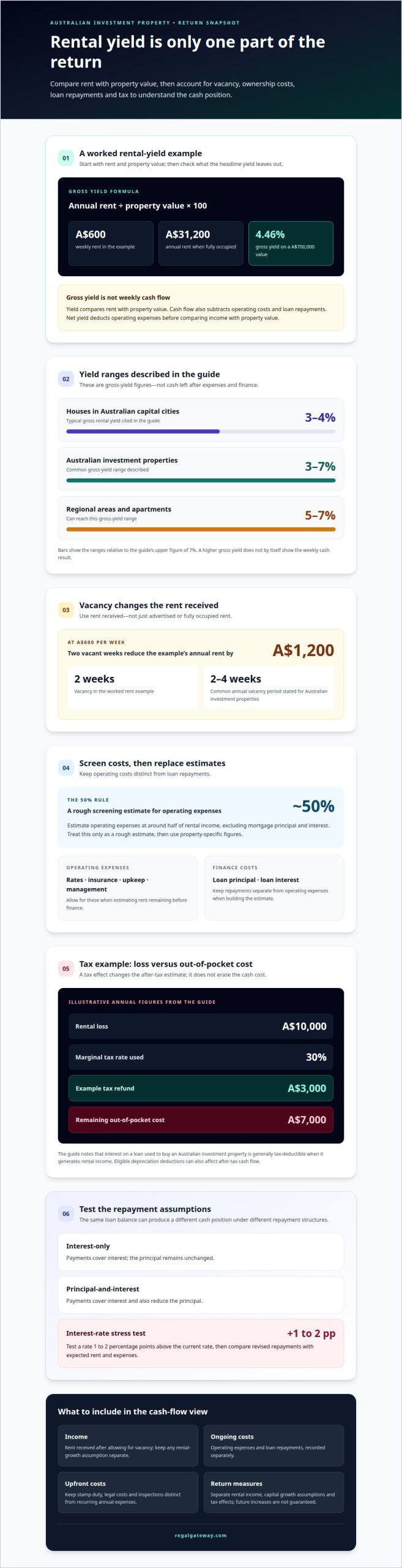
Set out expected rent across the annual period, then allow for vacancy and operating expenses. At A$600 per week, a fully occupied property earns A$31,200 annually; two vacant weeks reduce rent by A$1,200. Include rates, insurance, upkeep and management costs, and keep loan principal and interest separate from operating expenses.
The 50% Rule estimates operating expenses at around half of rental income, excluding mortgage principal and interest. Treat this as a rough screening estimate, then replace it with property-specific figures.
-
Set Rental Income and Growth Assumptions
Enter the expected rent and specify any rental growth assumption separately. Avoid treating future increases as guaranteed income: changes in rent, vacancy and maintenance can shift results over the estimate period. A 10-year average annual capital growth figure represents the average percentage change in median price over the prior 10 years, not rental growth.
For the A$600 weekly rent example, dividing A$31,200 annual rent by a A$700,000 property value gives a 4.46% gross yield. Net yield deducts operating expenses before comparing income with property value.
- Calculate operating return and gearing. Net operating income is rental income minus operating expenses, before loan costs. The capitalisation rate is net operating income divided by property value. Dividing net operating income by that rate gives an estimated investment value. Positive or negative gearing describes whether rental income exceeds or falls short of expenses, including interest.
- Estimate tax and deductions. Interest on a loan used to buy an Australian investment property is generally tax-deductible when it generates rental income. A calculator can estimate the applicable ATO marginal tax rate from yearly income or salary. For example, a A$10,000 annual rental loss at a 30% marginal tax rate means a A$3,000 tax refund and A$7,000 remaining out-of-pocket cost. Eligible depreciation deductions can also affect after-tax cash flow.
What Makes A Property Worth Investing In?
Assess an investment property alongside its financing, repayment obligations and tax position. Compare how each affects your available cash instead of judging the opportunity by rental yield alone.
-
Model Interest Rate and Repayment Changes
Compare interest-only with principal-and-interest repayments over the loan term. Interest-only payments cover interest, so the principal remains unchanged; principal-and-interest payments also reduce the principal. This affects both regular cash commitments and debt reduction.
Enter the loan amount, interest rate and repayment type separately. Compare the resulting payments with expected rental income and property expenses. Loans with the same balance can still produce different cash positions if their repayment structures differ.
-
Account for Loan Interest Tax Effects
Record investment loan interest as a separate expense before estimating any tax effect. Interest on a loan used to purchase an Australian investment property is generally tax-deductible when the property generates rental income. A deduction may affect your after-tax position, but it does not remove the repayment from the cash needed to hold the property.
Keep cash payments separate from tax estimates. This distinguishes an ongoing funding requirement from a later tax outcome and prevents a potential deduction from being treated as rent or immediate income.
-
Stress Test Interest Rates
Test the investment using an interest rate 1 to 2 percentage points above the current rate. Compare the revised repayments with expected rent and expenses, then assess whether the cash position remains manageable. Higher interest costs can weaken cash flow even if rent and rental yield remain unchanged.
Test the actual loan balance and repayment type for the property you’re assessing. Consider how reduced rent or higher operating expenses could compound the effect. This gives a more useful view of financing exposure than relying on one interest-rate assumption.
Estimated residential investment property returns in Australia
Estimate returns using rental income, ownership costs, tax effects and possible capital growth. A single yield figure cannot show the full first-year cash position or the assumptions behind future value.
-
Estimate First-Year Rental Cash Flow
Calculate the first year using rent received, vacancy, operating expenses, loan payments and upfront purchase costs. Australian investment property vacancy commonly lasts 2 to 4 weeks per year, so include a vacancy allowance rather than assuming continuous rent. Keep stamp duty, legal costs and inspections separate from recurring annual expenses to distinguish upfront cash required from ongoing cash flow.
- Compare estimated returns. Australian investment properties commonly show gross rental yields of 3% to 7%; regional areas and apartments can reach 5% to 7%. These figures describe rent relative to property value, not the amount left after insurance, maintenance, vacancy and finance. Rental income and capital growth are separate potential sources of return, while neither should be treated as guaranteed cash available.
-
Estimate Depreciation and End Tax Outcomes
Include potential depreciation deductions when estimating the end-of-year tax position, but keep deductions distinct from cash received. New Australian investment properties can generate A$8,000 to A$15,000 per year in depreciation claims. Eligible residential building construction can be depreciated at 2.5% per year for 40 years from completion, where construction started after 15 September 1987.
- Review the assumptions behind the final figure. A calculator example uses average annual capital growth of 8% for a suburb, with its median property price expected to double in 10 years. Treat that as an assumption to test, not a first-year income source. Check how changing rent, vacancy, insurance, maintenance or growth assumptions shifts projected equity and the overall return.
Weekly rental property cash flow
Australian property calculators estimate cash flow using rent, expenses, finance and tax assumptions. Weekly cash flow is rental income received minus expenses and mortgage payments allocated to the same period.
-
Select a Calculator and Enter Its Inputs
Choose an Australian investment property calculator and enter the purchase price, loan, rental income, expenses, tax position and future-growth assumptions. These inputs shape the estimate, so compare results only when the assumptions match. Include the repayment type: principal-and-interest payments reduce the loan balance, while interest-only payments do not repay the principal.
-
Calculate Weekly Rental Cash Flow
Convert annual totals into weekly equivalents by dividing them by 52. Subtract weekly operating expenses and mortgage payments from rent received to estimate pre-tax cash flow. Add the tax effect separately for an after-tax view. This calculation distinguishes cash paid out from deductions that may affect the eventual tax position.
- Use a complete-year view. Subtract weekly costs and loan payments from the average weekly rent, allowing for periods when the property is vacant.
- Test changes to the inputs. Vacancy, maintenance costs, monthly rent and interest rates can all shift the weekly result. If you select the optional vacancy setting, the calculator applies a 2% national average vacancy allowance. Compare that estimate with your own vacancy assumption, then assess whether reduced income or higher expenses alter the property’s cash position.
For practical insight into rent and tenant considerations, explore property management support.
Regal Gateway Property
Regal Gateway Property connects investment calculations with the practical decisions involved in buying and managing residential property in Atwell, Aubin Grove, Wandi, Hammond Park, Success, Treeby and Mandogalup. If you’re considering a purchase, the agency’s residential property sales service supports the sales process. Once you own an investment, property management and tenant selection and screening support rental operations and tenant placement.
A cash flow estimate is only as useful as its assumptions. Consider how rent, vacancy, ongoing expenses and loan repayments fit your investment objectives, then weigh the figures against the time and responsibilities of ownership. This broader view clarifies both the financial model and the day-to-day demands.
Contact Regal Gateway Property to discuss your residential property plans.
Turn Your Estimate Into a Considered Next Step
An investment decision is more useful when the figures connect to the property’s actual operating plan. Use a rental property cash flow calculator in Australia to compare scenarios, then identify which assumptions need closer attention before committing capital. Your priorities might include consistent income, manageable repayments or the time needed to oversee a rental.
Regal Gateway Property can help with the next stage, from initial assessment to informed residential property decisions across Atwell, Aubin Grove, Wandi, Hammond Park, Success, Treeby and Mandogalup. Rather than pursuing an attractive projection alone, consider how the property fits your objectives and the responsibilities of ownership. Keep assumptions clear and revisit them when circumstances change.
Contact Regal Gateway Property to discuss your residential property plans and take the next step with confidence.
Frequently Asked Questions
Should I use the advertised rent or the achieved rent?
For an occupied property, use the rent in the signed tenancy agreement, which reflects the amount payable. For a proposed purchase without a tenant, estimate rent using comparable properties and current demand, rather than relying only on an advertised figure. Revisit the estimate when the lease changes or a tenancy ends, as asking rents may differ from agreed rents.
What expenses should an Australian rental property cash flow calculator include?
Include recurring ownership costs, finance repayments and one-off acquisition costs, but keep the categories separate. Enter each expense in the period it is due, so an annual bill is not obscured in a weekly estimate. Record amounts the owner pays and distinguish them from tenant-paid charges or reimbursements. This makes the projected cash position easier to compare with bank statements and invoices.
How are rental income and vacancy rates estimated for Australian investment properties?
For an occupied property, estimate rental income from the lease; before purchase, use a considered market-rent estimate. Then allow for periods when rent may not be received, such as a changeover between tenants or the time needed to secure a new agreement. Update both assumptions as market conditions or tenancy circumstances change. A single annual estimate can hide shorter periods of reduced income.
How do Australian mortgage repayments affect rental property cash flow?
Mortgage repayments reduce the cash left from rent, so enter the loan’s applicable repayment amount and frequency. Interest-only repayments cover interest while leaving the principal unchanged; principal-and-interest repayments also reduce the outstanding balance. Review the payment schedule when the loan’s interest rate or balance changes. This separates operating performance from the cash required to meet financing commitments.
How are property management fees and landlord insurance priced in Australia?
Management fees are set by the agreement and may be calculated as a percentage of rent; the fee structure and inclusions vary. Landlord insurance premiums depend on the property and selected cover, including its location, building characteristics and insured risks. For a useful estimate, record each cost separately and use the relevant management agreement or insurance quote.
How do council rates, water charges, strata fees, and maintenance costs vary across Australia?
These costs depend on the property’s location, type, condition and applicable local charges. Council rates and water charges vary by area; strata fees depend on the scheme’s budgets and shared facilities, while maintenance reflects the building’s needs. For an investment in Atwell, Aubin Grove, Wandi, Hammond Park, Success, Treeby or Mandogalup, use property-specific records and allow for irregular repairs as well as routine bills.