
What if the most precise-looking online figure is the least useful guide to your sale? If you’re asking, “how much is my house worth,” conflicting estimates can make it difficult to know which number to trust.
That uncertainty is understandable. Automated estimates can provide a starting point, but they may not reflect your home’s condition, renovation quality or how closely a recent sale matches your property. An appraisal and a formal valuation serve different purposes, too, so the right figure depends on the decision you’re preparing to make.
This practical 2026 guide explains how to assess online estimates, identify genuinely comparable sales and account for details that shape a home’s market appeal. You’ll also learn how an appraisal differs from an estimate or formal valuation, and when local insight can help you build a more realistic view. For homeowners in Atwell, across the City of Cockburn and nearby suburbs, local context can help make sense of the evidence and clarify a potential next step.
Key Takeaways
- To answer “how much is my house worth,” treat estimates as evidence to assess, not as a guaranteed sale price.
- Check your property’s recorded details before relying on an online estimate, including bedrooms, bathrooms and land information.
- Compare relevant recent sales carefully. Nearby homes may differ in ways that make them poor comparisons.
- Consider how condition, layout, presentation, land and location-specific features may influence buyer perceptions.
- Match your next step to your plans. A local appraisal can add property-specific context when you’re preparing a selling strategy.
How much is my house worth? Understand what each estimate means
A home’s value is an evidence-based estimate of what it may be worth in a particular market at a particular time, not a guaranteed sale price. If you’re asking “how much is my house worth,” first identify what kind of figure you’re looking at: an online estimate, a real estate agent’s appraisal or a formal valuation. Each answers a different question, so they shouldn’t be treated as interchangeable.
What does ‘house value’ mean when you are considering a sale?
An estimated value is an informed indication of potential market worth. An asking price is the amount a seller chooses to advertise or seek, while the final sale price is what a buyer agrees to pay and the seller accepts. These figures are related, but they can differ. Two homes with similar estimates, for instance, may attract different interest because of their presentation, timing or buyer demand. Negotiation also affects the result: an offer may be above or below the asking price, depending on the circumstances.
An estimate is a reasoned view of potential value; the sale price is the amount achieved when a buyer and seller agree.
Online estimate, agent appraisal or formal valuation?
An online estimate is typically generated from available property records, comparable sales and market data. It’s quick and useful as an initial reference, but it may rely on incomplete or outdated details. It usually can’t assess your home’s current condition or finer features in person.
A real estate agent’s appraisal is a market-focused opinion intended to inform a potential selling decision. It can draw on relevant local sales, current buyer activity and an assessment of the individual property. An appraisal in Atwell or elsewhere in the City of Cockburn can add local context, but it remains an estimate, not a promise of the eventual result.
A formal valuation is a structured assessment prepared for a specific purpose, often as a written report. Lenders may seek one to inform a lending decision. Depending on the valuation and its scope, the valuer may review property information and inspect the home. For a foundational overview of the concepts and influences involved, see Real estate appraisal.
Different figures don’t automatically mean one source is wrong. Online tools may draw on different records or update at different times. An incorrect bedroom count or land detail can also affect the result. The useful question is not simply which estimate is highest, but what evidence supports each figure and how closely it reflects your property and the current market.
How to estimate your house value step by step
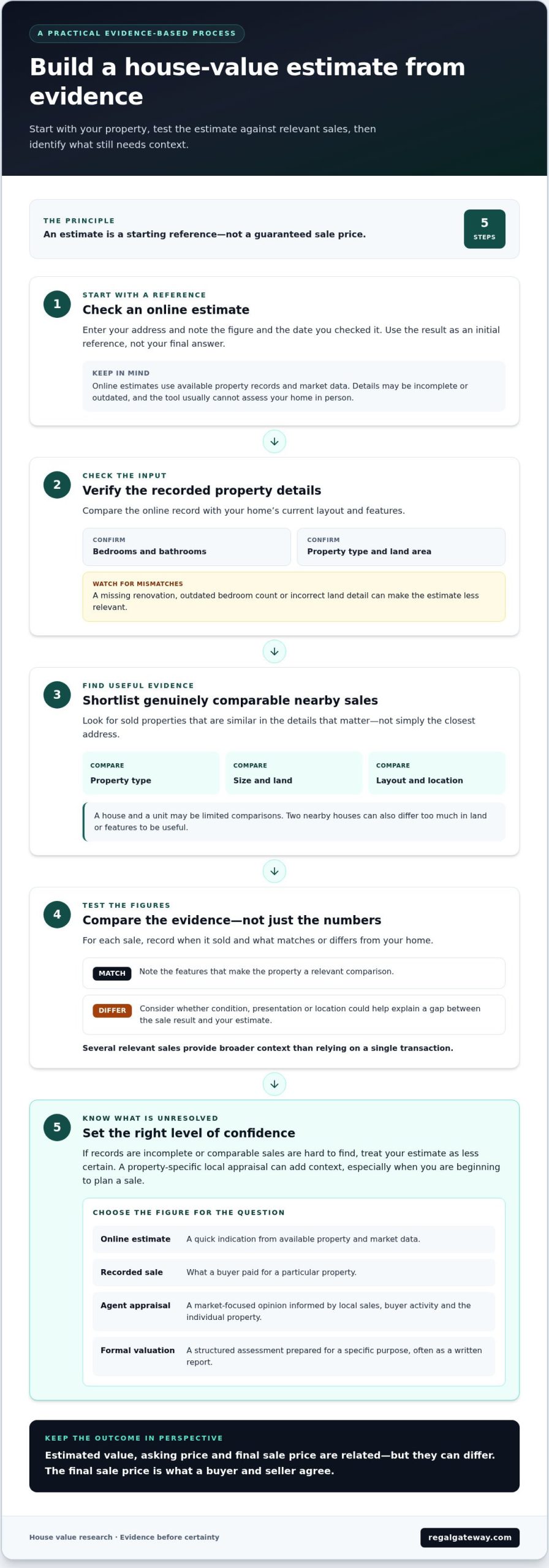
A useful estimate starts with your property, then gets tested against evidence. If you’re wondering “how much is my house worth,” use this process to build a considered view rather than relying on one online figure.
- Enter your address into an online estimate tool. Treat the result as a first reference point, not your final answer. Note the estimate and the date you checked it so you can compare it with other evidence gathered around the same time.
- Check the recorded property details. Confirm the number of bedrooms and bathrooms, property type, land area and other listed features against your home’s current layout. A missing renovation, outdated bedroom count or incorrect land detail can make an automated estimate less relevant to your property.
- Find recent nearby sales. Look for sold properties that are genuinely similar in type, size, land, layout and location. A house and a unit may offer limited comparison, as may two houses with notably different land or features, even if they’re close by.
- Compare the evidence, not just the figures. Record each sale’s date and the features that match or differ from your home. Consider whether differences in condition, presentation or location could help explain a gap between the sale result and your estimate.
- Identify what remains uncertain. If records are incomplete or comparable sales are hard to find, treat your estimate as less certain. A property-specific local appraisal can add context to your research, especially if you’re beginning to plan a sale.
Build a shortlist of comparable local sales
Proximity alone doesn’t make a sale comparable. An Atwell home may be a better reference for yours than a closer property elsewhere in Cockburn if its type, land and layout are more alike. Prioritise meaningful similarities, then account for differences rather than assuming every nearby sale points to the same value.
Several relevant sales provide stronger context than one result because they show how similar properties have performed across more than a single transaction. For broader preparation, read this Cockburn home-selling guide.
If you’re moving from research towards a selling decision, a locally informed residential property appraisal can help put online estimates and comparable sales in the context of your home.
How to compare online estimates with Atwell and Cockburn sales
To make sense of competing figures, weigh each source by what it can actually tell you. An online estimate is a model-based indicator, a recorded sale shows what a buyer paid for a particular property, and a property-specific appraisal adds local context about your home. None should be read as a guaranteed sale outcome.
| Evidence | What it can tell you | What to keep in mind |
|---|---|---|
| Online estimate | A quick indication based on available property and market data. | Check the property details and the estimate’s date. It may not account for your home’s condition or distinctive features. |
| Recent sales evidence | The price agreed for a specific property, offering a real-world market reference. | Confirm it was a completed sale, not an advertised asking price, and assess how closely the home compares with yours. |
| Property-specific appraisal | A local perspective that considers your home alongside relevant market evidence. | It’s an informed opinion to support a selling decision, not a promise of the price a buyer will pay. |
Which comparable sales deserve the most weight?
Start with properties that share the essentials: property type, land characteristics, layout and a reasonably current sale date. Then look at meaningful differences. A renovated interior, different presentation or distinctive feature may help explain why two otherwise similar homes achieved different results. In Atwell and Cockburn, a sale around the corner may be less relevant than one farther away that more closely resembles your property.
Give several closely matched sales more weight than one unusual result. A standout transaction may reflect that home’s particular attributes or circumstances, rather than a typical outcome for the suburb. Suburb averages offer broad context, but they can’t account for the details of an individual home or changes in current market conditions.
What if online estimates disagree?
Compare the property details and sales evidence behind each figure. Check whether the tools show the same bedroom count, land information and property type, and whether their data reflects a similar time period. A spread between estimates is a signal to investigate the evidence, not a promised selling range. If you’re asking “how much is my house worth,” the most useful answer comes from understanding why the figures differ and how well each fits your property.
Neighbourhood context can help explain buyer appeal, though lifestyle information shouldn’t replace property-level evidence. Explore Atwell’s local lifestyle and suburb guide for a broader view of the area.
What can change your home’s value in Atwell and Cockburn?
A home’s value reflects more than its suburb or bedroom count. Buyers assess how well the property fits their needs, and relevant local sales help show how similar homes have performed. If you’re asking “how much is my house worth,” consider the combination of condition, layout, land, presentation and location rather than assuming one feature determines the answer.
Which property features may influence buyer interest?
Consider the experience of living in the home as well as its recorded details. A functional layout, natural light and usable outdoor space may appeal to buyers, while visible maintenance needs can affect how they perceive the property and its upkeep. Good presentation can also make a home’s features easier to appreciate.
Renovations may strengthen appeal when they improve function, comfort or finish, but their influence depends on the property and the buyers considering it. The same applies to solar: it may attract some buyers, yet its presence alone doesn’t establish a fixed increase in value. Land size and usability matter too. A larger block may offer different possibilities, but its shape, access and practical use are also part of the picture.
A feature’s value depends on its appeal to likely buyers and what comparable local sales show, not on the feature alone.
How should you account for neighbourhood and market context?
Location is more nuanced than a blanket premium for living in Atwell or elsewhere in the City of Cockburn. A property’s position, surrounding setting and practical access can shape buyer response, but their importance varies with buyer priorities and the home itself. Nearby amenities may matter to one buyer and less to another.
Use recent, relevant sales to see how local buyers have responded to homes with similar characteristics, and interpret that evidence in light of current market conditions. A broad suburb trend can set the scene, but it won’t explain every difference between individual properties. For wider preparation advice, explore this Cockburn home-selling strategy.
Before deciding whether to renovate, focus on changes that make the home more functional and presentable, rather than assuming an upgrade will deliver a particular return. For guidance shaped around your property and local sales evidence, arrange a local market appraisal to help inform your selling plans.
How to turn a house value estimate into a confident next step
An estimate is most useful when it helps you decide what to do next. Your next step depends on whether you’re researching, beginning to plan a sale or ready to shape a selling strategy. You don’t need to settle on an asking price straight away. First, consider how much confidence you have in the evidence and what decision you’re preparing to make.
- Researching: Review online figures and property records, noting where details are missing or estimates differ.
- Planning a sale: Compare relevant completed sales and consider your home’s condition, improvements and likely buyer appeal.
- Preparing a strategy: Bring these findings together with your timing and goals to inform decisions about presentation, marketing and price positioning.
When is a local property appraisal useful?
A local appraisal can be especially useful when online figures conflict, recorded property details are inaccurate or an automated estimate doesn’t reflect important aspects of your home. It adds a property-specific perspective to your research, drawing on local market knowledge and relevant sales evidence. An appraisal provides professional market context, not a guarantee of the price a buyer will offer or the amount a sale will achieve.
To make the discussion more considered, prepare details that help explain your property’s position: its current layout, land characteristics, condition and notable improvements. If you’ve renovated or changed how a space is used, describe what was done and when. This gives the conversation more useful context than an online figure alone.
A considered selling decision starts with the right local context
Before settling on a path, bring together three elements: the estimates you’ve reviewed, the most relevant comparable sales you’ve found and an honest picture of your home’s condition and features. Then consider your priorities. A homeowner with a flexible timeframe may make different preparation choices from someone working towards a particular move date. A tailored strategy should reflect those circumstances, rather than relying on a suburb-wide figure or a single automated result.
Regal Gateway Property is based in Atwell and supports residential clients across the City of Cockburn and nearby suburbs, including Aubin Grove, Wandi, Hammond Park, Success, Treeby and Mandogalup. Its local market appraisals and personalised guidance can help put your property’s circumstances into a clearer selling context. Learn more about Regal Gateway Property’s local approach.
If you’re ready to discuss what your research may mean for a sale, discuss your property and possible selling pathway with the team.
Move from an estimate to a considered selling plan
Working out “how much is my house worth” starts with more than an online figure. Check that your property details are accurate, weigh recent sales that genuinely resemble your home, and consider how its condition, features and location may influence buyer interest. Together, these clues offer a more grounded view than any single estimate, while a local appraisal can add valuable property-specific context.
If you’re considering a sale in Atwell, the City of Cockburn or surrounding suburbs, Regal Gateway Property brings more than a decade of experience and personalised local market guidance. As a boutique residential agency based in Atwell, the team can help you interpret the evidence in light of your property and plans, without promising a particular sale price.
Discuss your property with Regal Gateway Property and take the next step with greater clarity. A thoughtful decision begins with the right local perspective.
Frequently Asked Questions
How much is my house worth in today’s market?
Your home’s potential value depends on its features, condition, location and current buyer demand, so there isn’t one figure that applies to every property. For homes in Atwell, Aubin Grove, Wandi, Hammond Park, Success, Treeby and Mandogalup, consider recent sales of genuinely similar properties alongside an online estimate. A local appraisal can add property-specific context, but no estimate can guarantee the final price a buyer will pay.
How accurate are online house value estimates?
Online estimates can be a useful starting point, but their accuracy depends on the quality and freshness of their data. A tool may not account for renovations, maintenance, layout or other details that distinguish your home from nearby properties. Check that the bedrooms, bathrooms, land and property type are recorded correctly, then compare the estimate with relevant completed sales. Treat differences between tools as uncertainty to investigate, not as a reliable selling range.
What is the difference between an appraisal and a formal valuation?
An agent appraisal is a market-focused opinion that can help inform a selling decision, drawing on local sales, buyer activity and the property’s individual features. It isn’t a guaranteed sale price. A formal valuation is a structured assessment for a defined purpose, and lenders may seek one when making lending decisions. The methods and level of inspection can vary, so consider which type of assessment suits the decision you need to make.
Can renovations increase how much my house is worth?
Renovations may improve buyer appeal, particularly if they make a home more functional, comfortable or well presented, but they don’t guarantee a higher sale price. For example, an updated kitchen may matter to buyers if it suits the home and local preferences. Before investing, consider the property’s condition, the likely buyer and what similar homes have sold for. A local appraisal can help put proposed improvements in context.
How do I find comparable house sales near my property?
Search for completed sales in your area, then shortlist homes with a similar property type, land, layout and condition. A nearby sale isn’t automatically comparable if the home differs substantially from yours. Check when the sale occurred and distinguish the recorded sale result from an advertised asking price or an automated estimate. For Atwell and surrounding suburbs, weigh several relevant examples rather than relying on one unusual transaction or a suburb-wide average.
Does solar increase a house’s value?
Solar may appeal to some buyers, but its presence alone doesn’t establish a fixed increase in value. Buyer interest can depend on the property, the system’s details and how well the home matches what local buyers want. Consider solar as one feature among many, alongside condition, layout, land and presentation. Compare your home with similar local sales, and avoid assuming that the installation cost translates directly into a higher sale price.