
A bank statement showing income can help you assess whether rent is manageable, alongside employment details and rental references. Knowing how to screen tenants for a rental property in WA also means checking identity and rental history consistently, then weighing the evidence fairly rather than relying on one document or first impression.
It’s reasonable to want confidence in an applicant’s ability to meet tenancy commitments while handling their personal information carefully. This guide covers assessing income, verifying references and contacting previous landlords, with practical context on privacy and fair treatment in Western Australia. You’ll have a clearer framework for making a considered, evidence-based decision.
Key Takeaways
- Before relying on a rental referee, independently establish their identity and connection to the property, then compare their account with the applicant’s rental history.
- Ask previous landlords or property managers about rent payment patterns, property care and whether they would rent to the applicant again.
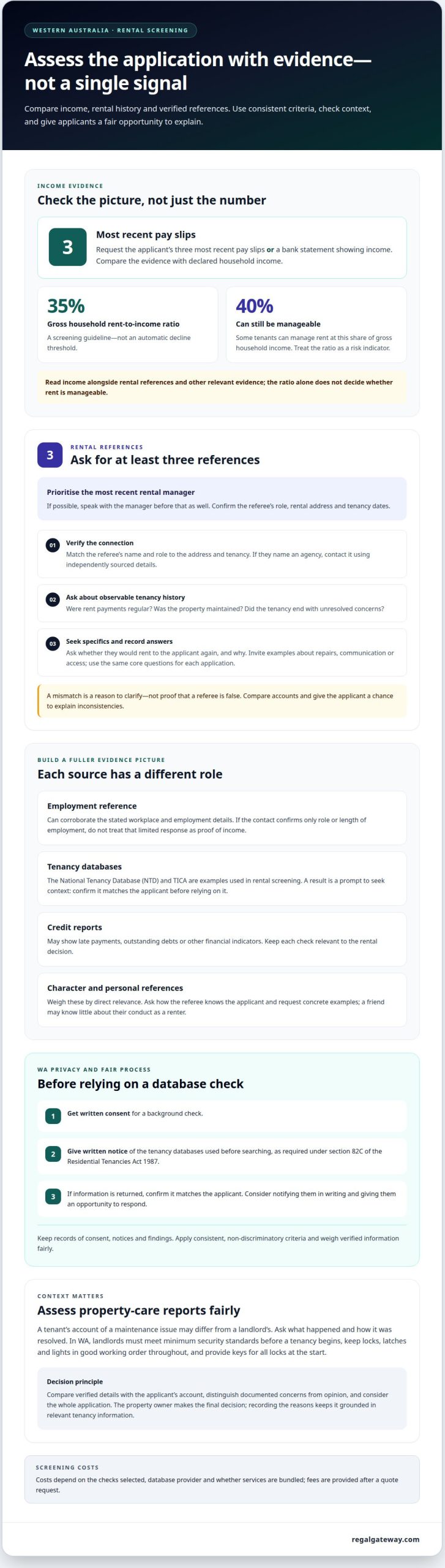
- Assess income evidence in context: a 35% gross household rent-to-income ratio is a guideline, not an automatic decline threshold.
- Follow WA database notice requirements and apply consistent, non-discriminatory screening criteria to every applicant.
How do I check the rental referee really owns the property?
Start by matching the referee’s name and role to the rental address. Ask whether they were the landlord or managing agent, and when they managed the tenancy. Compare their answers with the applicant’s rental history, including the address and tenancy dates. If they name an agency, contact it using independently sourced details rather than relying only on a number provided by the referee.
A previous landlord can comment on rent payment patterns, property care and tenancy conduct. Check that these details align with the applicant’s account. A mismatch is a reason to clarify the information, not proof that a referee is false. Employment references can corroborate the applicant’s stated workplace and employment details, while credit reports may show late payments, outstanding debts or other financial indicators.
Tenancy database checks provide another source of information. The National Tenancy Database (NTD) and TICA are examples of databases used in rental screening. A search may return rental history or other screening information, including a listing relevant to the application. Treat a result as a prompt to seek context, and confirm that the record matches the applicant before relying on it. Criminal-history checks are separate from tenancy and credit checks, so keep their purpose relevant to the rental decision.
In WA, written consent is required for a background check. Before searching a residential tenancy database, a landlord must give prospective tenants written notice of the databases used under section 82C of the Residential Tenancies Act 1987. If a search returns information about the applicant, consider notifying them in writing and giving them an opportunity to respond.
Screening costs depend on the checks selected, the database provider and whether services are bundled; fees are provided after a quote request. Keep records of consent, notices and findings, and weigh verified information consistently when considering an applicant’s opportunity to rent.
Contacting previous landlords and property managers
Ask prospective tenants for at least three references, prioritising the manager of their most recent rental. If possible, speak with the manager before that as well. Verify each referee’s role and connection to the residential address using independently sourced agency details. This helps distinguish a landlord’s direct account from a personal reference with no knowledge of the tenancy.
Keep questions focused on observable rental history. Ask whether rent was paid regularly, whether the property was maintained and whether the tenancy ended with unresolved concerns. Ask whether the landlord would rent to the applicant again, and why. Invite specific examples, such as how the tenant reported a repair or communicated about access. Record each referee’s answers consistently across applications.
Interpret a report alongside both parties’ responsibilities. A tenant’s account of a maintenance issue may differ from a landlord’s, so ask what happened and how it was resolved. In WA, landlords must meet minimum security standards before a tenancy begins, keep locks, latches and lights in good working order throughout, and provide keys for all locks at the start. These duties provide practical context when discussing property care.
Reference checks inform a decision, but don’t replace a fair assessment of the whole application. Compare verified details with the applicant’s account, distinguish documented concerns from opinion, and give the applicant an opportunity to explain inconsistencies. The property owner makes the final decision about which applicant to accept. Recording the reasons clearly helps keep the decision grounded in relevant tenancy information.
For owners seeking a more structured approach to tenancy decisions, explore residential property management support. Thoughtful reference checks can help establish a reliable picture of previous tenancies while keeping the selection process measured and evidence-led.
Employment and rental references
Review each application for rental history, stated income, employment details and the applicant’s reason for moving. These details provide a consistent basis for comparing applicants. Ask who can verify the listed employment and what role that person holds. The aim is to corroborate relevant information, not to seek private details unrelated to rental obligations.
Income evidence helps assess whether rent appears manageable. Request the applicant’s three most recent pay slips or a bank statement showing income, then compare the evidence with the declared household income. A gross household rent-to-income ratio of 35% is a screening guideline, not an automatic decline threshold. Some tenants can manage rent at 40% of gross household income, so treat the ratio as a risk indicator.
Ask for three references, including the manager of the most recent rental and, if possible, the manager before that. Confirm the tenancy dates and address, then ask about regularity of rent payments, communication and care of the property. Compare the responses with the applicant’s account. A national tenancy database search may add relevant rental-history information, but it doesn’t replace a direct reference.
Character and personal references offer a different perspective from rental or employment records. Ask how the referee knows the applicant and request concrete examples of reliability, communication and respect for shared obligations. A colleague may describe how the applicant handles commitments, while a friend may know little about their conduct as a renter. Weigh each reference according to its direct relevance.
Use the same core questions for each application, and record what each referee actually says. If an employment contact can confirm only the role or length of employment, don’t treat that limited response as proof of income. Consider all the evidence together, including rental references and income documents, before deciding whether the application demonstrates the capacity to meet rent and tenancy responsibilities.
Western Australian tenancy laws, privacy and anti-discrimination practices
In Western Australia, lawful tenant screening depends on relevant criteria, careful handling of personal information and fair treatment. These principles shape how to screen tenants for a rental property in WA, from application questions to the use of database findings.
Tenant Selection Without Discrimination
Non-discriminatory tenant selection means assessing applicants against consistent, tenancy-related criteria rather than protected personal characteristics. The Equal Opportunity Act 1984 (WA) and Disability Discrimination Act 1992 are relevant to tenant selection. Compare applicants using the same evidence, such as income and rental history, rather than assumptions about disability or personal circumstances. A documented, consistent approach helps keep decisions focused on suitability for the tenancy.
Information Requested on Applications
Rental applications can request information relevant to an applicant’s ability to meet tenancy obligations, including identity, rental history, income, employment and references. Ask only for details that support this assessment, and explain their purpose. Obtain written consent before background checks. For residential tenancy database searches, give prospective tenants written notice naming the databases before searching. This keeps information requests purposeful and helps applicants understand how their details will be used.
Privacy and Screening Risks
Privacy-conscious screening means limiting access to applicant information and using it for the stated rental assessment. Avoid collecting unrelated details or sharing application material beyond those involved in the decision. Unlawful discrimination can lead to complaints and legal consequences, while careless handling of personal information can create disputes. Keep records of consent, notices and decision-related information. A fair approach to how to screen tenants for a rental property in WA treats every applicant’s information with care.
Western Australian Tenancy Laws
The Residential Tenancies Act 1987 covers tenant rights in Western Australia, including residential tenancy database searches. Under section 82C, landlords must provide written notice identifying the databases before searching. A tenancy database search may reveal information about an applicant, so consider any findings carefully and give them an opportunity to respond. Treat any finding as information to assess in context, rather than an automatic decision, and allow the applicant to respond.
For support with a consistent, considered screening process, discuss tenant selection.
Regal Gateway Property: Residential Property Sales
Regal Gateway Property provides tenant selection and screening for owners assessing rental applications and choosing a tenant. Property management is a natural next step for owners seeking ongoing management of a residential rental. For owners considering a sale instead, Regal Gateway Property also provides residential property sales.
Whether you’re preparing to rent out a property or reviewing how tenant selection fits your plans, the appropriate support depends on your next property decision. For guidance on tenant selection, property management or a residential sale, contact Regal Gateway Property.
Make your next tenancy decision with confidence
A considered approach to how to screen tenants for a rental property in WA can shape more than the choice of applicant; it can establish a clear, consistent standard for future leasing decisions. Set out what information you’ll assess, how you’ll compare applications and where you’ll record your reasoning before the next vacancy arises. That preparation helps keep decisions deliberate rather than rushed by competing applications or time pressure.
As your property plans evolve, the right support can help align tenant selection with your wider investment priorities. Regal Gateway Property supports owners across Atwell, Aubin Grove, Wandi, Hammond Park, Success, Treeby and Mandogalup, whether you’re refining your rental approach or considering a change in direction.
Contact Regal Gateway Property to discuss your property plans. A thoughtful process is a strong foundation for what comes next.
Frequently Asked Questions
Can I ask an applicant for bank statements?
Yes, you can request a bank statement as evidence of income when assessing an application. Explain why you need it and focus on information relevant to rent affordability, not unrelated spending. Obtain written consent before conducting a background check. A statement can support an income assessment, but consider it alongside the applicant’s other relevant information.
Can a private landlord access TICA or NTD?
A private landlord can use tenancy database screening, including services such as TICA or the National Tenancy Database (NTD). In Western Australia, provide written notice naming the database before searching under section 82C of the Residential Tenancies Act 1987. If a search finds information about the applicant, notify them in writing within 7 days. Confirm any matching record belongs to the applicant before relying on it.
How do I verify a payslip is real?
Compare the employer, pay period and income figures on a payslip with the applicant’s other evidence. For example, check whether the stated pay aligns with regular income shown in a bank statement. If details don’t match, ask the applicant to clarify. With their permission, contact the employer using independently sourced details to verify employment information, rather than relying solely on a number printed on the payslip.
How long should screening take?
Screening time depends on how quickly applicants provide complete documents and referees respond. A database search may be straightforward, while confirming employment or clarifying inconsistent rental dates can take longer. Explain which checks remain outstanding, then assess every application using the same criteria. Don’t treat speed alone as evidence of suitability; a prompt application still needs adequate supporting information.
What Makes a Great Tenant?
A strong applicant provides consistent information, demonstrates the capacity to meet rental obligations and communicates clearly about the tenancy. References can illustrate practical behaviours, such as reporting maintenance concerns promptly or respecting agreed access arrangements. No single quality guarantees a successful tenancy, so consider relevant evidence together. The aim is a sound match between the applicant’s circumstances and the property’s requirements.
What am I not allowed to consider?
Don’t use disability or other protected personal characteristics as a reason to disadvantage an applicant. The Equal Opportunity Act 1984 (WA) and Disability Discrimination Act 1992 are relevant to tenant selection. Apply consistent, tenancy-related criteria instead, such as verified income and rental information. Whether a property is in Atwell, Aubin Grove, Wandi, Hammond Park, Success, Treeby or Mandogalup, assess applications fairly and individually.