
A defensible bond claim rests on evidence, not an assumption that the bond can cover every cost at the end of a tenancy. When considering rental bond claims WA landlords should ask whether each proposed deduction is justified and supported, especially when ordinary wear and tear could be mistaken for tenant damage.
It’s understandable to want a property returned in good condition and to feel uncertain if a tenant may dispute a claim. Start by comparing the property’s condition at the beginning and end of the tenancy, then document any claimed loss clearly. Since 28 March 2026, either party can apply to have a bond released, and the other party has 14 days to respond or dispute the application.
This checklist explains when a claim may be appropriate, what records to assemble and how to approach the WA process if you and your tenant disagree. Condition reports, dated photographs and relevant invoices can help distinguish a substantiated claim from normal deterioration, supporting a careful and consistent decision.
Key Takeaways
- For rental bond claims WA landlords are considering, assess each proposed deduction against the tenancy records rather than treating the bond as a reserve for routine costs.
- Compare the property’s condition at the start and end of the tenancy to distinguish potential tenant damage from ordinary deterioration.
- Gather dated photos, condition reports and relevant communications, then link each item of evidence to the concern or amount you’re raising.
- Communicate clearly and factually, and understand the current WA steps and response timeframes if the tenant disputes a proposed claim.
- Consistent property records make end-of-tenancy reviews more organised. Regal Gateway schedules the first routine inspection 6 weeks after the tenancy begins, then inspections every 3 months.
Rental bond claims in WA: what landlords should understand first
A rental bond is security for obligations under a tenancy agreement. In Western Australia, the Bond Administrator holds the bond. It isn’t money the landlord holds or a reserve for routine maintenance, upgrades or ordinary property costs. Rent must be dealt with separately, not treated as a payment from the bond.
At the end of a tenancy, the bond can be distributed after the parties’ positions have been assessed. A bond claim is a request for an agreed or determined distribution, not an automatic entitlement to the full amount. The evidence and circumstances matter: a landlord should be able to explain why each proposed deduction is justified and how the amount relates to an outstanding obligation.
What is a rental bond claim in Western Australia?
In practical terms, a landlord’s claim asks for some or all of the bond to be allocated to them rather than refunded to the tenant. The parties may agree on the distribution. If they disagree, the relevant WA process determines what happens to the disputed amount. The bond remains security while that process is followed, rather than becoming an informal fund either party can draw on.
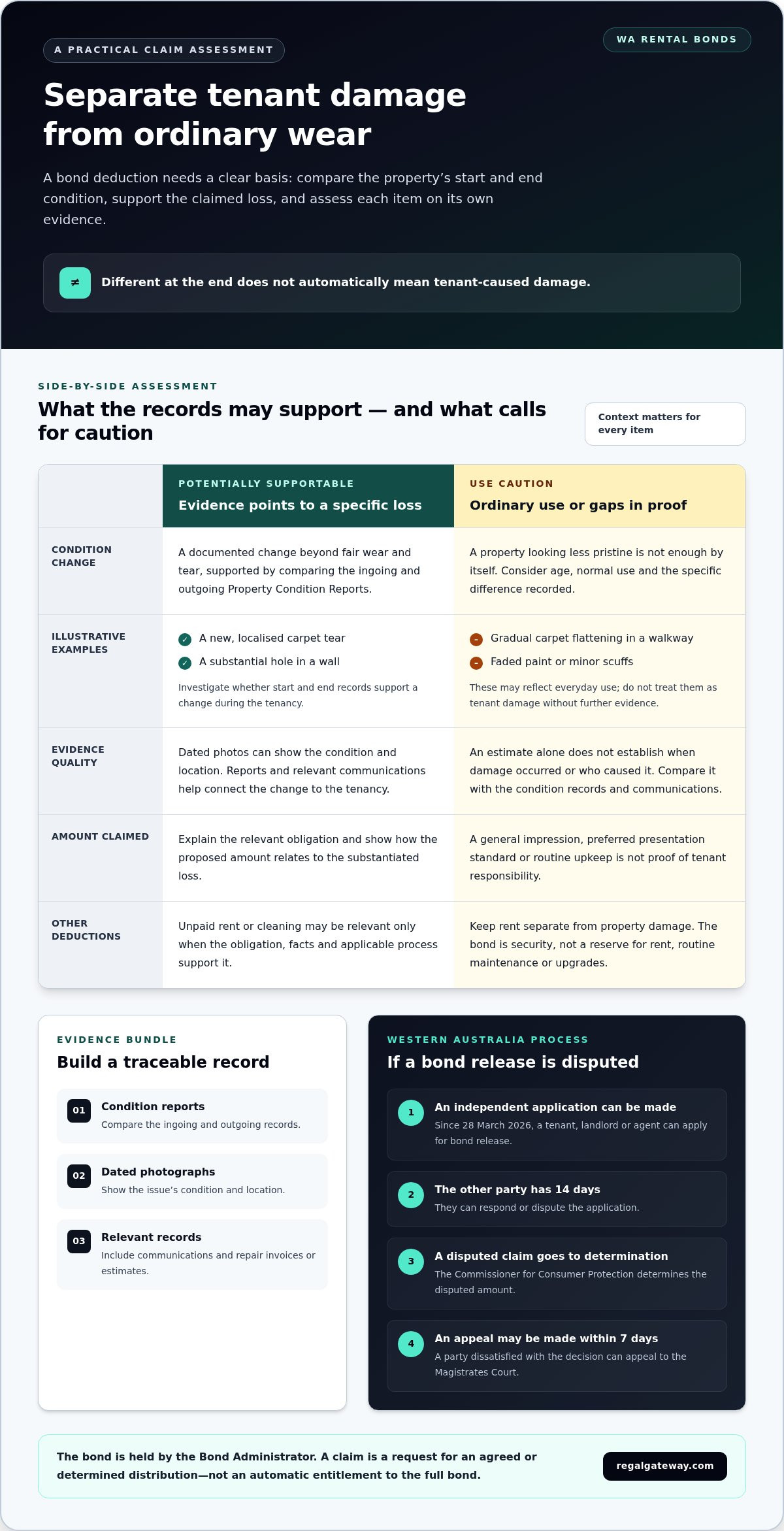
WA’s process changed on 28 March 2026. A tenant, landlord or agent can independently apply for bond release, and the other party has 14 days to respond or dispute the application. A disputed claim is referred to the Commissioner for Consumer Protection for a determination. A party dissatisfied with the decision has 7 days to appeal to the Magistrates Court. Check current guidance from Bonds Administration and Consumer Protection WA before applying or advising a tenant, as forms and procedures can change.
When might a landlord consider a claim?
Documented damage beyond fair wear and tear may support a claim. For example, a newly broken fixture could warrant closer assessment if the ingoing and outgoing records show its condition changed during the tenancy. Gradual fading or minor scuffing from ordinary use, by contrast, shouldn’t be treated as tenant damage just because the property looks less pristine than it did at the start.
Unpaid rent or cleaning needed to return the property to its original condition may also be relevant, but don’t assume a cost is deductible without checking its legal basis and the applicable process. For each item, set out a clear explanation, reliable records and a considered assessment of the tenancy’s circumstances. An estimate or general impression alone may not establish that the tenant is responsible for the amount claimed.
For rental bond claims WA landlords are considering, start by identifying the specific obligation, comparing the available evidence and confirming the current procedure. A claim should reflect a substantiated loss, not a preference to retain bond funds.
Which rental bond claims may be supportable, and which need caution?
A sound assessment distinguishes a change in the property’s condition from the ordinary effects of living in it. The question isn’t simply whether something looks different at the end of the tenancy. Consider whether the records support that the tenant caused damage beyond fair wear and tear, and whether the proposed amount relates to that damage.
Damage beyond fair wear and tear
Compare the ingoing and outgoing Property Condition Reports, then use dated photographs and other relevant records to understand what changed. The examples below are illustrative, not automatic tests. Context matters, including the item’s condition at the start, its age and the nature of the difference observed.
- Potentially beyond ordinary wear: a new, localised tear in a carpet or a substantial hole in a wall may warrant investigation if the starting and ending records support a change during the tenancy.
- More consistent with ordinary deterioration: gradual carpet flattening in a walkway, faded paint or minor scuffs may result from everyday use. Don’t treat them as tenant-caused damage without further evidence.
These examples don’t determine responsibility on their own. A property’s age, normal use and the owner’s preferred standard of presentation aren’t proof that a tenant caused damage. Equally, don’t dismiss a tenant’s responsibility where reliable records show a specific change beyond expected deterioration.
Evidence should tell a coherent story. A dated photograph can show the condition and location of an issue, while a repair invoice or estimate may indicate the work and amount involved. An estimate alone doesn’t establish when damage occurred or who caused it. Compare it with the condition reports and relevant communications before deciding whether it supports a proposed claim.
Fair wear and tear, rent, and other proposed deductions
Fair wear and tear shouldn’t be presented as tenant-caused damage. If the evidence points to ordinary deterioration, don’t turn routine upkeep or a desire to refresh the property into a bond claim.
Keep rent matters separate from property damage. The bond is security, not rent: a landlord shouldn’t intentionally use it to pay rent during the tenancy. If rent remains outstanding at the end, treat it as a separate obligation and verify the current WA rules and process before proposing any bond distribution for it.
Apply the same care to cleaning, missing items and any other proposed deduction. Don’t assume a cost or absence automatically gives you grounds to claim. Establish the relevant facts and check the current legal basis and procedure before presenting it as a claim item. This measured approach helps keep rental bond claims WA landlords make specific, evidence-led and fair to both parties.
Consistent inspection records can help clarify what changed and when. Regal Gateway Property provides property management support for organised tenancy records as an independent boutique agency serving Atwell and surrounding Cockburn suburbs.
What evidence should WA landlords gather before making a bond claim?
A well-supported claim should let someone who wasn’t present follow the property’s condition from the start of the tenancy to its end. Build the record from documents created at the time, rather than relying on memory after a concern appears. For each proposed item, identify what changed, where it is recorded and how the evidence relates to the amount sought.
Use the Property Condition Report as a baseline
The ingoing Property Condition Report (PCR) is the starting point for comparison. In WA, the tenant must return it within 7 working days. Review the notes and photographs room by room, and keep the completed report with the tenancy file. Regal Gateway provides the PCR at key collection, giving the parties a documented reference point from the outset.
At the outgoing inspection, compare each concern with that baseline rather than asking only whether the property appears different. A mark in a photograph may be hard to assess without context, so check the corresponding room notes, the item’s recorded starting condition and any later inspection records. Record observations precisely, including the location and nature of the issue.
Create a clear inspection and damage record
Routine inspections add context between the ingoing and outgoing reports, but they don’t replace either one. Regal Gateway schedules the first inspection 6 weeks after the tenancy begins, then inspections every 3 months, up to 4 per year. Each routine inspection requires 7-14 days’ written notice. Photo-supported inspection reports are stored on file.
Keep the evidence organised and link each proposed claim item to its supporting records. A practical file may include:
- The completed ingoing PCR and its photographs.
- The outgoing inspection record, with dated photographs of specific concerns.
- Relevant inspection reports that help show when a change was observed.
- Communications about the condition, access, repair or response to the concern.
- Repair documents or invoices, where relevant, accurate and available.
For example, if a report identifies damage to a particular door, pair it with a clear photograph and any relevant repair document. Explain how the records support the concern and the amount proposed. Don’t rely on a general estimate without saying what work it covers, or present a document as proof of responsibility if it only describes a repair.
Consistent before-and-after records help landlords assess a claim fairly by showing what changed, where it changed and how the proposed amount relates to the evidence. Clear records can also make it easier to discuss a concern with the tenant without overstating what the evidence establishes. This is especially useful when rental bond claims WA landlords propose are disputed, because the evidence needs to speak clearly for itself.
WA rental bond claim checklist: prepare, communicate, and address disputes
A careful process keeps the end-of-tenancy discussion focused on facts. Before proposing a bond distribution, confirm the tenancy has ended, complete the final inspection and gather the supporting records. Set out each concern separately, explain the evidence behind it and communicate calmly with the tenant before following the current WA process.
A practical checklist before lodging or responding
Work through these steps in sequence. They help make your position clear and supported before you apply.
- Confirm the tenancy end details. Record the termination date and whether keys have been returned, then complete the final inspection. The landlord or agent must complete the final Property Condition Report and provide a copy to the tenant within 14 days after the tenancy ends.
- Compare the records. Review the ingoing and final condition reports alongside dated photographs and relevant communications. Keep the comparison specific to each room, fixture or item in question.
- Itemise the concerns. Describe each proposed deduction separately, identify the supporting evidence and explain how any relevant repair document relates to the amount proposed. Avoid combining unrelated concerns into a single unexplained figure.
- Communicate your position. Share your reasons and relevant supporting material with the tenant, invite a factual response and consider any information they provide. Clear communication can help identify what is agreed and what remains disputed.
- Check the official process. Review current Bonds Administration instructions and Consumer Protection WA guidance for the applicable terminology and submission steps before taking action.
If the tenant disputes a proposed deduction
A disagreement doesn’t give either party unilateral control over the bond. Keep communication professional and address the specific point in dispute. For example, explain which report or photograph supports your view, and consider any evidence the tenant offers in reply. If the records don’t support an item, reassess it rather than relying on assumption.
WA’s bond dispute process changed on 28 March 2026. Any party to the bond can apply for its release, and the other party has 14 days to respond or dispute the application. A disputed claim is referred to the Commissioner for Consumer Protection for an evidence-based determination. A party dissatisfied with the decision has 7 days to appeal to the Magistrates Court. Confirm current requirements with official WA sources before acting, as process details and instructions may change. A proposed claim isn’t a guaranteed outcome.
For broader landlord guidance, the Atwell property management guide offers a perspective on organised local property oversight. Regal Gateway Property provides local support with tenancy records and communication through property management for landlords in Atwell and surrounding Cockburn suburbs.
How Regal Gateway supports well-documented property management in Cockburn
Clear tenancy records are built over time, not assembled from memory at the end of a lease. Consistent inspections and detailed, photo-supported reports give landlords a documented history of the property’s condition. That history helps them review changes in context when the tenancy ends. Records support a fair assessment, but don’t guarantee that a bond claim will be accepted or determine how a dispute will be resolved.
Consistent inspections support clearer tenancy records
Regal Gateway Property provides the Property Condition Report at key collection, creating an initial reference for the tenancy file. The first routine inspection is scheduled 6 weeks after the tenancy begins, followed by inspections every 3 months, up to 4 per year. Routine inspections require 7-14 days’ written notice. Detailed reports, including photographs, are stored on file so relevant observations can be considered alongside the ingoing and final condition records.
A record is most useful when it is clear and specific. Photos can show the location and visible condition of an item, while report notes add context about what was observed at the time. If a landlord attends an inspection, that attendance must be disclosed to the tenant. Respectful, transparent processes go hand in hand with careful documentation, helping landlords assess how the property has changed without treating routine wear as an assumed claim.
Local landlord support across Cockburn suburbs
As an independent boutique agency, Regal Gateway Property provides property management for landlords in Atwell and surrounding Cockburn suburbs, including Aubin Grove, Wandi, Hammond Park, Success, Treeby and Mandogalup. Its local focus supports organised tenancy records and clear communication throughout the rental period, rather than leaving owners to reconstruct a timeline when questions arise at the end.
For landlords, the practical value is continuity: a condition report at the start, inspection records during the tenancy and clear documentation at the transition between occupants. When considering rental bond claims WA landlords may propose, that sequence brings relevant evidence together for review. Assess each item on its own facts and follow the current WA process. Inspection records support a claim, but don’t promise a particular outcome.
Property decisions also sit within a broader investment context. The Cockburn property investment guide offers wider perspective for landlords considering their ongoing plans alongside day-to-day tenancy management.
If you’d value a more organised approach to managing a rental property in the area, explore Regal Gateway Property management and its local support across Cockburn.
Set a more considered standard for your next tenancy
Every tenancy is an opportunity to make the next transition more orderly. Treating rental bond claims WA landlords consider as evidence-led decisions can help protect the property while keeping discussions with tenants measured and fair. The same thoughtful approach to recordkeeping throughout the tenancy means future decisions can draw on a clear history instead of one reconstructed at the last moment.
Regal Gateway Property is an independent boutique agency serving landlords in Atwell and surrounding Cockburn suburbs, with photo-supported inspection reports stored on file. Owners seeking local support with their investment can explore Regal Gateway’s property management support.
A well-organised tenancy and a considered approach to each decision help you move forward with greater confidence and care.
Frequently Asked Questions
Can a WA landlord claim a rental bond for damage?
Yes. A landlord may seek a bond distribution for tenant-caused damage beyond fair wear and tear, provided the claim is supported by relevant evidence and follows the current WA process. Records showing a newly damaged fixture, for example, may support a claim more clearly than a general assertion that the property was left in poor condition. The tenant can dispute the proposed distribution, and the outcome isn’t guaranteed.
What can a landlord claim from a rental bond in WA?
A landlord may propose deductions for legitimate, documented costs such as damage beyond fair wear and tear or cleaning needed to return the property to its original condition. Unpaid rent may also be relevant to an end-of-tenancy bond assessment, but the bond must not be used as rent during the tenancy. Check current WA guidance before including cleaning, rent arrears, missing items or another proposed deduction, as eligibility and process depend on the circumstances.
Can a landlord use the bond to cover unpaid rent in WA?
No. A landlord shouldn’t use the bond as a rent payment during the tenancy. If rent remains unpaid when the tenancy ends, keep a clear rent ledger and distinguish the arrears from property damage when assessing any proposed bond distribution. Check current Bonds Administration and Consumer Protection WA instructions before seeking a distribution for arrears. A landlord’s proposal doesn’t itself establish entitlement to the disputed amount.
What evidence should a landlord provide for a bond claim?
Provide records that explain each item being claimed, such as the ingoing and final Property Condition Reports, dated photographs, relevant inspection notes and communications about the issue. Where a repair is involved, an accurate invoice or other relevant repair document can help explain the proposed amount. For rental bond claims WA landlords make, organise evidence by item and show how it supports both the concern and the amount requested.
How many routine inspections can a WA landlord conduct?
WA allows up to 4 routine inspections per year. Regal Gateway’s schedule begins with an inspection 6 weeks after the tenancy starts, followed by inspections every 3 months. Routine inspections require 7-14 days’ written notice, and an owner may attend only if their attendance is disclosed to the tenant. Inspections document the property’s condition; they don’t replace the formal reports completed at the start and end of a tenancy.
What happens if a tenant disputes a rental bond claim in WA?
If a tenant disputes a bond application, the parties should follow the current WA dispute process and provide relevant evidence. Under the process effective from 28 March 2026, a disputed bond claim is referred to the Commissioner for Consumer Protection for an evidence-based determination. The other party has 14 days to respond to a release application, and a party dissatisfied with the Commissioner’s decision has 7 days to appeal to the Magistrates Court. Verify current instructions before acting.
When must a tenant return the Property Condition Report in WA?
A tenant must return the Property Condition Report within 7 working days. They should review it carefully, note any disagreement with the recorded condition and retain a copy of the completed report. If a room’s description doesn’t reflect its condition at key collection, recording that difference promptly helps preserve a clear starting record. The report can then be compared with the final inspection when the tenancy ends.
Does a landlord automatically receive the bond after a tenant moves out?
No. Moving out doesn’t automatically transfer the bond to the landlord. The Bond Administrator holds the bond, and its distribution follows an application and agreement or the applicable determination process. Under the WA process effective from 28 March 2026, the tenant, landlord or agent can apply for release. A landlord seeking a deduction should identify its basis and supporting evidence; the landlord alone doesn’t decide a disputed amount.