
A plan on a map isn’t the same as an approved development. That distinction can matter when you’re weighing a property decision. Treeby development plans include proposals, strategic frameworks and projects at different stages. Start by asking not just what is planned, but where it applies and how far it has progressed.
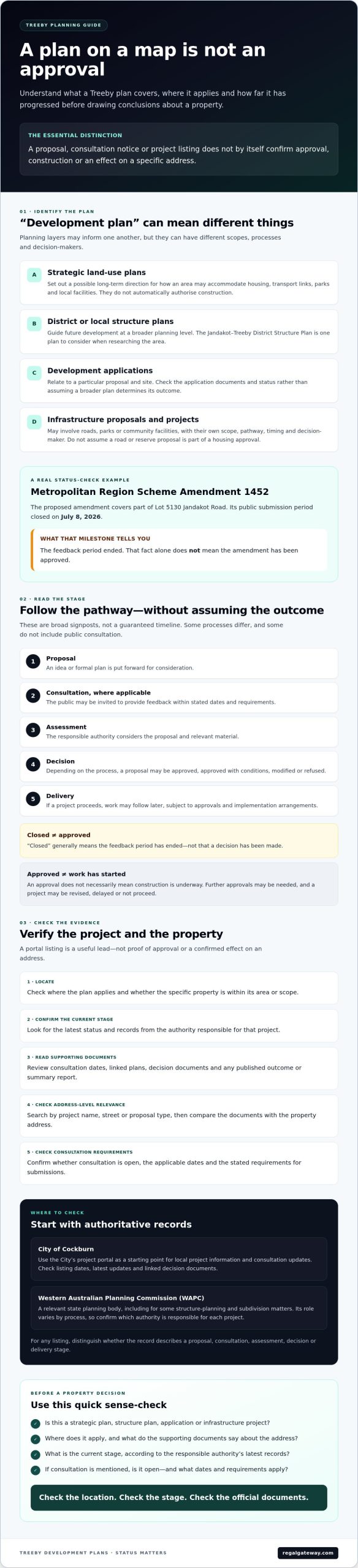
Keeping track can feel difficult when updates are spread across government planning pages and project documents. For example, the public submission period for the proposed Metropolitan Region Scheme Amendment 1452, covering part of Lot 5130 Jandakot Road, closed on July 8, 2026. That milestone does not, by itself, mean the amendment has been approved.
This guide explains how to identify plans that may shape Treeby, check their status through authoritative sources and distinguish proposal, consultation, assessment and approval. It also covers the Jandakot-Treeby District Structure Plan and the details to check at an address level, so you can consider relevant, confirmed changes more clearly before making a property decision.
Key Takeaways
- Separate strategic plans, structure plans, applications and infrastructure projects. Each has a different scope and status.
- Track proposals through consultation, assessment and decision, checking the responsible authority’s records for the current stage.
- Assess how a plan could relate to a specific property by checking its location, planning stage and supporting documents.
- Use the City of Cockburn project portal and official records to search Treeby development plans by project name, street or proposal type.
- Before acting, check the information against the property address and confirm whether consultation is open and what submission requirements apply.
What Treeby development plans cover, and why their status matters
Treeby development plans is a broad term, not a single approval or document. It may refer to long-term land-use strategies, district or local structure plans that guide future development, individual development applications, or infrastructure proposals involving roads, parks and community facilities. These planning layers can inform one another, but they may be prepared, assessed and decided through separate processes.
This distinction matters when you’re considering a home or investment. A strategic plan may indicate a possible direction for an area without authorising construction. A proposal may be open for feedback, or an application may be under assessment. Even an approval does not necessarily mean work has started. Treating every map, consultation notice or project listing as a confirmed nearby development can lead to conclusions the underlying documents do not support.
Treeby is within the City of Cockburn. For background on the suburb’s establishment and location, see Treeby, Western Australia. For planning decisions, rely on the latest documents from the authority responsible for the specific project.
What counts as a development plan in Treeby?
Long-term land-use planning considers how areas may accommodate housing, transport links, parks and local facilities over time. A development application, by contrast, relates to a particular proposal and site. Supporting projects may have their own planning pathway, timing and decision-maker. For example, don’t assume a proposed road or reserve improvement is part of a housing approval.
A project’s appearance in a portal does not establish that it has been approved or will affect a particular property. Check its location, scope, stage and supporting documents before drawing conclusions.
Who publishes or assesses planning information?
The City of Cockburn’s project portal is a useful starting point for local project information and consultation updates. Its dated Treeby East Reserve feedback listing, for example, is a lead to investigate, not evidence by itself that a project is approved or underway. Check the listing date, latest update and any linked decision documents before interpreting its status.
The Western Australian Planning Commission (WAPC) is a relevant state planning body, including for some structure-planning and subdivision matters. Its role varies by process, so confirm which authority is responsible for each project. For a reliable status check, review the latest documents and records published by that authority. Note whether they describe a proposal, consultation, assessment, decision or delivery stage.
How Treeby plans move from an idea to a decision
A planning matter may pass through several stages, but the sequence depends on the proposal and the responsible authority. A useful guide is: proposal, consultation where applicable, assessment, decision, then delivery. Some processes do not include public consultation. Others involve separate planning, subdivision or development decisions, so don’t assume one pathway applies to every project.
- Proposal: An idea or formal plan is put forward for consideration.
- Consultation: The public may be invited to provide feedback within stated dates and under specified requirements.
- Assessment: The responsible authority considers the proposal and relevant material.
- Decision: Depending on the process, the proposal may be approved, approved with conditions, modified or refused.
- Delivery: If a project proceeds, work may follow later, subject to its approvals and implementation arrangements.
These stages are broad signposts, not a guaranteed timeline. A project may be revised, delayed or not proceed. Further approvals may also be required before construction can begin.
How to read a consultation or project status
Portal labels such as open, closed, under review and completed can indicate what is happening, but they do not replace the underlying documents. “Open” may mean feedback is being accepted. “Closed” generally means the feedback period has ended, not that a decision has been made. “Under review” suggests further consideration. For “completed,” check the project record to understand what has actually concluded.
When consultation closes, the feedback period has ended. That does not, by itself, mean the proposal has been approved. Check the consultation dates, any published outcome or summary report, and linked decision documents. For Treeby East Reserve, review the City of Cockburn portal’s latest listing and supporting records before describing the feedback outcome or current stage.
What approval and delivery can, and can’t, tell you
An approval records a decision within a particular planning process. It does not necessarily confirm that construction has started, when it will begin or when the project will be completed. Delivery may depend on further steps, and timelines can change. Avoid relying on estimated dates unless the responsible authority has provided current, project-specific information.
For any Treeby development plans, identify the decision-maker and approval pathway from official records rather than assuming the same authority handles every stage. Once a change is confirmed and relevant to a property, discussing its real estate implications with a local property professional may help put it in context.
Which Treeby development plans could matter to a property?
A plan’s relevance depends on more than its apparent distance from a property on a map. Consider the project type, its current stage, the land it covers and what the supporting documents confirm. A district structure plan, for example, can guide future land use across a broad area, while a development application may relate to a defined site and proposal. The Jandakot-Treeby District Structure Plan focuses on four former quarry sites covering about 147 hectares. That broad scope alone does not establish an effect on any particular home.
Potential impacts vary by project. A park or local facility may offer future amenity, depending on whether it proceeds and how residents can access it. Transport works may affect routes or connectivity. A land-use change or construction project may raise different questions about access, activity or outlook. Proximity alone cannot confirm noise, disruption, access changes or an effect on property value. Those questions require evidence specific to the proposal and address.
Questions to ask about a plan near your address
Start with the project boundary and maps. Check whether your property or nearby lots are identified in the documents. Review proposed land uses, access points and any stated staging or infrastructure details. If construction is discussed, look for confirmed information about its scope and timing rather than relying on broad descriptions or assumptions.
Record each document’s publication or revision date alongside the project’s stated status. This helps distinguish current information from an earlier proposal that may have changed. If the official documents do not answer a property-specific question, seek appropriate professional advice instead of treating an approximate map distance as definitive.
Separate amenity potential from investment assumptions
A planned park or service may appear attractive, but its value to a particular household depends on delivery, location and practical access. A planning announcement is not a promise of capital growth, stronger rental demand or a particular resale result. Those outcomes depend on a wider range of property and market factors, so don’t infer them from a proposal alone.
For broader regional context, read this Atwell property investment guide, while keeping its discussion separate from address-level evidence in Treeby. Before making a decision, compare the latest maps and application material with the property’s location, then consider confirmed information alongside your own objectives. This is a more considered way to assess which Treeby development plans may genuinely be relevant.
How to check the latest Treeby planning updates yourself
A reliable search is easier when you follow the same steps each time instead of relying on a headline or a single project listing. Begin with the City of Cockburn project portal to find local projects and consultation information. Search for “Treeby” and, where filters are available, narrow the results by project category. If you know a project name or nearby street, search for those terms too. Records may use different labels for the same area or proposal.
A practical official-source checking sequence
Once you find a relevant listing, open its project page and check who is responsible, what land or proposal it covers, and the latest recorded status. Read the linked documents, not just the summary. Look for publication or revision dates, consultation opening and closing dates, maps, decision notices and any outcome report. If the local page links to a state planning record, follow the reference and confirm that it relates to the same proposal.
Keep these details together as you research:
- Project identity: Name, location, proposal type and responsible authority.
- Geography: Project boundary, affected lots and relevant access or land-use maps.
- Status: The latest update, any consultation deadline and whether a decision document is available.
- Evidence date: When each document was published or last revised.
This gives you a clearer record of what is confirmed, what is still being considered and what may have changed. Treat a portal label as a signpost. Use the latest official document to understand the project’s stage.
Keep research useful and current
Save the official project page and note when you checked it. Before making a property decision or publishing details about a named project, revisit the page and confirm that the status, consultation dates and supporting documents remain current. Compare newer documents with earlier versions to see whether boundaries, wording or decisions have changed. Headlines can leave out those distinctions.
For wider local context rather than project status, you can refer to this Treeby and Cockburn lifestyle guide. For property-specific planning information, start with official records. If you’ve confirmed a change that may relate to your real estate plans, discuss its local property relevance with Regal Gateway Property. This approach gives Treeby development plans useful context without treating an early proposal as a settled outcome.
What Treeby residents and property owners can do next
After identifying a project’s current stage and checking its official documents, decide what action, if any, is relevant to you. Residents may want to comment on a proposal. Buyers may need to clarify how a confirmed plan relates to a particular address. Owners may wish to consider verified information alongside their property and plans. Keep these questions separate, and don’t treat an unconfirmed proposal as a settled outcome.
For Treeby residents and prospective buyers
If consultation is open, read the project material and submission instructions before providing feedback. Focus your comments on the proposal and the issues that matter to you. Submit them within the stated period and through the specified channel. A closed consultation is not an invitation to submit late feedback unless the responsible authority says otherwise.
For a property decision, check current records against the exact address rather than relying on a suburb-wide summary. Save relevant project pages, note consultation dates and published decisions, and record when you checked them. If the documents leave a practical question unanswered, contact the responsible authority and ask for clarification. Planning information is one part of due diligence. Consider it alongside your needs, the property’s condition and other independent advice.
For owners considering a property decision
Owners can consider confirmed local information in the context of their property’s location and circumstances. A nearby proposal may be worth understanding, but it should not be presented as a guaranteed benefit or drawback in a sale campaign, or as proof of a particular valuation outcome. Keep any description precise: distinguish what has been proposed, what has been decided and what has actually been delivered.
For buyers and owners, a measured approach is most useful: verify the record, consider how it relates to the property, then make decisions based on the full picture. Regal Gateway Property provides residential sales and property management in Treeby and nearby Cockburn suburbs. If you’d like to discuss how a confirmed, property-relevant change may fit into your real estate plans, speak with Regal Gateway Property.
Make your next property decision with clarity
The most useful way to assess Treeby development plans is to verify the project’s current stage, then compare its boundaries and documents with the specific property you’re considering. A proposal, consultation and approval each mean something different. None should be treated as a guarantee of construction or a particular property outcome.
Keep official records current and consider confirmed planning changes alongside your priorities and independent due diligence. Regal Gateway Property supports residential sales and property management across Treeby and surrounding Cockburn suburbs, including Atwell, Aubin Grove, Wandi, Hammond Park, Success, Treeby and Mandogalup. The agency was founded in 2013.
If a verified local change may influence your real estate plans, discuss your Treeby property plans with Regal Gateway Property. Use authoritative information and consider your individual circumstances before deciding what to do next.
Frequently Asked Questions
What development plans are currently proposed for Treeby?
Planning matters may be at different stages, so check official records before treating a proposal as current or approved. As of September 2026, Metropolitan Region Scheme Amendment 1452 proposes rezoning part of Lot 5130 Jandakot Road, and its public submission period closed on July 8, 2026. Feedback on the draft Jandakot-Treeby District Structure Plan is being considered for a recommendation to the Western Australian Planning Commission. Check the City of Cockburn portal and linked records for updates.
Is the Treeby East Reserve project approved?
The available project information reported that feedback closed on August 17, 2026, and the project was under review. That extract alone does not establish whether approval has since been granted. A closed feedback period means submissions are no longer being accepted, not that a decision has been made. Check the City of Cockburn’s latest project page, any published consultation outcome and formal decision documents before describing the project as approved or underway.
How can I find development applications near my Treeby property?
Start with the City of Cockburn’s project and planning resources. Search for Treeby, the relevant street or a known project name where search tools allow. Open the official record and review its maps, application documents, publication dates and current status. If you can’t find a relevant result, contact the authority responsible for planning or the application and ask where the current records are held. Compare the project boundary with your property address.
Can a proposed development affect my Treeby property value?
A proposal alone cannot show whether a particular property’s value will rise or fall. Any eventual effect may depend on the project’s location, what is ultimately approved and delivered, the property’s characteristics and broader market conditions. Treat planning information as one part of due diligence, not a valuation or a promise of future benefit. Before making a decision, verify the latest documents and consider property-specific advice alongside other relevant information.
What is the difference between a planning proposal and an approved development?
A planning proposal describes a possible change. An application enters the relevant assessment process. An approval is a formal decision, which may include conditions, but does not necessarily mean construction has started. The precise pathway depends on the project and responsible authority. Check official records for the latest status and decision documents, and don’t infer approval from a consultation notice or media report. For Treeby development plans, both stage and location matter.
Can Treeby residents comment on local development plans?
Residents may be able to provide feedback when an official consultation is open, subject to that project’s process, instructions and closing date. Read the supporting material, follow the stated submission requirements and send feedback through the specified channel before the deadline. If consultation has closed, check for a published outcome or contact the responsible authority to ask what information is available. A closed period does not, by itself, confirm a project decision.
Where can I check the latest Treeby planning updates?
Begin with the City of Cockburn’s project and consultation portal, then follow links to detailed records held by the responsible authority. Search by suburb, project name or street, and check page updates, document dates, maps and decision notices. For state-level planning matters, use the official state records referenced by the project page. This approach can also help residents compare local context across Treeby, Atwell, Aubin Grove, Wandi, Hammond Park, Success, Mandogalup and nearby Treeby communities.
For help considering a confirmed planning change alongside your residential sales or property management plans, contact Regal Gateway Property.