
In Western Australia, the moment your signature meets the page, you have entered a binding commitment with no cooling-off period to protect you from second thoughts. This high-stakes environment makes the building inspection clause WA not just a standard formality, but a vital instrument of risk management in the 2026 property market. We understand that acquiring a prestigious residence in suburbs like Atwell or Success is a significant milestone, yet the path to settlement is often clouded by confusion over what constitutes a major structural defect versus a routine maintenance task.
This guide provides the clarity and strategic foresight required to navigate these contractual complexities with absolute confidence. You will learn how to master the 2026 updates to REIWA Form 167, ensuring your investment remains an enduring asset rather than a liability. By examining the strict timelines for notices and the nuances of the Australian Standard AS 4349.1-2007, we will equip you with the expertise to identify critical issues before they become your financial burden. This knowledge grants you the leverage to negotiate from a position of professional strength, securing your future in a home that meets the highest standards of excellence.
Key Takeaways
- Acknowledge that Western Australia’s unique real estate framework offers no cooling-off period, which renders the meticulous drafting of your initial Offer and Acceptance paramount to the security of your investment.
- Distinguish between cosmetic maintenance and the technical definition of a major structural defect under a standard building inspection clause WA to ensure your expectations are perfectly aligned with the legal protections provided.
- Master the specific definitions of a ‘residential building’ to identify exactly which architectural elements, such as the main roof and integrated alfresco, fall within the protective scope of your contract.
- Recognise the critical nature of contractual deadlines and the buyer’s responsibility in coordinating inspections to prevent the accidental forfeiture of your right to demand rectification.
- Discover how to maintain a sophisticated competitive edge in the 2026 market by utilizing strategic deposit structures that demonstrate financial strength without compromising on essential structural safeguards.
The WA Offer and Acceptance (O&A) Framework and the Building Clause
In the refined landscape of Western Australian real estate, the process of acquiring a home is governed by a singular, powerful document known as the Offer and Acceptance (O&A). This instrument is far more than a simple expression of interest; it’s a comprehensive blueprint that dictates every facet of your property acquisition. While many buyers focus on the headline price, the true security of your investment lies within the specific conditions woven into the contract’s fabric. Incorporating a robust building inspection clause WA into your initial offer ensures that your pursuit of an elevated lifestyle is grounded in structural certainty.
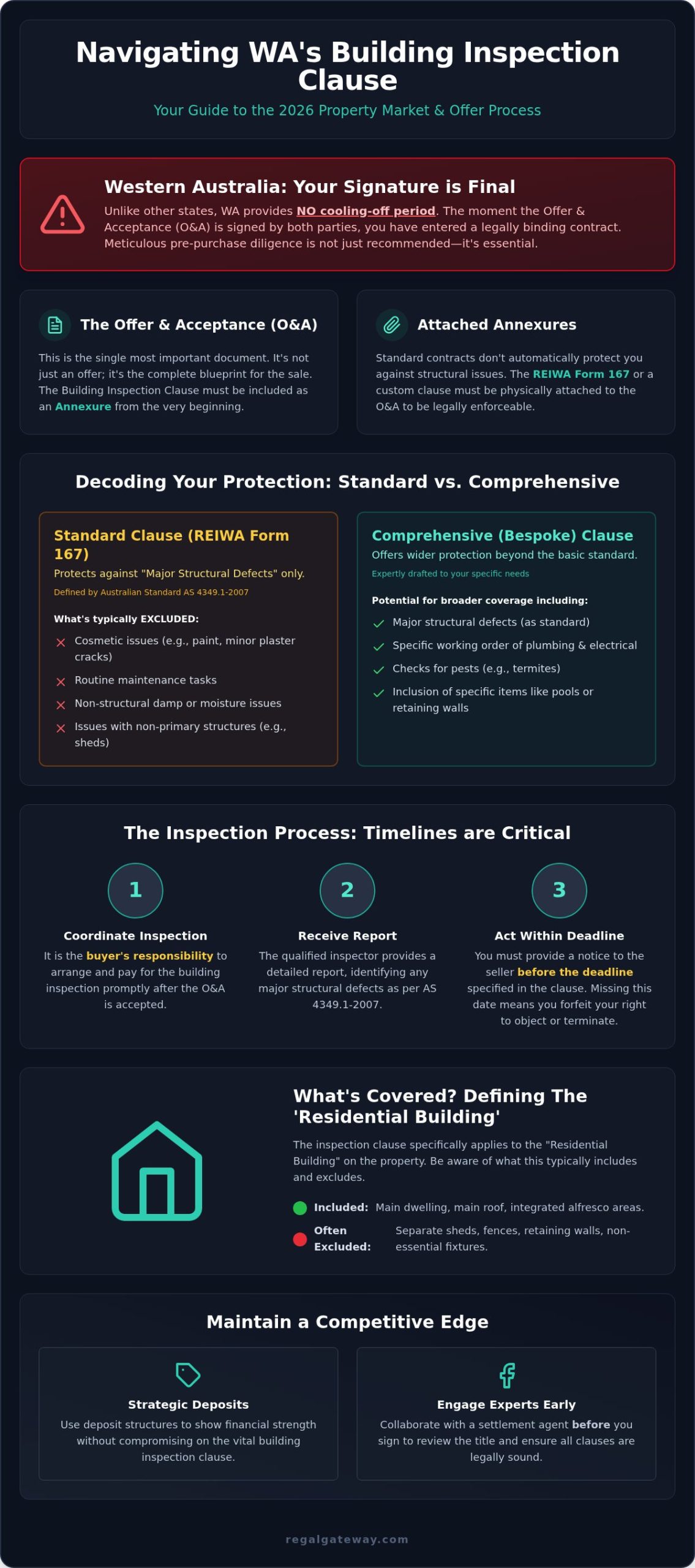
Beneath the surface of your specific terms lies the Joint Form of General Conditions. This document serves as the silent foundation of your contract, providing a standardised framework for the sale of land in WA. However, it’s vital to understand that the standard pre-printed terms don’t automatically include detailed protections regarding the physical state of the dwelling. Instead, the building inspection clause WA is typically presented as an Annexure. This additional document must be meticulously drafted and attached to the O&A to ensure it carries the full weight of Australian contract law once the deal is finalised.
The Reality of Finality in WA
The Western Australian market operates with a level of finality that often surprises those accustomed to the eastern states. Unlike New South Wales or Victoria, where a mandatory cooling-off period provides a safety net for second thoughts, WA offers no such reprieve. Your first signature is your final commitment to the vendor. The Contract for Sale of Land or Strata Title by Offer and Acceptance becomes a legally binding instrument the moment mutual acceptance is reached between the vendor and the purchaser. This lack of a “change of mind” window makes your initial conditions paramount; if a protection isn’t in the contract at the time of signing, you don’t have it.
The Role of the Settlement Agent
Engaging a sophisticated settlement agent before you commit your signature to the page is a hallmark of a discerning buyer. While a building inspector focuses on the physical integrity of a home in Success or Wandi, your settlement agent scrutinises the legal integrity of the asset. They review the Certificate of Title for encumbrances, easements, or restrictive covenants that a physical inspection won’t catch. By collaborating with your agent early, you ensure that all annexures are authorised, legally enforceable, and aligned with your broader investment strategy. This proactive approach transforms a standard transaction into a curated experience of secure property ownership.
Standard vs. Comprehensive: Decoding the Inspection Clause
The security of your future home depends entirely on the precision of the language used in your contract. While most buyers are familiar with the concept of a building inspection clause WA, few understand the profound difference between a standard REIWA Form 167 and a comprehensive, bespoke annexure. The standard clause is designed to protect against “Major Structural Defects,” a technical term that often excludes many issues a buyer might consider significant. Relying solely on the basic template without expert refinement can leave you vulnerable to costly repairs immediately after settlement.
According to Consumer Protection WA, including a clear building inspection condition is one of the most vital steps in pre-purchase due diligence. However, the standard protection is limited to the integrity of the primary load-bearing elements. This means that aesthetic imperfections, minor maintenance items, or even certain non-structural damp issues won’t typically trigger a right to terminate or demand repairs. To ensure your investment is truly protected, you must look beyond the structural shell.
The Major Structural Defect Trap
The definition of a “Major Structural Defect” follows the Australian Standard AS 4349.1-2007, which focuses on the failure of structural members. It’s a high bar to clear. For instance, a leaking shower or a series of cracked floor tiles might be frustrating and expensive to fix, but they rarely qualify as structural failures. Without specific wording that includes “Good Working Order” for electrical, plumbing, and gas appliances, you may find yourself inheriting a home where the oven doesn’t heat or the air conditioning has failed, with no legal recourse against the seller. When you partner with our team for bespoke residential property sales advice, we help you identify these gaps before you sign.
Timber Pest Protection
In the Western Australian climate, a timber pest inspection isn’t an optional luxury; it’s a non-negotiable safeguard. Subterranean termites are a pervasive reality in suburbs like Atwell and Hammond Park, where sandy soils provide the perfect environment for these silent invaders. A standard pest clause focuses on active infestations, but a sophisticated buyer will also look for evidence of historic damage that may have compromised the home’s integrity. Under the 2026 updates to standard annexures, it’s essential to align your inspection dates with your finance approval timeline to maintain a seamless transition toward settlement. Ensuring the inspector is a registered builder adds a layer of professional competence that simple pest controllers might lack.
Defining the ‘Residential Building’ in Your Contract
In the world of high-stakes Western Australian real estate, precision is your most valuable asset. When you invoke a building inspection clause WA, you’re not just inspecting a physical structure; you’re triggering a legal definition of what constitutes the “Residential Building.” Misunderstanding this boundary can lead to a situation where major defects in expensive external features are entirely excluded from the seller’s obligation to repair. To ensure your pursuit of an elevated lifestyle is fully protected, you must understand exactly where the inspector’s mandate begins and ends.
The standard REIWA Pre-Purchase Building Inspection Annexure generally limits its protection to the primary dwelling. This technicality means that the structural integrity of the home is guaranteed, but the surrounding infrastructure may not be. For a buyer, the goal is to align the contract with the reality of the property’s layout, ensuring that every significant architectural element is accounted for within the structural assessment. This requires a meticulous approach to the Offer and Acceptance process, moving beyond generic terms to define the scope of the inspection with absolute clarity.
What is Under the Main Roof?
The “Main Roof” rule is the primary barometer used to determine inclusions in a standard inspection. Traditionally, this encompasses everything sharing a continuous roof structure with the primary dwelling, such as habitable rooms, integrated garages, and original verandahs that were part of the initial architectural design. Modern houses for sale in Atwell often feature sophisticated alfrescos under the main roof line, ensuring these luxurious outdoor spaces receive the same structural scrutiny as the master suite. However, standalone structures like detached granny flats or permanent studio retreats are often considered separate entities. Unless they are explicitly named in your annexure, they may fall outside the protective umbrella of the standard clause.
The Common Exclusions
Vulnerabilities often hide in plain sight within the garden and perimeter of a property. Standard wording frequently leaves structures like detached patios, pergolas, and carports exposed if they aren’t physically integrated into the main roof. In a high-value transaction, ignoring these elements is a risk that can compromise your peace of mind. Similarly, retaining walls and fences are essential for the stability of many WA blocks, yet they aren’t automatically considered part of the “Residential Building.” To secure your investment, you should consider adding specific ‘Annexure items’ to your contract to cover:
- Structural retaining walls that provide essential land stability.
- Boundary fencing and security gates.
- Bore pumps and integrated reticulation systems.
- Pool equipment, including pumps and heating units.
By defining these as essential components of the sale, you ensure they are verified as being in good working order or structurally sound before you take possession of your new retreat.
Managing Deadlines and the Inspection Process
In the fast-paced 2026 real estate market, time is the most unforgiving element of your contract. The ‘Inspection Date’ stipulated in your Offer and Acceptance represents a critical boundary that defines the validity of your building inspection clause WA. Missing this prescribed deadline by even a single business day can result in the automatic waiver of your rights, leaving you to inherit any structural liabilities without recourse. Success in these high-stakes transactions requires a disciplined approach to the calendar, ensuring every procedural requirement is met with professional precision.
As a buyer, the burden of momentum rests entirely on your shoulders. You are responsible for appointing an inspector, facilitating their access to the property, and covering all associated costs. Your obligation isn’t merely to conduct the inspection, but to deliver the complete report to the seller or their agent by the agreed-upon date. This delivery is the formal trigger for any subsequent negotiations or rectification requests, making it the linchpin of your pre-settlement strategy.
The Critical Path to Settlement
Navigating the interval between acceptance and settlement requires a structured timeline to maintain your legal advantage. We recommend following these three essential steps:
- Step 1: Appoint a registered building surveyor or qualified inspector immediately upon the contract’s execution to ensure availability within your window.
- Step 2: Ensure the final report is delivered in full to the seller’s representative by the due date; partial summaries or verbal notifications are insufficient.
- Step 3: Evaluate the findings with your Regal Gateway Property advisor to determine the strategic implications of any identified issues.
When a Defect is Discovered
If your report identifies a major structural defect, the process transitions into a formal notification phase. You must serve a ‘Notice of Major Structural Defect’ to the seller, a step that requires acting in good faith. This isn’t an opportunity to renegotiate the purchase price for minor wear and tear, but a focused request for the rectification of significant failures. Once the notice is served, the seller typically has a window of up to 14 days to respond or remedy the issue. If the seller refuses to address a verified major structural defect, you may face a choice between terminating the contract or accepting the property as is. This is where professional guidance becomes indispensable, turning a potential deal-breaker into a managed negotiation. To ensure your interests are protected during these complex exchanges, contact our expert sales team for tailored residential property sales guidance.
Strategic Bidding: Balancing Protection and Competition
In the fervent 2026 real estate market, the allure of the “clean offer”, one stripped of all conditions, is a seductive but dangerous myth. While some suggest that waiving your building inspection clause WA is the only way to win in high-demand suburbs, doing so is a high-stakes gamble that fundamentally compromises your financial security. A sophisticated bidder understands that true leverage comes from demonstrating financial capacity and professional poise, not from abandoning essential due diligence. By utilising comprehensive local intelligence, such as our detailed market reports for Success WA, you can price your offer with surgical precision, ensuring it stands out for its accuracy and strength.
Demonstrating an elite financial position doesn’t require you to sacrifice your protection. Instead, consider using a variable deposit structure. By offering a more significant initial deposit than the standard requirement, you signal to the vendor that your liquidity is robust and your intent is serious. This strategic move allows you to maintain your inspection and finance clauses while appearing as a far more attractive candidate than those offering a lower deposit or an unconditional, but financially stretched, bid.
Winning in a High-Demand Market
Presenting an elite offer requires a delicate balance of transparency and tactical positioning. Rapport with the listing agent is often as critical as the offer price; an agent who trusts your professional approach is more likely to recommend your bid to their client. Be mindful of the 48-hour clause, a common mechanism in Western Australian contracts that allows a seller to accept a superior offer if you don’t move to an unconditional status within two days. By partnering with a boutique agency, you ensure your offer is presented with the authority required to navigate these competitive pressures without forfeiting your right to a structurally sound home.
The Final Inspection Protocol
Your journey toward acquiring an enduring asset culminates in the pre-settlement walkthrough. This is your final opportunity to verify that the property’s condition remains consistent with the day you signed and that any negotiated rectifications for major structural defects have been completed to an authorised professional standard. It’s not merely a formality; it’s the final safeguard in a meticulously managed process. If agreed repairs are found wanting, your settlement agent can facilitate the necessary hold-backs to ensure compliance before funds are released. We invite you to adopt a higher standard of property acquisition and experience a curated real estate journey with our specialist team, where every nuance of your transaction is handled with the poise and expertise your investment deserves.
Securing Your Future in the Cockburn Property Market
Navigating the intricate landscape of Western Australian real estate requires more than just financial readiness; it demands a strategic mastery of the contractual instruments that safeguard your future. By understanding the technical nuances of the building inspection clause WA, you transform a standard transaction into a secure investment in an enduring asset. We’ve explored the critical importance of defining structural boundaries and the necessity of adhering to strict procedural deadlines to maintain your legal advantage. These measures ensure that your transition into a new home in Atwell or Success is defined by confidence rather than uncertainty.
Regal Gateway Property provides the bespoke guidance and extensive local expertise required to navigate these complex negotiations with professional poise. As a trusted agency rooted in the City of Cockburn, we’re dedicated to facilitating your access to a superior quality of life through transparent market intelligence and a high-end service model. We invite you to discover your next home with Regal Gateway Property and experience a curated journey toward property success. Your pursuit of an elevated lifestyle deserves the protection of a partner who values excellence as much as you do.
Frequently Asked Questions
Is there a cooling-off period when making an offer on a house in WA?
No, Western Australia does not provide a mandatory cooling-off period for residential property transactions. Once both the buyer and seller sign the Offer and Acceptance document, the contract becomes legally binding immediately. This lack of a “grace period” highlights why your initial conditions and the building inspection clause WA are so critical. You must be entirely satisfied with the terms before committing your signature, as there is no statutory right to withdraw once mutual acceptance is reached.
What qualifies as a ‘Major Structural Defect’ in a WA property contract?
Under the standard REIWA annexure, a Major Structural Defect is defined as a significant failure of a structural member that requires rectification to prevent further damage or safety risks. This typically includes issues with the foundations, load-bearing walls, floor joists, or roof framing. It specifically excludes non-structural items like cosmetic cracks, leaking taps, or general maintenance. Understanding this high threshold is essential for managing your expectations during the settlement process in suburbs like Success or Hammond Park.
Who pays for the building and pest inspection in Western Australia?
The buyer is responsible for both the cost and the coordination of building and pest inspections in Western Australia. While you bear the financial investment, this arrangement ensures the inspector works exclusively in your interest, providing an unbiased assessment of the property’s integrity. In the 2026 market, standard inspections in Perth generally range between A$595 and A$895, with combined building and pest reports offering a more cost-effective strategy for comprehensive due diligence before settlement.
What is a 48-hour clause, and how does it affect my offer?
A 48-hour clause is a condition that allows a seller to continue marketing the property while your offer is “subject to” certain conditions, such as finance or a building inspection. If the seller receives a superior, unconditional offer, they can trigger this clause. You then have 48 business hours to waive your conditions and proceed to an unconditional contract. If you cannot or choose not to, the seller may terminate your agreement to accept the other offer.
Can I withdraw my offer if the building report shows minor maintenance issues?
You generally cannot withdraw your offer based on minor maintenance issues if you are using the standard REIWA building inspection clause WA. The standard protection is strictly limited to major structural defects that compromise the building’s stability. Issues like peeling paint, stiff doors, or cracked roof tiles are considered “maintenance” rather than “structural.” To protect against these, you would need to negotiate a more comprehensive “Good Working Order” annexure before signing the initial Offer and Acceptance.
How long do I have to complete a building inspection after my offer is accepted?
The timeframe is dictated by the specific date inserted into your Offer and Acceptance contract. Typically, buyers negotiate a window of 7 to 14 days from the date of acceptance to conduct the inspection and deliver the report to the seller. In a competitive market, shorter windows are often preferred by vendors. It’s vital to appoint a registered builder immediately to ensure you don’t miss these strict deadlines, which could lead to the automatic waiver of your rights.
What happens if the seller refuses to fix a structural defect found during inspection?
If a major structural defect is identified and the seller refuses to rectify it, the buyer typically has the right to terminate the contract and receive their deposit back in full. Alternatively, you might choose to proceed with the purchase and handle the repairs yourself, perhaps using the defect as a point for further price negotiation. This phase requires careful legal and strategic guidance to ensure you don’t inadvertently breach the contract while protecting your long-term financial interests.
Do I need a building inspection clause if I am buying a brand-new home?
Even when purchasing a brand-new residence in developing areas like Wandi or Treeby, a building inspection remains a vital safeguard. While you may have a builder’s warranty, a “Practical Completion Inspection” ensures that the home meets Australian Standards before you take possession. This professional review identifies defects or incomplete works that are much easier to rectify before you move in. It provides an essential layer of security, confirming that your new asset is truly a private retreat of excellence.