
What if the deliberate choice to report a short-term fiscal deficit was actually the most sophisticated method for securing a multi-million dollar legacy in the Western Australian southern suburbs by 2030? You’ve likely felt a sense of trepidation when exploring what is negative gearing, perhaps balancing the anxiety of immediate out-of-pocket costs against the desire for a more prosperous future. It’s a common hesitation for investors in the Atwell and Cockburn Central markets, where the distinction between losing money and gaining wealth is often blurred by a lack of precise, local intelligence.
This strategic guide clarifies how negative gearing serves as a visionary gateway to unparalleled capital appreciation and portfolio growth within the prestigious Cockburn property landscape. We’ll demystify the 2026 regulatory shifts and provide a bespoke roadmap for leveraging tax efficiencies to build a curated property sanctuary. By examining specific 6164 postcode performance data and strategic acquisition techniques, you’ll discover how to transform today’s deductions into tomorrow’s enduring financial security.
Key Takeaways
- Gain a profound understanding of what is negative gearing and how this bespoke financial mechanism allows you to offset investment expenses against your income for superior tax efficiency.
- Discover the visionary logic behind prioritizing long-term capital appreciation over immediate yield to effectively subsidize the acquisition of prime real estate within the Cockburn region.
- Identify the specific market dynamics within Atwell, Hammond Park, and Wandi that make these southern corridor locales the premier choice for a sophisticated investment strategy.
- Learn to navigate interest rate sensitivity and regulatory shifts with professional poise, ensuring your property portfolio remains a secure and enduring legacy.
- Understand the necessity of a concierge-level property management partner to safeguard your assets and facilitate your journey toward unparalleled financial success.
Understanding Negative Gearing: The Bespoke Financial Mechanism
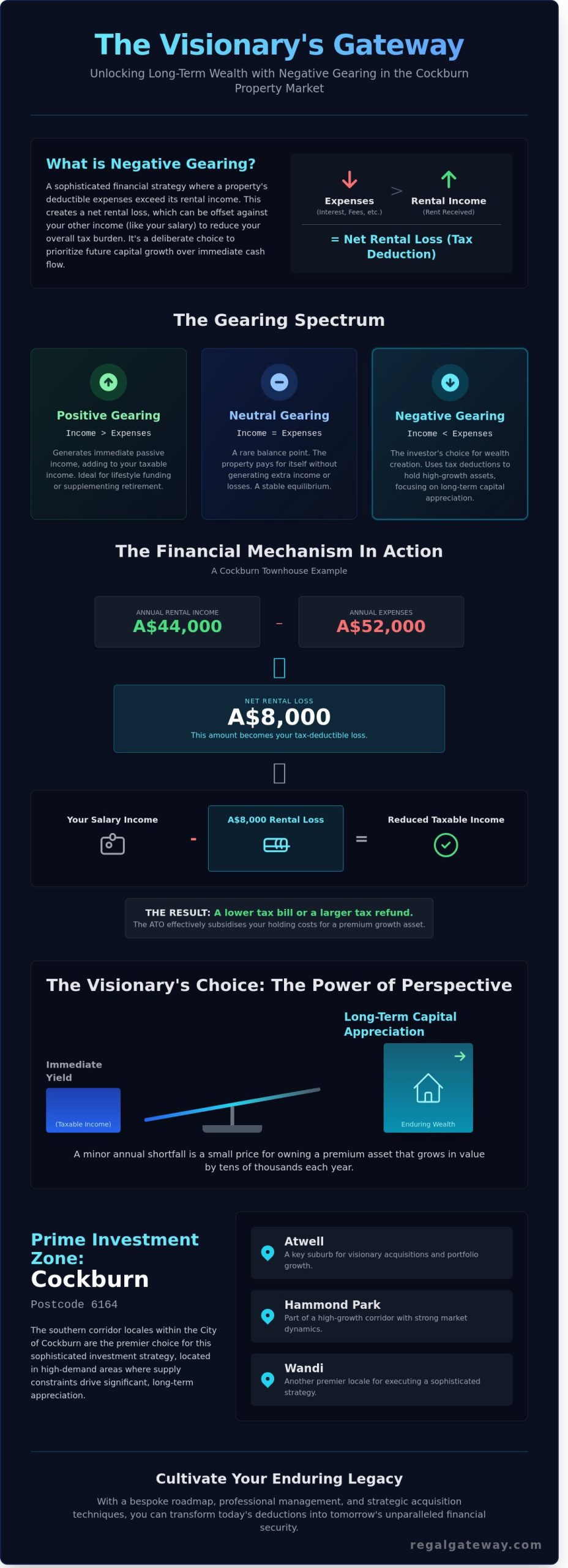
Negative gearing represents more than a mere accounting deficit. For the discerning investor navigating the 2026 property market, it’s a calculated entry into high-value asset ownership. When we explore what is negative gearing, we define it as a sophisticated investment state where the deductible expenses of a property, including mortgage interest and maintenance, exceed the gross rental income generated. This creates a net rental loss, which the Australian Taxation Office (ATO) allows you to offset against other forms of income, such as your professional salary.
Strategic investors in Atwell and Cockburn view this phase as a temporary, purposeful stage in a broader wealth journey. It’s not a failure of the asset to perform, but rather a deliberate choice to prioritize long-term capital growth over immediate liquidity. By 2026, the focus has shifted toward securing prime land holdings in Western Australia’s high-growth corridors, using tax efficiencies to lower the holding costs of these visionary acquisitions. Understanding the distinction between actual cash flow losses and “paper losses” is essential. Non-cash deductions, particularly depreciation on a new A$800,000 residence, allow you to claim a loss on paper without an equivalent out-of-pocket expense, preserving your actual cash reserves.
The Fundamental Equation of Gearing
The arithmetic of this strategy is precise and requires a meticulous approach to portfolio management. You must weigh the total rental income against the cumulative costs of interest repayments, property management fees, insurance, and council rates. If your annual expenses for a Cockburn townhouse reach A$52,000 while the rent returns A$44,000, the A$8,000 shortfall becomes a powerful tool. This loss reduces your overall taxable income at your marginal tax rate, effectively receiving a subsidy from the tax system to hold a premium asset. Negative gearing is the strategic bridge between current tax efficiency and future capital gain.
Positive vs. Negative vs. Neutral Gearing
- Positive Gearing: This occurs when your rental income exceeds all operating costs and interest. It generates immediate passive income, ideal for those seeking to fund a luxury lifestyle or supplement retirement funds.
- Neutral Gearing: This is the rare balance point where income meets expenditure perfectly. It’s a stable equilibrium that neither costs the investor out-of-pocket nor adds to their tax burden.
- Negative Gearing: The preferred entry point for many high-net-worth individuals in suburbs like Atwell. It allows for the acquisition of superior properties with higher growth potential that might otherwise be cash-flow prohibitive.
The historical context of Negative gearing in Australia shows it’s a foundational element of the national investment landscape. When you ask what is negative gearing in the context of a 2026 strategy, you’re looking at a gateway to prestige. It’s a method of securing a sanctuary or a legacy for the future while utilizing current tax structures to manage the journey. This approach ensures that your capital is working in high-demand areas where supply constraints drive significant appreciation over time.
The Visionary Logic: Why Investors Seek Strategic Losses
Sophisticated investors within the City of Cockburn rarely view a property through the narrow lens of monthly cash flow. Instead, they perceive these assets as powerful vehicles for long-term wealth creation. Understanding what is negative gearing requires a fundamental shift in perspective; it’s the art of prioritising substantial capital appreciation over immediate, taxable yield. By accepting a calculated deficit between rental income and holding costs, you essentially invite the Australian Taxation Office to subsidise your acquisition of premium real estate.
This strategy serves as a gateway to larger asset bases that might otherwise remain out of reach. When you reduce the “holding cost” of a high-value property through tax offsets, you’re able to control a more significant piece of the Cockburn landscape. The logic is simple yet profound. A minor annual shortfall is a small price to pay for the privilege of owning a sanctuary that grows in value by tens of thousands of dollars each year. This is the essence of strategic portfolio diversification in a competitive market.
Capital Growth as the Ultimate Prize
Historical data from the Atwell and Success corridors demonstrates why capital growth remains the superior objective for the high-net-worth individual. In 2025, several pockets within Atwell saw median price increases exceeding 8.5%, a figure that renders a 1% or 2% rental shortfall statistically insignificant. When a A$900,000 property appreciates by 7%, the A$63,000 gain in equity vastly outweighs the after-tax cost of maintaining the mortgage. Selecting “Blue Chip” locations ensures this growth trajectory remains reliable. Investors who focus on these prime suburbs are not merely buying bricks and mortar; they’re securing a legacy within a region known for its enduring desirability and infrastructure investment.
The Role of Depreciation in 2026
Modern tax strategies in 2026 place a heavy emphasis on the “paper losses” generated through depreciation. Newer builds in emerging suburbs like Treeby offer unparalleled opportunities to utilise capital works and plant and equipment deductions. These non-cash expenses allow you to deepen the tax benefits of your investment without increasing your actual out-of-pocket spending. By commissioning a bespoke depreciation report from a qualified quantity surveyor, you can unlock thousands of dollars in annual claims. This technical precision ensures that your property remains a fiscal asset even while it serves as a physical sanctuary for its residents. As you curate your investment journey, aligning with a strategic advisor can transform these managed losses into the foundation of a prosperous future.
Negative Gearing in the Cockburn Market: Atwell, Success, and Beyond
Perth’s southern corridor offers a sophisticated environment for investors evaluating what is negative gearing and how it functions as a portal to long-term wealth creation. In the current 2026 market, entry prices for premium 4×2 homes in the Cockburn region have seen a 12% increase over the past eighteen months. This growth often results in a strategic shortfall between rental income and holding costs, which savvy investors use to their advantage. Suburbs like Hammond Park and Wandi represent visionary choices for this approach. These locales benefit from their proximity to the A$1.2 billion Cockburn Gateway upgrade and the Kwinana Freeway, ensuring that short-term tax benefits are eventually eclipsed by substantial capital appreciation.
The evolution of the Cockburn Central precinct acts as a powerful catalyst for property values. The integration of the Metronet Thornlie-Cockburn link, which reached full operational capacity in late 2025, has already begun to drive up land value across the corridor. This creates a unique window for the strategic acquisition of assets. By securing property in these high-growth zones, you aren’t just buying real estate; you’re establishing a legacy within a corridor that is rapidly becoming the commercial and lifestyle heart of Perth’s south. Balancing a portfolio here requires a blend of high-growth detached houses and high-yield modern townhouses to maintain a healthy financial equilibrium.
Suburb Spotlight: Atwell and Aubin Grove
Atwell and Aubin Grove stand as pillars of stability within any high-end portfolio. The occupancy rates in these family-oriented suburbs reached a record 99.2% in January 2026, reflecting a deep-seated demand for residences that offer a sense of sanctuary. This lifestyle appeal ensures that your investment isn’t just a structure, but a sought-after home that attracts high-caliber tenants. To understand why these areas command such prestige and how they support a stable investment strategy, view our comprehensive analysis of Living in Atwell WA: The Ultimate 2026 Lifestyle and Suburb Guide.
Yield Analysis in the Southern Corridor
Balancing your portfolio requires a meticulous comparison between asset types. While a modern townhouse in Success might provide a 5.2% gross yield, a bespoke family home in Atwell offers the kind of long-term security and growth that seasoned investors prize. You must also integrate the cost of elite oversight into your calculations when determining what is negative gearing looks like for your specific tax bracket. Property management fees are a vital component of this equation, as these costs are typically tax-deductible and ensure your asset is maintained to an unparalleled standard. For a precise look at how these figures impact your bottom line, refer to our Property Management Fees in Atwell & Cockburn: A Strategic 2026 Guide.
- Atwell 4×2 Homes: High capital growth potential with stable, long-term family tenancies.
- Success Townhouses: Higher immediate rental yields with lower entry price points.
- Hammond Park: Significant growth corridor driven by new infrastructure and lifestyle amenities.
- Wandi: Modern housing stock offering excellent depreciation benefits for tax purposes.
Navigating the Risks: Market Stability and Regulatory Shifts
Every visionary investment requires a clear-eyed assessment of potential headwinds. While the primary allure of what is negative gearing lies in its tax-effective nature, the strategy is inherently tied to market volatility and the cost of debt. The most common objection among Atwell and Cockburn investors is the fear of a capital loss. If the property’s value does not appreciate at a rate that exceeds the annual out-of-pocket losses, the strategy loses its efficacy. In the Western Australian market, where median house prices in Cockburn rose by approximately 14% between 2023 and 2024, the risk of stagnation appears low; however, historical data proves that property cycles are never linear.
Interest rate sensitivity remains the most significant variable for a negatively geared portfolio. A 0.50% increase in the Reserve Bank of Australia’s cash rate can add thousands of dollars to annual interest expenses, potentially stretching an investor’s cash flow beyond a comfortable limit. To mitigate this, sophisticated investors maintain a bespoke financial buffer. This liquidity reserve, ideally covering at least four to six months of mortgage repayments and property expenses, ensures that a temporary vacancy or an unexpected repair does not compromise the asset’s stability. By 2026, we anticipate heightened scrutiny of Australian tax concessions. Monitoring potential legislative shifts regarding Capital Gains Tax (CGT) discounts is vital, as any alteration to these policies could impact the terminal value of your investment sanctuary.
Managing Cash Flow Volatility
High-quality tenant selection acts as a premier hedge against the inherent risks of gearing. A property that sits vacant for even 21 days can disrupt a meticulously planned tax strategy. Securing a reliable tenant who views your property as a long-term home ensures the consistent rental yield required to service debt. To achieve this level of security, you must master The Art of Tenant Screening in WA: Securing Premium Investments. Maintaining the property to an unparalleled standard further guarantees that your asset remains a first-choice selection for the most desirable residents in the market.
The Exit Strategy: From Negative to Positive
The ultimate goal of understanding what is negative gearing is recognizing it as a temporary phase in a broader wealth creation journey. As you reduce the principal debt or as rental prices increase, the property will eventually “flip” into a positive income stream. This transition requires a visionary approach to debt reduction and a firm grasp of the eventual impact of Capital Gains Tax. Planning your exit strategy well in advance ensures that your portfolio remains a sanctuary of generational wealth rather than a financial burden. Your investment should always serve your lifestyle, providing the freedom that comes with a well-curated and strategically managed asset base.
Ready to secure your financial future with a tailored investment approach? Connect with our strategic advisors to explore premium opportunities in the 2026 market.
Cultivating Your Legacy: Professional Management and Acquisition
Securing a prosperous future in the Atwell and Cockburn corridors requires a shift from passive ownership to active, strategic management. Regal Gateway acts as your sophisticated concierge, providing the expertise necessary to transform a simple residential asset into a high-performing component of your financial legacy. Our role is to bridge the gap between a standard acquisition and a visionary investment that stands the test of time in Western Australia’s evolving market.
When you grasp the intricacies of what is negative gearing, you quickly realise that the quality of your property management team directly impacts your fiscal efficiency. A sophisticated partner doesn’t just collect rent; they protect the tax-effective structure of your investment. By ensuring every allowable expense is meticulously documented, we help you maintain the delicate balance between rental income and deductible outgoings.
Bespoke Property Management Services
A premier investment deserves more than basic oversight. Professional management is the cornerstone of protecting your asset’s value and ensuring that your tax strategy remains robust. Our team focuses on high-precision reporting and proactive care, which are essential for investors who utilise what is negative gearing to offset their taxable income. We provide a level of transparency and meticulous care that allows you to focus on your broader portfolio goals while we handle the daily complexities.
Our commitment to excellence is reflected in our strategic approach to asset preservation, which includes:
- Coordination of comprehensive depreciation schedules to maximise non-cash tax deductions.
- Rigorous tenant selection processes designed to secure residents who value the sanctuary of your property.
- Strategic maintenance planning that preserves the premium condition of your home while managing cash flow.
Our approach to Property Management Atwell: The Definitive Landlord’s Strategy ensures that vacancy rates remain well below the Perth metropolitan average, which sat at a tight 0.7% in late 2024. This stability is vital for maintaining the predictable cash flow required for a successful long-term gearing strategy.
Your Gateway to Success
We invite you to experience a new standard of real estate partnership where every decision is backed by deep market intelligence and a commitment to your long-term prosperity. Our team provides the analytical depth required to navigate the 2026 market, ensuring your acquisitions in Cockburn Central or Atwell are positioned for maximum capital appreciation. We invite you to contact Samantha Francis for a visionary market appraisal that aligns your property’s potential with the evolving 2026 landscape.
Your journey toward a curated property portfolio begins with a single, strategic conversation. Whether you’re looking to acquire your first investment or refine an existing collection of assets, our experts are ready to provide a bespoke portfolio review tailored to your unique financial aspirations. Reach out to Regal Gateway today to unlock the full potential of your real estate legacy.
Securing Your Legacy in the Cockburn Property Market
Navigating the complexities of what is negative gearing requires a blend of financial precision and local market foresight. As we move through 2026, the ability to transform short-term revenue deficits into significant capital appreciation remains the hallmark of a sophisticated investor. By focusing on prime assets in Atwell and the surrounding City of Cockburn, you’re not just acquiring property; you’re cultivating a strategic sanctuary for your wealth. Success in this landscape demands more than just data; it requires the nuanced touch of a partner who understands the rhythmic flow of the Western Australian market.
Regal Gateway offers over a decade of unparalleled local market intelligence, providing a concierge-level service that’s both visionary and deeply grounded. Led by Samantha Francis, our independently owned boutique firm bridges the gap between ambitious investment goals and practical realization. Our award-winning property management team ensures every detail of your portfolio is meticulously curated; this allows you to enjoy the security of a well-managed legacy. We invite you to experience a higher standard of real estate expertise tailored to your unique financial journey.
Begin your journey toward investment excellence with a bespoke Atwell property appraisal.
Your path to a more prosperous future starts with a single, decisive step toward expert guidance.
Frequently Asked Questions
Is negative gearing legal in Australia for 2026?
Yes, negative gearing remains a foundational pillar of the Australian taxation landscape in 2026, allowing investors to offset property losses against their personal income. While policy discussions occasionally surface in Canberra, the current legislative framework preserves this mechanism as a legitimate strategy for wealth creation. Investors in the Cockburn region continue to utilize these provisions to manage their portfolios while awaiting long-term capital appreciation.
Can I use negative gearing for a holiday house in WA?
You can certainly apply negative gearing to a Western Australian holiday residence, provided the property is genuinely available for rent and isn’t reserved for exclusive personal use. The Australian Taxation Office requires that your claim is proportionate to the time the property is listed on the market at a competitive rate. If you spend 4 weeks at your Dunsborough retreat, you can only claim expenses for the remaining 48 weeks of the year.
What expenses can I claim on a negatively geared property in Atwell?
Investors in Atwell can claim an extensive suite of deductible expenses, including interest on the mortgage, property management fees, and council rates. You’re also entitled to claim non-cash deductions such as building depreciation and plant and equipment allowances, which are vital for enhancing your cash flow. Maintaining meticulous records of every A$1 spent on repairs or landscaping ensures you maximize your strategic tax position during the annual return process.
How does negative gearing affect my borrowing capacity for future homes?
Negative gearing often presents a paradox where it reduces your immediate borrowing capacity because lenders prioritize your ability to service debt despite the tax benefits. Most Australian banks will only recognize 80% of your rental income and will factor in the out-of-pocket costs of a loss-making property as a liability. This means a property losing A$500 per month could potentially reduce your future loan eligibility by over A$70,000 in the eyes of a conservative credit assessor.
What happens to my negative gearing if I move into the property?
The moment you transition an investment property into your primary sanctuary, your eligibility for negative gearing deductions ceases entirely. Since the property is no longer generating assessable income, you can’t claim interest or maintenance costs against your salary. It’s a significant shift that transforms the asset from a tax-effective investment into a personal legacy, requiring a complete recalibration of your financial strategy and portfolio balance.
Is it better to have a positively or negatively geared property in Success?
Choosing between a positively or negatively geared property in Success depends on whether you prioritize immediate liquidity or long-term capital appreciation. For high-income earners, understanding what is negative gearing is essential for reducing tax liabilities while holding premium assets in high-growth corridors. Conversely, a positively geared property provides a steady stream of A$100 to A$200 in weekly surplus cash flow, which is ideal for those seeking to bolster their lifestyle immediately.
How do I claim negative gearing on my tax return?
You claim negative gearing by detailing your total rental income and all associated property expenses within the rental schedule of your annual Australian tax return. The resulting net loss is then subtracted from your gross salary, reducing your overall taxable income and often triggering a substantial refund. Most sophisticated investors in Cockburn engage a specialist property accountant to ensure every A$1 of depreciation and interest is captured accurately to secure their financial position.
Can I still negatively gear if I have a low income?
While you can technically utilize negative gearing on a lower income, the strategic benefits are significantly diminished because you’re in a lower tax bracket. If your annual earnings are below the A$45,000 threshold, your tax saving might only be 19 cents for every A$1 lost, compared to 45 cents for high-wealth individuals. Understanding what is negative gearing reveals that the strategy is most potent when used to offset higher marginal tax rates rather than straining a limited cash flow.