
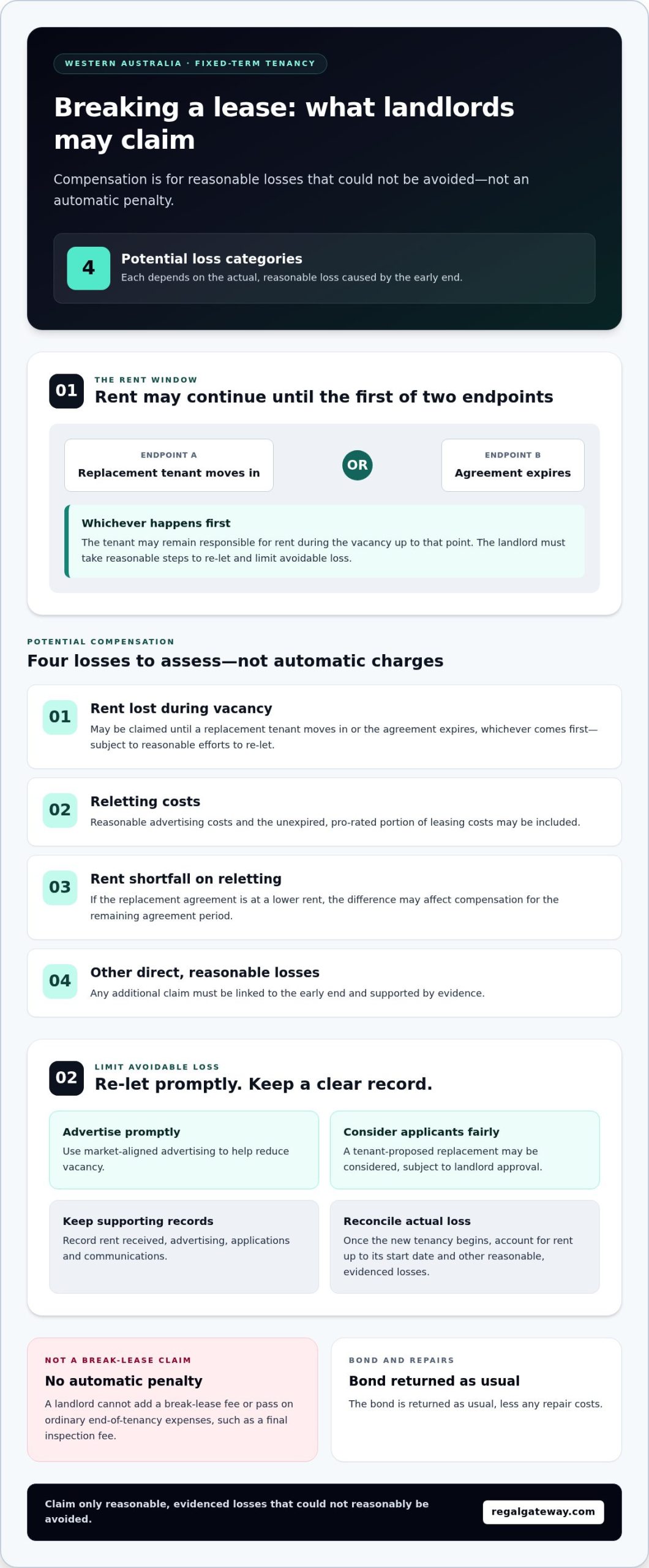
For WA landlords, the cost of breaking a lease is not an automatic penalty. A tenant who leaves a fixed-term agreement early may be liable for reasonable losses caused by the early end. These may include rent until a replacement tenant moves in or the agreement expires, advertising, a pro-rated leasing fee and, in some cases, the difference if the property is relet for less. Landlords must take reasonable steps to re-let the property and limit those losses.
It’s understandable to expect the departing tenant to cover the financial impact, particularly when a vacancy interrupts rental income. But compensation is for reasonable losses that could not have been avoided, not an extra fee for ending the agreement.
This guide explains what breaking a lease means in Western Australia, how to respond when a tenant is struggling to continue, and how the duty to limit losses affects what a landlord may claim. It also explains how lower rent on reletting can change the calculation, helping you manage the transition with clear expectations and a sound understanding of your responsibilities.
Key Takeaways
- A tenant leaving a fixed-term lease early may be responsible for reasonable losses, not an automatic penalty or usual end-of-tenancy charges.
- Rent may remain payable until a replacement tenant moves in or the agreement expires, whichever happens first.
- Prompt, market-aligned advertising and fair consideration of applications help limit vacancy and support a reasonable compensation claim.
- If the property is relet at a lower rent, the difference may affect compensation for the remaining agreement period.
- Financial hardship and a landlord’s request to end a fixed-term tenancy involve different processes, so understanding the relevant grounds matters.
What does ‘break a lease’ mean?
Breaking a fixed-term lease means the tenant ends the agreement before its agreed expiry date. In Western Australia, this may give rise to a claim for reasonable losses, not an automatic penalty.
Tenant Break-Lease Costs
Compensation is for reasonable costs caused by early termination, and the amount depends on the actual loss. In Western Australia, a tenant may be responsible for rent until a replacement tenant is found, advertising, a pro-rated leasing fee and other reasonable related losses.
For example, a landlord may seek rent lost during a vacancy, but must reduce avoidable loss by taking reasonable steps to re-let. The landlord also remains liable for a portion of the leasing fee, based on the time left when the lease ends. Western Australian rental guidelines outline that parties must act reasonably to mitigate any financial losses during an early termination.
Reasonable costs may include advertising and the remaining portion of leasing costs. A landlord cannot add a break-lease penalty or pass on ordinary end-of-tenancy expenses, such as a final inspection fee. The tenant’s bond is returned as usual, less any repair costs.
Early Lease Endings in WA
A sale, a landlord’s plan to move in or proposed demolition does not mean the tenant has agreed to end a fixed-term lease. A landlord may seek the tenant’s agreement but cannot require it. If the landlord faces undue hardship, they may apply to the Magistrates Court for an order ending the tenancy.
A landlord asking to end a fixed-term lease early can’t rely on a notice alone to compel the tenant to leave. The route identified for a landlord who says continuing the tenancy causes undue hardship is an application to the Magistrates Court. A periodic tenancy is different; landlords must use the applicable lawful notice process, while a tenant ending a periodic tenancy must give at least 21 days’ written notice.
If a landlord ends a tenancy unlawfully, they may face a claim for compensation for the tenant’s losses. A court may order a lessor to cover costs caused by termination, including relocation costs. Any claim depends on losses linked to the early end, rather than an automatic break fee.
For a dispute, the parties can seek a court order through the Magistrates Court. A tenant may also apply to the Court for an order using Form 12, titled Application for Court Order, on the e-courts portal. These routes matter when agreement cannot resolve whether the lease should end or who bears resulting costs, and professional property managers like Regal Gateway Property can help navigate these requirements.
What to do when a tenant cannot afford to continue with the lease agreement?
Financial hardship does not automatically end a Western Australian fixed-term tenancy. Until the tenancy officially ends or a replacement tenant moves in, whichever happens first, the tenant must continue paying rent. The landlord should clarify the tenant’s intentions, explain the likely financial consequences and keep the reletting process moving.
Start with a written conversation. Ask when the tenant expects to leave, whether they are proposing an early end date and whether they can continue paying rent in the meantime. A tenant who intends to break a lease should notify the landlord in writing as soon as possible. There is no universal minimum notice period for ending a lease early, so prompt communication can reduce uncertainty and potential costs.
Explain likely costs promptly, with an approximate figure and a breakdown. Depending on the circumstances, a tenant ending a fixed-term lease may be responsible for:
- Rent during the vacancy, until a replacement tenant moves in or the agreement expires, whichever comes first.
- Advertising costs and the unexpired portion of the leasing fee.
- A rent shortfall if the replacement agreement is at a lower rate.
- Other reasonable losses directly caused by ending the agreement early.
These are potential losses, not automatic charges. The amount depends on the vacancy, reletting terms and costs that could reasonably have been avoided. Keep records of rent received, advertising, applications and communications. Together, they show how the final figure was calculated.
Meanwhile, advertise promptly and consider a replacement tenant proposed by the tenant, subject to landlord approval. A replacement may shorten the vacancy, but the proposed start date and rent affect the calculation. If the tenant remains in the property while options are discussed, rent and the agreement’s other obligations continue to apply.
Where financial hardship is severe, the tenant may apply to court for early termination and must show how continuing the lease would cause further hardship. Moving for a new job alone does not automatically remove financial liability, unless specific legislation applies. Certain legally recognised grounds, including family violence or destruction of the property in a natural disaster, may allow early termination without break costs.
Once the new tenancy begins, reconcile rent up to its start date and calculate any other reasonable, evidenced loss. Return the bond as usual, less any repair costs. A precise written account helps both parties distinguish rent still payable from costs associated with the early end.
A replacement tenant may reduce vacancy costs, subject to landlord approval. If a tenant abandons the tenancy, the landlord may claim compensation for losses, including lost rent, subject to applicable limitations. Severe hardship may be relevant when seeking an early end to a tenancy.
Landlord duty to mitigate tenant losses
After a tenant breaks a fixed-term lease, a Western Australian landlord must take reasonable steps to find a replacement and limit losses. This duty affects what can be claimed: rent lost because the landlord delayed reletting or chose an unreasonable strategy may not be recoverable from the tenant. It also shapes the cost of breaking a lease WA for landlords, because avoidable losses cannot simply be passed on.
Begin marketing promptly once the property is ready to be shown and offered for rent. Avoidable delays can increase the tenant’s claimed liability, so keep dated advertisements, inspection arrangements and application records. If repairs are needed, distinguish essential work from optional renovations. Rent lost while completing avoidable renovations cannot be passed on to the tenant.
Set the advertised rent using an up-to-date comparative market analysis. A market-aligned figure supports a timely search for a suitable replacement, while setting the asking rent above that figure may weaken the landlord’s position. In Western Australia, advertising above a market-aligned rent during a break-lease process could be viewed as a failure to mitigate losses. It could also lead to penalty-free early termination of the agreement.
Consider applications fairly and respond without unnecessary delay. A landlord should not unreasonably reject applicants while seeking compensation for a continuing vacancy. Keep each application, the decision and the reason for declining it. For example, records of a prompt review and a specific tenancy-related concern explain a decision better than a bare rejection.
Reasonable mitigation does not require accepting every applicant or overlooking relevant suitability concerns. It does require a genuine, timely effort to secure a replacement on market terms. A tenant may suggest a replacement, subject to landlord approval, but the landlord’s assessment should be reasonable and focused on the application.
Keep a clear record of the rental transition. Note when advertising began, the rent sought, enquiries, viewings, applications, decisions and the date the new tenancy starts. These details help distinguish losses caused by the early departure from those arising from the landlord’s choices or avoidable delays. They also make the calculation more transparent for both parties.
Mitigation affects the amount claimed, not just the process. If the property remains vacant despite prompt advertising at a market-aligned rent and reasonable application decisions, document the steps taken when assessing lost rent. If reletting was delayed for discretionary work or the asking rent was above market, the avoidable portion may be excluded. This is central to assessing the cost of breaking a lease WA for landlords: a claim should reflect reasonable, evidenced losses.
Clear records and a disciplined reletting process help protect the landlord’s position while limiting the tenant’s exposure to avoidable costs. They also provide a practical basis for resolving disagreements about vacancy periods, rejected applications or the rent set for the new tenancy.
Compensation for a lower rent on reletting
If a replacement tenant agrees to pay less rent, the difference may form part of the landlord’s claim for loss during the original agreement’s remaining term. It is not an automatic fee. The relevant figure is the actual weekly shortfall, considered alongside the reletting date and the landlord’s efforts to limit losses.
The tenant who broke the lease may owe that weekly shortfall for the remainder of the original agreement.
To understand the calculation, separate the rent difference from vacancy loss. The replacement tenancy’s start date determines when rent from the new tenant begins. Before that date, the potential loss is rent for the vacant period. After it, the potential loss may be the weekly gap between the former rent and the new rent for the remaining agreement period.
Keep the calculation tied to the actual dates and amounts. A clear record should show:
- The rent payable under the original agreement.
- The rent agreed with the replacement tenant.
- The date the replacement tenancy begins.
- The remaining period of the original agreement.
- Rent received during any vacancy and after reletting.
This breakdown helps prevent overlapping claims. For example, vacancy rent ends when the replacement tenancy starts; the lower-rent shortfall relates to the period after that. The landlord should calculate each period separately, not charge vacancy rent after the new tenant has started paying.
The rent selected matters too. In Western Australia, a landlord must take reasonable steps to limit tenant losses. Advertising above a market-aligned figure could be viewed as failing to do so. An up-to-date comparative market analysis helps explain why the advertised rent was reasonable, especially if the replacement rent is lower.
Keep the advertisement, comparative analysis, signed replacement agreement and dated rent ledger together. These records connect the claimed difference to the actual reletting, rather than an unsupported estimate. They also show whether the landlord acted promptly and set a market-aligned rent.
If the replacement rent matches the original rate, there is no weekly rent difference to claim for the period after reletting. If it is lower, the claim should reflect the actual gap and remaining term, excluding losses the landlord could reasonably have avoided. A transparent calculation gives both parties a concrete basis for discussing compensation.
Can a landlord terminate a fixed-term tenancy early in WA, and on what grounds?
A Western Australian landlord cannot require a tenant to agree to end a fixed-term tenancy early. If the tenant declines, the landlord may apply to the Magistrates Court for an order ending the tenancy. The stated ground is undue hardship: continuing the tenancy would cause hardship to the lessor.
A planned sale, a landlord’s intention to move in or proposed demolition does not, by itself, secure the tenant’s agreement. These plans may explain why the landlord wants possession, but they do not replace mutual agreement or a court order. A fixed-term agreement remains in force unless it ends through a lawful process.
First, distinguish a request from a legal termination. The landlord can explain the proposed end date and invite the tenant to agree. The tenant may refuse. Do not treat a request as an instruction to leave or assume that a notice alone requires the tenant to depart early. The key question is whether the tenant agrees or the Magistrates Court orders termination.
For an undue-hardship application, the landlord’s case must explain how continuing the tenancy causes hardship. Set out the relevant circumstances clearly and connect them to the requested end date. A wish to sell or occupy the property should not, on its own, be presented as proof of undue hardship. If agreement cannot be reached on that ground, a court application is the available route.
Keep a written record of the proposal, the tenant’s response and the reason possession is sought. If the tenant agrees, record the termination date and any compensation arrangement. If agreement is not reached, do not act as though the tenancy has already ended while an application is unresolved. The existing agreement continues to govern the parties until it ends lawfully.
The financial consequences differ from those when a tenant breaks a lease. A landlord seeking early termination may face a claim for losses caused by ending the tenancy, including relocation costs. A court may order a lessor to compensate tenants for those costs. The outcome depends on the circumstances and the losses linked to termination, so keep relevant communications and expense records.
For future tenancies, strengthen tenant selection and screening to support informed leasing decisions. For a current fixed-term agreement, keep the focus on consent or the undue-hardship court process, rather than assuming a sale, move-in plan, or demolition ends the tenancy.
In Western Australia, a lessor can apply to the Magistrates Court to end a tenancy if continuing it would cause the lessor undue hardship. Keep the explanation focused on how the continuing tenancy affects the lessor, rather than presenting the desired outcome as the reason for termination. Set out the circumstances clearly, explain the hardship said to arise and connect it to the ongoing agreement. Keep supporting communications and records together, and ensure the account is consistent with what has already been communicated to the tenant. Avoid overstating the case: the application must rest on hardship caused by continuation, and applying does not guarantee that the tenancy will end.
Regal Gateway Property: Residential Property Sales
Regal Gateway Property offers Residential Property Sales for owners considering a change in plans after a tenancy ends. If you intend to keep the home as a rental, Property Management and Tenant Selection and Screening can support the next tenancy. If selling is the preferred direction, Residential Property Sales can help with that transition. The right next step depends on your plans for the property, its rental prospects and whether you want to keep it as an investment.
For guidance on your property’s next chapter, contact Regal Gateway Property.
Shape the next chapter for your property
A tenancy transition can be a useful time to reassess the role your property plays in your broader plans. Rather than treating the cost of breaking a lease in WA for landlords as an isolated event, consider how your next decision may shape the property’s future: retain it as a rental, prepare it for sale or refine your approach to selecting future tenants.
Regal Gateway Property offers Property Management and Tenant Selection and Screening for owners who plan to continue leasing residential property, as well as Residential Property Sales for those considering a sale. The right direction starts with your priorities for the property and the ownership experience you want going forward.
Contact Regal Gateway Property for advice about your property’s next step. A thoughtful decision today can help you move forward with greater clarity and confidence.
Frequently Asked Questions
Quick answer: How are break fees calculated?
In WA, there is no automatic fixed break fee when a tenant ends a fixed-term lease early. The calculation considers reasonable losses caused by the early end, such as lost rent, reletting expenses and any rent shortfall, while excluding avoidable losses and charges that cannot be passed on. For a practical audit, match each claimed amount to a receipt, rental ledger or dated tenancy record, and avoid counting the same loss twice.
What are you legally required to pay?
As a landlord, you remain responsible for your share of the leasing fee, based on the time remaining when the tenancy ends. A tenant may owe reasonable costs directly caused by breaking the agreement, but you cannot add a penalty or charge ordinary end-of-tenancy expenses such as a final inspection fee. For a property in Atwell, Aubin Grove, Wandi, Hammond Park, Success, Treeby or Mandogalup, keep the lease and cost records together.