
A tenancy-database check should be one part of a fair, consistent screening process, not the whole decision. A practical tenant selection criteria checklist for WA covers identity, income and affordability, rental history, landlord references, credit and rental-related debts, followed by a tenancy-database check as a cross-check.
Careful screening matters, and applicants deserve a clear picture of what you’ll assess. Set out consistent criteria before inviting applications so the process is easier to follow and decisions stay focused on relevant information.
This guide covers the checks to make, including assessing rental references, explaining your criteria before requesting application fees, reviewing credit and rental-related debts, and handling tenancy-database information appropriately. It also explains why a database result should be weighed against verified references and the applicant’s wider circumstances, rather than treated as a decision on its own.
Key Takeaways
- Compare rental history with references from recent property managers, and ask about payment patterns rather than relying on an application alone.
- Set out screening criteria clearly and apply the same relevant checks to every applicant.
- Consider credit history and rental-related debts alongside the applicant’s wider circumstances, not as isolated signals.
- Use tenancy-database results as a cross-check, and follow the rules for telling applicants about database use and handling listing information.
Checking rental history and landlord references
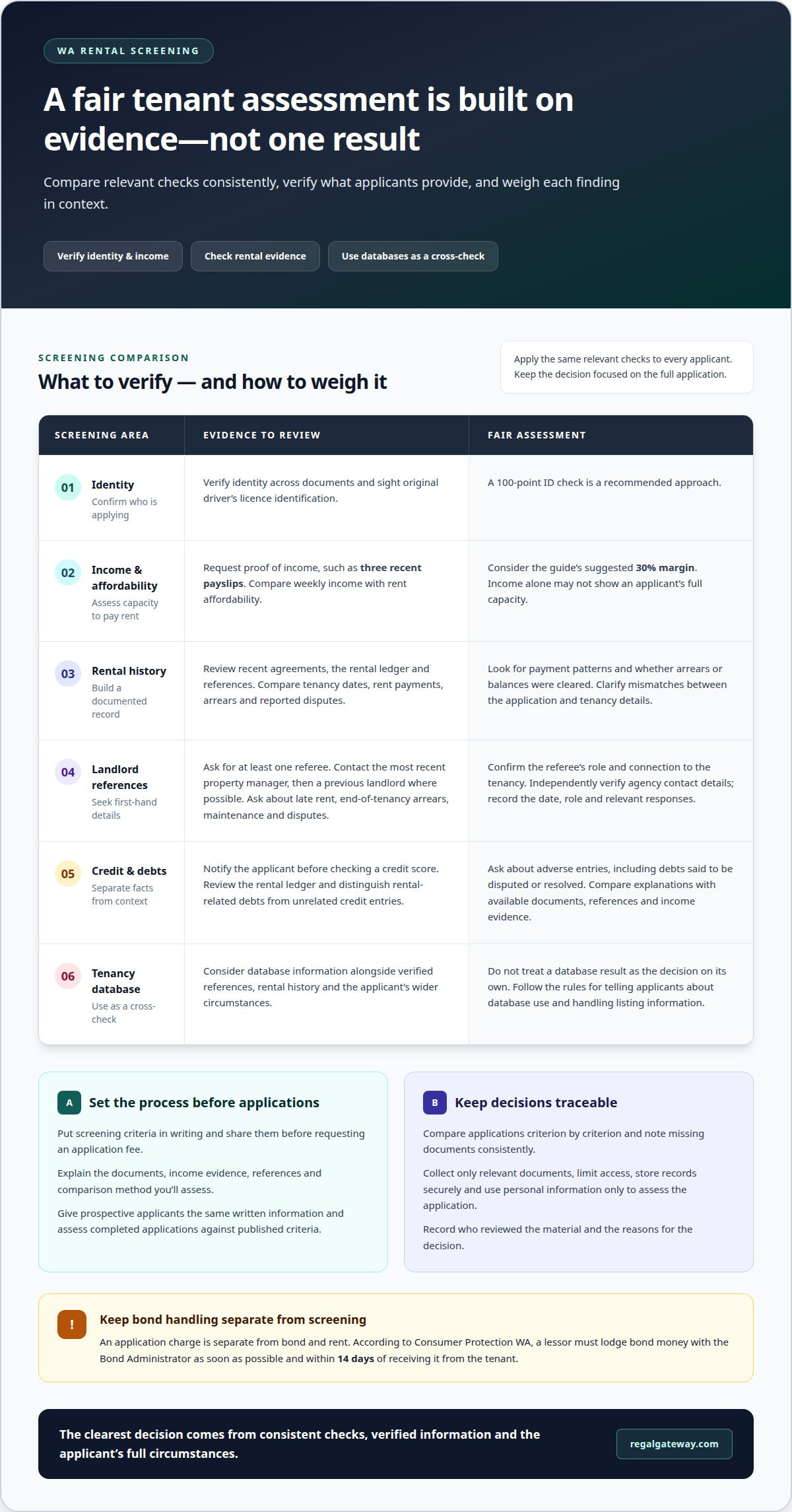
Build a documented rental history using the applicant’s recent agreements, rental ledger and references. Contact the property manager for the most recent tenancy, then a previous landlord where possible. Compare dates, rent payments, arrears and any reported disputes.
For identity, employment and income checks in WA, verify identity across documents and sight original driver’s licence identification; a 100-point ID check is a recommended approach. Request proof of income, such as three recent payslips, and compare weekly income with rent affordability, including the guide’s suggested 30% margin.
- Ask for at least one referee and contact the most recent property manager, because first-hand details can clarify payment and care patterns.
- Ask whether rent was ever late, whether arrears remained at the end of the agreement, and how maintenance or disputes were handled, because specific examples are more useful than general praise.
- Confirm the referee’s role and connection to the tenancy, because a personal contact cannot verify a landlord’s account as directly as a property manager.
- Compare reference dates and tenancy details with the application, because mismatches may need clarification before you decide.
For reference confirmation, use contact details independently associated with the agency or property management business, rather than relying only on a number supplied by the applicant. Record the date, referee’s role and relevant responses, and keep the notes with the application. Western Australia’s residential tenancy legislation includes the Residential Tenancies Act 1987, according to Western Australian Legislation.
To check references and make a rental offer in WA, contact the applicant’s recent property managers, confirm relevant details and weigh their responses alongside the rest of the application. Once the evidence supports a decision, communicate it and explain the tenancy agreement terms clearly.
Keep the bond process distinct from screening: according to Consumer Protection WA, Government of Western Australia, a lessor must lodge bond money with the Bond Administrator as soon as possible and within 14 days of receiving it from the tenant.
Providing written screening criteria before application fees
Before inviting applications for a WA rental, put your screening criteria in writing and share them before requesting an application fee. Explain which documents you’ll assess, the income evidence you require, how you’ll consider references and how you’ll compare applications. Clear criteria help every applicant understand the process.
- List each screening step, because applicants can prepare relevant information before submitting an application.
- Describe income evidence and affordability factors, because income alone may not show an applicant’s full capacity to meet rent.
- Explain which rental history and references you’ll consider, because applicants should know what evidence may inform the decision.
- Keep the criteria consistent, because changing the standard between applications makes comparative assessment less objective.
At property inspections, give every prospective applicant the same written information. Record questions and answers consistently. For example, explain the application process without implying that one visitor will receive preference. Assess completed applications against your published criteria, not impressions formed during a brief inspection.
Compare applications criterion by criterion. Keep a simple record of whether each applicant supplied the requested documents, met the stated income threshold and provided verifiable references. If an application is incomplete, note what is missing and give applicants the same process for providing further information. This gives you a clearer basis for comparing applications.
Collect only documents relevant to screening, such as proof of income and identity. Limit access to application records, store them securely and use personal information only to assess the rental application. Record who reviewed the material and the reasons for the decision so the process remains traceable.
For fees, deposits or holding payments, distinguish an application charge from bond and rent, and request only payments permitted under WA tenancy rules. According to Consumer Protection WA, Government of Western Australia, a lessor must lodge bond money with the Bond Administrator as soon as possible and within 14 days of receiving it from the tenant.
A documented process brings criteria and applicant records into one clear sequence; structured applicant screening can support a more consistent assessment.
An application charge is separate from bond and rent. Request only payments permitted under WA tenancy rules.
Reviewing credit history and rental-related debts
Consider credit information alongside the rental ledger, references and income evidence. Before checking an applicant’s credit score, notify them. Then assess whether any reported debts are relevant to their ability to meet rent and other tenancy obligations.
A credit result needs context. Ask about circumstances behind adverse entries, such as a recorded debt the applicant says is disputed or resolved. Compare their explanation with available documents and rental references, then record how each relevant detail informed your decision.
- Review the rental ledger for payment patterns, arrears and whether balances were cleared.
- Separate rental-related debts from unrelated credit entries, because their connection to tenancy obligations differs.
- Consider criminal-history information separately from credit and rental history, and assess only information relevant to the published screening criteria.
- Use the same relevant checks for each applicant and document the reasons for your assessment.
WA tenant-selection criteria should be relevant to the tenancy, clear and consistently applied. The Equal Opportunity Act prohibits discrimination against rental applicants on listed grounds, including family status. Assess applications using evidence, not assumptions about an applicant’s circumstances.
Assess pets, smoking and household size against clear, property-related criteria applied consistently. Children relate to family status, so don’t reject an application simply because an applicant has children. Record the specific tenancy-related reason for a decision instead of relying on a broad label.
Keep records focused. Note when a credit check was authorised, what information you considered and how the applicant’s explanation affected your assessment. For example, distinguish an unresolved rental arrear from a credit entry unrelated to a tenancy, and weigh each against the ledger and references.
Careful screening takes effort, but a written record makes it easier to explain how evidence supports a decision and to apply a consistent process. Don’t treat a credit score or criminal-history result as a complete picture of an applicant’s ability to meet rental obligations.
National tenancy database checks
A National Tenancy Database check is a cross-check, not a substitute for the application, rental ledger or references. In WA, tell prospective tenants if you use a tenancy database, follow the rules for listings and updates, and notify applicants before conducting credit-score checks.
Search the database after assessing the other screening criteria. This sequence helps keep the process objective: first consider the applicant’s information and references, then use any database result to identify records that need careful review.
- Confirm the applicant’s identity details before searching, so a similar name doesn’t lead to a record being assigned incorrectly.
- Review what the result actually reports, which may include rental history, bankruptcy information, court judgments and identity validation.
- Compare any rental record with the applicant’s account and available references, because an entry needs context before it affects a decision.
- Document the search date, result and how you considered it, keeping the record with the screening file.
A database entry can prompt useful follow-up, but it shouldn’t decide an application by itself. For example, a rental-history listing may raise questions about a past tenancy. Compare its details with the applicant’s account and other evidence before deciding what weight to give it.
Keep information proportionate to the decision. Distinguish a tenancy-related record from bankruptcy information or a court judgment, and note which published criterion each relevant finding relates to. If details differ from the application, ask for clarification and record the response rather than treating a mismatch as proof of wrongdoing.
For notice and database checks in WA, tell prospective tenants if you use a tenancy database and notify applicants before credit-score checks. Follow applicable rules for database listings and updates, and document each screening step consistently.
For a considered tenant-screening process, discuss applicant screening support as you prepare to assess rental applications.
Regal Gateway Property: Residential Property Sales
Regal Gateway Property provides Tenant Selection and Screening for owners seeking a considered, evidence-based approach to assessing applicants. If you’re preparing to lease a residential property, the service can help structure the screening process, from reviewing applications to considering references and tenancy-database information.
For support beyond selecting a tenant, Regal Gateway Property also provides Property Management. If you’re buying or selling a home, the agency offers Residential Property Sales as a separate service for that stage of your property plans.
Choose support that fits your immediate property needs, whether you’re assessing applicants, managing a rental or progressing a residential sale. Contact Regal Gateway Property to discuss the service that suits your next step.
Make your next tenancy decision with confidence
A strong selection process becomes a repeatable standard for managing your investment, not just a safeguard for one property. Use your tenant selection criteria checklist for WA as a practical decision framework, and review it when your property, application process or relevant requirements change. Clear records help you understand how decisions were reached and keep future assessments consistent.
Decide how much of the screening process you want to manage yourself. If you’d value support assessing rental applicants or guidance with another stage of your residential property plans, contact Regal Gateway Property to discuss the relevant service.
Contact Regal Gateway Property today to discuss a thoughtful next step for your property. With a clear process and the right support, you can move forward with greater assurance.
Frequently Asked Questions
What is a tenant screening checklist?
A tenant screening checklist is a repeatable set of steps for assessing a rental application against relevant criteria. A tenant selection criteria checklist for WA might track documents received, income evidence, rental references, credit checks and any database search. Following the same sequence helps show how each application was assessed. A notes column can capture missing details or points that need clarification.
What checks can landlords conduct on rental applicants in Western Australia?
WA landlords can assess identity, income, rental history and references, and may use credit checks or tenancy databases as part of screening. Notify applicants before credit-score checks, and tell prospective tenants if you use a tenancy database. For rentals in Atwell, Aubin Grove, Wandi, Hammond Park, Success, Treeby and Mandogalup, apply relevant criteria consistently and consider information in context.
What documents and information should a WA rental application checklist include?
Include the completed application, identity documents, proof of income, rental history and referee contact details. You can also record whether an applicant has authorised or been notified about relevant checks, where applicable. For example, note which income documents were supplied and the period they cover. Collect only information needed for assessment, restrict access to application records and use personal details only for screening.
Can WA landlords check rental history and contact previous landlords?
Yes. Landlords can contact an applicant’s previous property manager or landlord about relevant rental history. Ask factual questions about the tenancy, such as whether the applicant met payment obligations and how the agreement ended. If an applicant has no established rental record, consider other relevant information, such as employment references, rather than treating limited rental history alone as a negative.
How should WA landlords compare applications and choose a tenant fairly?
Compare each application against the same written, tenancy-related criteria, then record the evidence supporting your decision. A simple comparison can mark each criterion as met, needing clarification or not evidenced, without turning assumptions into conclusions. The Equal Opportunity Act prohibits discrimination against rental applicants on listed grounds. Keep decisions focused on relevant information, not protected attributes or personal impressions.
What tenant-selection records should WA landlords keep, and how can they reduce privacy and compliance risks?
Keep the criteria used, application documents, relevant correspondence, check dates and a concise record of your decision. Limit access to staff involved in screening, store files securely and avoid collecting details unrelated to the tenancy decision. For example, record why an application needed clarification and what information resolved the question. Clear records support consistent decisions, while careful handling helps protect applicants’ personal information.