
A polished pitch tells you less than a clear explanation of how a property manager works. Before deciding, ask for recent references from landlords and tenants, then ask about the manager’s experience, time at the agency and familiarity with properties like yours. These are some of the most useful questions to ask a property manager before hiring because they help you assess the service behind the promises.
Choosing someone to oversee a valuable asset takes more than a reassuring first meeting. You’ll want to understand how their approach suits your property, priorities and communication expectations, and get a transparent picture of the management arrangement.
This guide covers what to ask about fees, tenant screening, digital tools, experience and specialisation, and how to assess the answers. The aim is to help you make a well-informed hiring decision.
Key Takeaways
- Ask how tenant applications are assessed, including how income, rental history and references inform selection.
- Find out who will manage your property and how local market knowledge shapes rental recommendations and updates.
- Request a clear breakdown of management, letting and administration fees, with each service explained in writing.
- Assess relevant experience and specialisation through examples of similar properties and references from landlords and tenants.
1. 4.How do you screen tenants?
Ask the property manager to explain each screening step, from application to recommendation. A structured process should assess rental history, contact references and verify income claims. Ask whether checks include employment verification or credit checks, and how each result informs the decision. For example, a reference may clarify an applicant’s previous rental conduct, while verified income helps assess affordability.
Discuss how the agency sets selection criteria for your property. Criteria should reflect the property’s requirements and be applied consistently to every applicant. Ask whether the landlord can help establish those criteria before advertising, and how the manager balances your preferences with fair, lawful treatment. A tailored Tenant Selection Plan can clarify the decision process, while written records explain why an applicant was recommended.
Australian tenancy rules vary across states and territories, so landlords and property managers must follow the requirements that apply where the property is located. Ask the agency how it keeps screening, tenancy agreements, bond handling and notices aligned with those rules, and clarifies each party’s responsibilities in the management agreement.
Ask how rent arrears are followed up, when the landlord is informed, how the bond is lodged and who manages dispute communication. A defined process should record payment follow-up and outline the steps taken if a tenant falls behind. Clear agreement terms also establish how concerns are escalated and documented.
Finally, ask how the manager addresses tenant issues before they escalate and what process applies if eviction becomes necessary. The response should explain prevention, communication, documentation and the legal steps involved in ending a tenancy. Confirm who makes decisions at each stage and how you’ll receive updates. Specific answers show whether screening and ongoing tenancy management follow a considered, accountable process.
2.5. Digital tools for property management
Ask who will handle the property day to day, and how many properties they oversee. An Australian property manager should generally handle no more than approximately 120 properties. Ask how the agency allocates enquiries, inspections and leasing tasks, and who steps in when your manager is unavailable. Knowing the named contact and their responsibilities gives your management agreement a practical structure.
Local knowledge should inform rental recommendations, not just advertising language. Ask for a rental market report comparing your property with similar local rentals, including relevant features and current asking rents. Find out how often the manager reviews this information and how it informs the proposed rent. References from landlords with similar properties can help you understand the manager’s communication and reporting in practice.
Digital tools should make information easy to access. Ask whether owners receive statements, inspection reports and market updates by email or through an online portal. If tenants can pay rent through a portal, clarify how you can view payments and track rent collection. A useful system makes documents, payment records and updates straightforward to retrieve.
Discuss how the agency will advertise the rental, including its use of major rental listing websites and social media. Ask who prepares the listing, responds to enquiries and updates you on leasing progress. Also clarify inspection arrangements: routine inspections should follow the legislation that applies in the property’s state or territory. Ask what reports you’ll receive afterwards.
If you change managers, agree on a handover covering tenancy records, rent records, inspection reports, correspondence and keys or access devices. Ask who coordinates the transfer and how outstanding matters are recorded, so the incoming manager can continue with an accurate collection of information. A clear handover process supports continuity; explore local property management guidance as you consider the right approach for your rental.
3. 2.What fees do you charge?
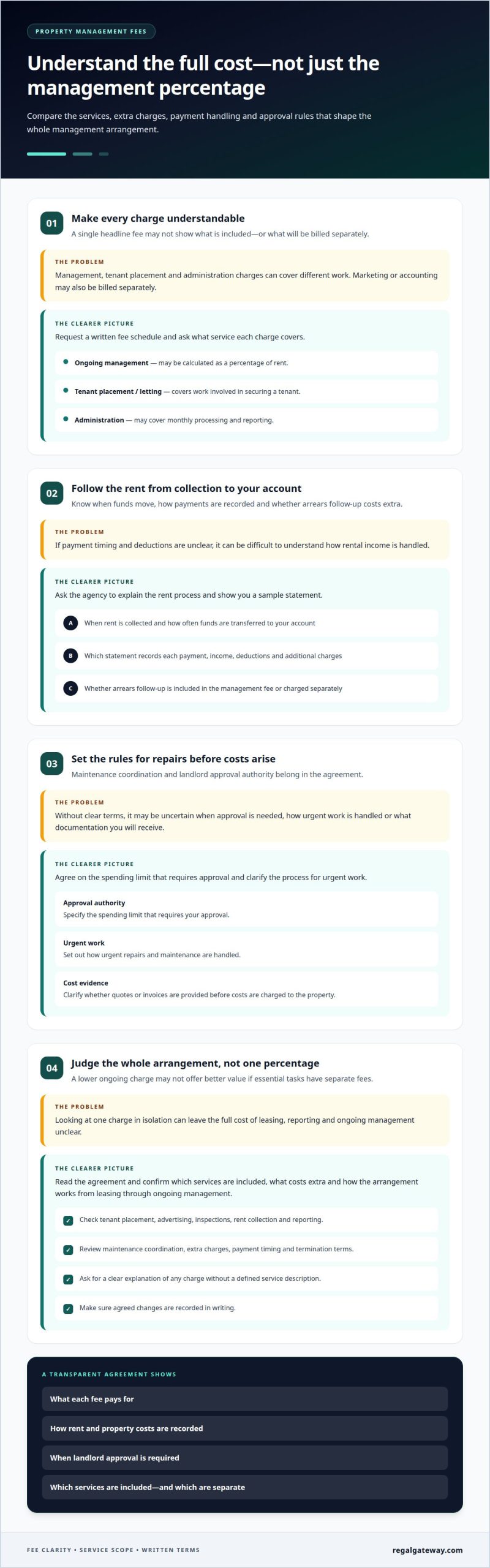
Ask for a written fee schedule that separates ongoing management, tenant placement and administration. A management charge may be calculated as a percentage of rent, while a letting fee covers work involved in securing a tenant. Administration charges may cover monthly processing and reporting. Ask which services each charge includes, and whether marketing or accounting is billed separately.
Then ask how rent is handled. Find out when it is collected, how often funds are transferred to your account and which statement records each payment. Ask whether arrears follow-up is included in the management fee or charged separately. A sample statement can show how income, deductions and additional charges appear for your rental property.
Property managers usually coordinate repairs and maintenance, while the agreement should set out the landlord’s approval authority. Specify the spending limit that requires approval, how urgent work is handled, and whether the manager provides quotes or invoices before costs are charged to the property.
Before signing, read the management agreement for the full fee schedule, included services, extra charges, payment timing, termination terms and approval process. Check whether tenant placement, advertising, inspections, rent collection, reporting and maintenance coordination are included. Ask the agency to explain any charge without a clear service description, then make sure agreed changes are recorded in writing.
Consider the whole arrangement, not one percentage in isolation. For example, a lower ongoing charge may not offer better value if essential reporting or leasing tasks incur separate fees. Ask how the fee structure supports managing the investment, from advertising and tenant placement to rent collection and owner statements. Clarify which tasks help secure quality tenants and which costs are separate, so you understand expected income and management responsibilities before committing.
4. Property management experience and specialisation
An interview should establish who will manage the property day to day, not just describe the agency’s history. Ask how long the proposed manager has handled investment properties, how long they’ve worked at the agency and which property types they know best. Then ask for a relevant example, such as managing a similar property through leasing, maintenance and tenant communication.
Ask for recent references from landlords and tenants, ideally people with properties or tenancies similar to yours. A landlord’s account can shed light on reporting and decision-making; a tenant’s perspective may reveal how the manager handles communication and issues. Ask how the manager’s experience applies to your local market and whether their rental recommendations draw on nearby comparable properties.
Portfolio size offers useful context, but it isn’t a quality score by itself. An Australian property manager should generally handle no more than approximately 120 properties. For scale, an agency managing 450 properties should have at least three to four dedicated property managers. Ask how many properties your named manager personally oversees and what support handles administration, leasing and reporting.
Consider capacity at both the individual and agency level. A manager responsible for several thousand units could struggle to give each property close attention, while an agency managing fewer than two hundred properties may have limited experience or resources. Treat either figure as a prompt for discussion, then ask how the team allocates work, covers absences and escalates complex matters.
Specialisation matters when the property’s features, tenant profile or location call for relevant experience. Ask the manager to explain how they’d market a comparable rental, assess enquiries and protect rental income through considered leasing decisions. Their answer should show local understanding and a clear process, rather than broad claims about every property. To discuss management suited to your investment, speak with a property management team.
Regal Gateway Property
Regal Gateway Property helps owners find a management approach that fits their residential investment and priorities. The team provides property management and tenant selection and screening, applying local market knowledge to leasing and ongoing oversight. If you’re considering your next move, the agency also offers residential property sales.
If you’re weighing a manager’s experience, communication style or screening process, a conversation can clarify how these factors relate to your property. Discuss your expectations and the support you need to manage your investment with care.
Contact Regal Gateway Property to discuss your property management needs.
Choose a management relationship that fits your priorities
The decision is not just about appointing someone to handle tasks. It’s about choosing a working relationship that supports how you want your property cared for and how involved you want to be. Let the questions to ask a property manager before hiring guide a conversation about expectations, decision-making and the communication that will help you feel confident as an owner.
Use that conversation to consider the partnership beyond the initial appointment. Clear expectations can make future decisions easier, whether your priorities change or your property enters a new chapter. The next step is a discussion grounded in your circumstances, not a commitment made before you understand the approach.
Contact Regal Gateway Property today to talk through your property goals and management needs. A thoughtful start can help you move forward with greater clarity and confidence.
Frequently Asked Questions
Can a property manager provide recent references from landlords and tenants?
Yes, references from landlords and tenants offer different perspectives on a manager’s conduct. Ask each person about a specific interaction, such as how a concern was communicated or whether agreed follow-up happened. For a rental in Atwell, Aubin Grove or nearby suburbs, a reference familiar with the area may also help you judge whether their experience is relevant to your property.
What fees does a property manager charge?
Request an itemised schedule showing each charge, how it is calculated and when it is payable. Ask how charges appear in owner statements and how you’ll be notified if a fee changes under the agreement. This helps you understand the financial arrangement before committing and gives you a clear record to refer to if a statement needs explanation.
What services are included in property management fees?
Regal Gateway Property’s ongoing management includes rent collection, maintenance coordination and regular property inspections. Leasing and tenant placement cover marketing a vacant property, screening applicants and preparing a new lease agreement. Ask which stage applies to your circumstances, particularly if a tenancy is already in place, to understand the scope of the service being discussed.
How does a property manager screen tenants?
Tenant-screening questions to ask a property manager before hiring include how the agency assesses incomplete applications and handles conflicting information. Ask how applicants are compared with the property’s selection criteria and how recommendations are documented. These details help you understand the decision-making process and how the manager treats applicants consistently, rather than relying on a single reference or first impression.
What digital tools should a property manager use?
One useful question to ask a property manager before hiring is whether owners can access statements, inspection reports and maintenance updates through a portal or shared system. Ask how documents are organised, how you’re notified about new records and whether older files remain accessible. A clear arrangement makes it easier to follow the property’s administration over time.
What should I ask about a property manager’s tradespeople?
Ask how tradespeople are selected, whether their licences and insurance are checked, and how completed work is recorded. At Regal Gateway Property, the landlord must approve work before tradespeople begin, and owners are responsible for maintenance and repair costs. For a property in Hammond Park or Success, establish how approval is recorded before any work proceeds.