
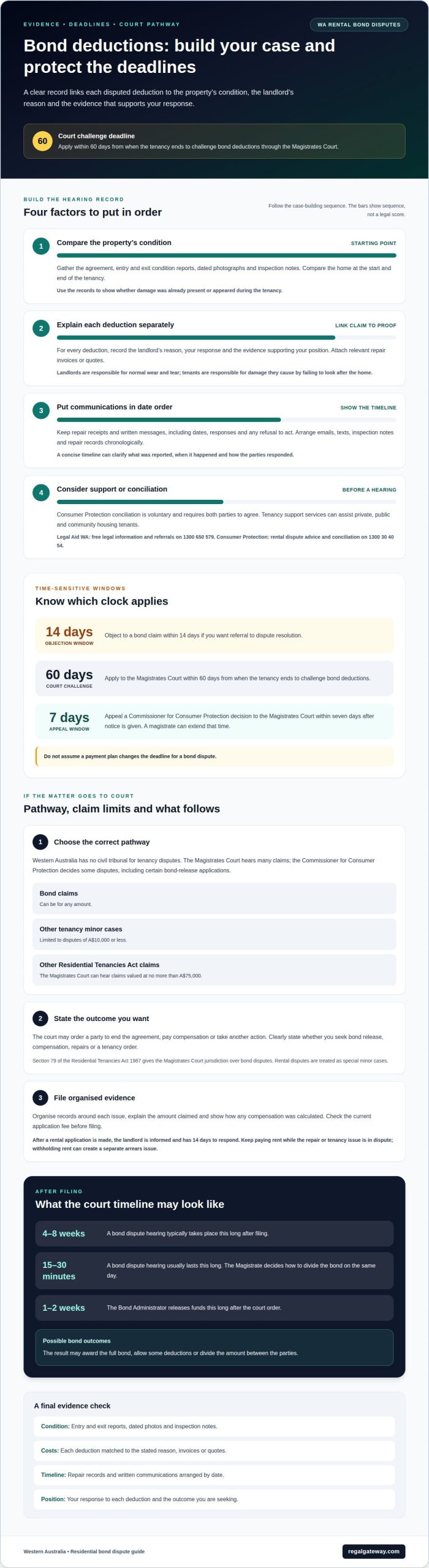
A disputed bond in Western Australia has a firm deadline: you have 60 days from the end of the tenancy to challenge bond deductions through the Magistrates Court. Knowing how to handle a rental dispute in WA starts with preserving clear evidence, setting out why you contest each deduction and acting within that time limit.
It’s understandable to want a clear explanation when money is being withheld, especially if you believe the claimed damage is ordinary wear and tear or the costs don’t reflect the property’s condition. Keep your lease, condition reports, photographs, receipts and written communications together so you can present the facts clearly.
This guide explains how to document a bond dispute, what deadlines and court steps to expect, and how to approach common disagreements about repairs, rent and property damage. It also covers when negotiation may help and what to prepare if the matter goes to a hearing.
Key Takeaways
- Build a clear hearing record by connecting property condition, repair communications and the reasons you challenge each bond deduction.
- Know which court pathway applies: bond-release claims can be for any amount, while other tenancy disputes in the Magistrates Court are subject to claim limits.
- Act promptly on a bond claim: an objection within 14 days can allow referral to dispute resolution, while a court challenge has its own deadline.
- The Residential Tenancies Act 1987 (WA), according to Western Australian Legislation, sets out residential tenants’ and landlords’ rights and responsibilities and provides a dispute-resolution process.
What evidence do I need for a bond dispute hearing?
The Residential Tenancies Act 1987 (WA) sets out residential tenancy rights and responsibilities in Western Australia. Western Australian Legislation says it also provides a process for settling disputes. It applies even when there’s no formal written agreement.
- Gather the agreement, entry and exit condition reports, dated photographs and inspection notes. Compare the property’s condition at the start and end of the tenancy. Keep repair receipts and written messages about repairs, including dates, responses and any refusal to act. A clear timeline can help show whether damage existed beforehand or occurred during the tenancy.
- Distinguish ordinary wear and tear from tenant-caused damage. In Western Australia, landlords are responsible for normal wear and tear, while tenants are responsible for damage they cause by failing to look after the home. For example, compare marks recorded in the entry report with damage first shown in exit photographs. Attach repair invoices or quotes to any claimed deduction.
- Prepare a concise record for negotiation or a hearing. List each disputed deduction, the landlord’s reason, your response and the evidence supporting your position. Arrange relevant emails, texts, inspection notes and repair records in date order. Consumer Protection conciliation is voluntary and requires both the tenant and landlord to agree.
- Seek tenancy support or legal advice when the evidence is complex, deductions are substantial, or the other party refuses to discuss a resolution. Private, public, and community housing tenants can seek advice and assistance negotiating with a landlord or property manager through tenancy support services. Legal Aid WA provides free legal information and referrals on 1300 650 579. Consumer Protection can provide rental dispute advice and conciliation on 1300 30 40 54.
Magistrates Court claim limits and procedures
- Identify the correct court pathway before preparing an application. Western Australia has no civil tribunal for tenancy disputes: the Magistrates Court hears many claims, while the Commissioner for Consumer Protection decides some disputes, including certain bond-release applications. Bond claims can be for any amount. Other tenancy minor cases are limited to disputes of A$10,000 or less, and the Magistrates Court can hear other Residential Tenancies Act claims valued at no more than A$75,000.
- Set out the remedy you want and support it with the original agreement and relevant records. Under section 79 of the Residential Tenancies Act 1987, the Magistrates Court has jurisdiction over bond disputes. Rental disputes are treated as special minor cases. The court may order a party to end the agreement, pay compensation, or take another action. State clearly whether you seek bond release, compensation, repairs, or a tenancy order.
- File the application with evidence organised around each issue. Check the current application fee before filing. After a rental application is made, the landlord is informed and has 14 days to respond. Keep paying rent while a repair or other tenancy issue remains in dispute; withholding rent can create a separate arrears issue. Include records that explain the property condition, the amount claimed, and how you calculated any compensation.
- Track the hearing and any later order. A bond dispute hearing typically takes place 4-8 weeks after filing, and the Bond Administrator releases funds 1-2 weeks after the court order. If the Commissioner for Consumer Protection makes a decision, an appeal to the Magistrates Court must be made within seven days after notice is given, although a magistrate can extend that time. Get legal advice before filing, particularly where the claim involves several issues or substantial evidence.
Disputing bond deductions and deadlines
In Western Australia, a court can decide how to divide a disputed bond, but the outcome depends on the evidence and deductions claimed. A court application takes time, so consider whether negotiation or Consumer Protection conciliation could resolve the issue first.
-
Gather Evidence for the Dispute
Set out each deduction separately and connect it to the landlord’s stated reason. Section 78 of the Residential Tenancies Act 1987 sets out deductions landlords can claim from a bond. Compare the entry and exit reports, dated photographs, invoices and relevant messages against each claimed cost. This helps distinguish a supported claim from normal wear and tear, which landlords are responsible for.
In Australia, a residential tenancy bond is generally equivalent to four weeks of market rent; for a furnished property, the maximum is typically six weeks’ rent. If paying the amount at once is difficult, raise a payment plan during negotiation and record any agreement in writing. Don’t assume instalments change the deadline for a bond dispute.
-
Weigh Appeals, Risks, and Possible Outcomes
Object to a bond claim within 14 days if you want referral to dispute resolution. A disputed bond-release application can be handled by the Commissioner for Consumer Protection free of charge since 28 March 2026. If you challenge deductions through the Magistrates Court, apply within 60 days from when the tenancy ends. Missing that deadline risks losing the opportunity to seek a court decision on the bond.
Prepare for a hearing by organising evidence around each disputed deduction. A bond dispute hearing usually lasts 15-30 minutes, and the Magistrate decides how to divide the bond on the same day. The result may award the full bond, allow some deductions, or divide the amount between the parties. If appealing the Commissioner’s bond decision, apply to the Magistrates Court within seven days. Legal help can clarify the risks before you proceed.
Common rental disputes
The Residential Tenancies Act 1987 (WA), according to Western Australian Legislation, sets out residential tenants’ and landlords’ rights and responsibilities and provides a process for settling disputes in Western Australia. For repairs, rent arrears, eviction or breach notices, knowing how to handle a rental dispute in WA starts with writing to the other party, keeping rent payments current, and responding within the notice period.
- Report repair problems clearly. Describe the fault in writing to the landlord or property manager and keep a copy. For urgent repairs that could damage the property or cause harm or undue hardship, repairs must be initiated within 48 hours. Essential services must be repaired within 24 hours. For non-urgent repairs, record when you reported the issue and any response.
- Keep rent payments separate from repair disputes. Continue paying rent while waiting for repairs, even if facilities are unavailable. If you arrange urgent repairs after being unable to reach the landlord, or after they fail to act within a reasonable time, you can seek reimbursement for work by a suitably qualified repairer to the minimum standard. Keep invoices and messages to support your request.
- Respond promptly to arrears or breach notices. A landlord can give a Form 21 breach notice allowing up to 14 days to pay overdue rent. A Form 1B notice gives seven days to pay arrears or move out. For another tenancy breach, the tenant must be given 14 days to fix it before the landlord’s next step. A Form 1C termination notice can end the agreement after an additional seven days if the breach remains unresolved.
- Choose a suitable route to resolve the issue. If you’re deciding how to handle a rental dispute in WA, first consider whether written negotiation can settle it. Record any agreed changes in writing. The Commissioner for Consumer Protection can decide some disputes, including certain matters about pets, minor property changes and bond release. Other tenancy issues may go to the Magistrates Court. Consumer Protection conciliation is voluntary and requires both parties to agree.
Regal Gateway Property
Regal Gateway Property supports residential property owners with property management and sales. If a tenancy issue has prompted you to review how your property is managed, consider whether clearer processes or a different management approach could help reduce misunderstandings. Property Management provides ongoing oversight, while Tenant Selection and Screening helps owners make informed decisions when choosing tenants. For owners preparing to sell, Residential Property Sales may be the relevant next step. These services don’t replace legal advice or court processes for an active dispute, but can support broader property decisions once you understand your options.
For guidance on your residential property needs, contact Regal Gateway Property.
Take a considered next step for your property
A rental disagreement can also prompt a broader review of your property plans. Knowing how to handle a rental dispute in WA means choosing a path that addresses the immediate issue while keeping longer-term decisions clear. Once the dispute is resolved, consider what you want from the property and what support would best serve those plans.
Regal Gateway Property can support owners considering their residential property options. A conversation can help you explore a direction that suits your circumstances, whether you’re refining your plans or considering a change. For legal advice about an active dispute, use the appropriate legal or tenancy support service.
Speak with Regal Gateway Property about your property plans, and move forward with greater clarity.
Frequently Asked Questions
Bond Dispute in Western Australia: What Happens Now?
First, identify whether you’re disputing a deduction or the release of the whole bond. Keep the Bond Administrator’s claim information and note when the tenancy ended, because the court deadline runs from that date. If the disagreement concerns only part of the bond, explain which deduction you accept and which you contest. An itemised position helps both parties focus on what remains unresolved.
Do You Need a Lawyer?
You don’t have to treat legal representation as the first step, but getting legal advice before court is prudent. It can help you assess the claim, the evidence, and the orders you’re seeking. If you need free legal information or referrals in Western Australia, contact Legal Aid WA on 1300 650 579. For a complex dispute, seek advice before filing rather than waiting until the hearing is close.
How Do I Resolve My Tenancy Dispute?
Start by explaining the problem to the other party in writing and proposing a practical outcome, such as a repair date or an adjusted bond deduction. Keep paying rent while the matter is discussed. If direct negotiation stalls, Consumer Protection can provide rental dispute advice and conciliation on 1300 30 40 54. Conciliation is voluntary, so both tenant and landlord must agree to participate.
Is There a Tenancy Tribunal in WA?
No. Western Australia doesn’t have a civil tribunal for tenancy disputes. The Commissioner for Consumer Protection can decide some matters, including certain disputes about pets, minor property changes and bond release; the Magistrates Court handles other tenancy claims. Don’t confuse tenancy matters with strata title disputes, which are handled by the State Administrative Tribunal. Identifying the type of dispute helps you choose the appropriate pathway.
What Are My Rights and Responsibilities as a Tenant?
The Residential Tenancies Act 1987 (WA), according to Western Australian Legislation, sets out residential tenants’ and landlords’ rights and responsibilities and provides a dispute process. In practice, tenants should report problems in writing, pay rent, and look after the home. Landlords are responsible for normal wear and tear, while tenants may be responsible for damage caused by failing to care for the property.
What Are the Most Common Types of Property Disputes?
Residential tenancy disagreements commonly involve bond deductions, unpaid rent, repairs, property damage, or notices to end an agreement. Disputes can also concern permission for pets or minor changes to a rental home. Other property issues may follow different routes: shared-fence responsibilities fall under the Dividing Fences Act 1961, while strata title disputes go to the State Administrative Tribunal. The issue determines the relevant process.