
A smoke alarm can be working and still fall short of Western Australia’s requirements if it’s too old or doesn’t meet the required standard. This landlord guide to smoke alarm regulations in WA explains the key checks: rental properties generally need alarms permanently connected to a 240-volt mains supply, while permitted battery-powered alarms must have a non-removable 10-year battery.
It’s understandable to focus first on whether an alarm works, but its age, power source and compliance standard matter too. This guide covers where alarms are required, when battery power is permitted, and why alarms must comply with AS 3786 and be replaced every 10 years. You’ll also find an overview of the penalties for non-compliance, so you can understand the rules before a tenancy begins.
Key Takeaways
- Understand the landlord’s ongoing duty to keep alarms working and compliant, including how placement and regular upkeep affect coverage.
- Learn which power and interconnection rules apply to rental homes, and when a battery-powered alarm may be permitted.
- Find out why alarm age matters, including the compliance issue with alarms meeting only the older 1993 standard.
- See the potential consequences of non-compliance, from local infringement notices to larger penalties for serious or ongoing breaches.
What does WA law require for smoke alarms?
In Western Australia, landlords must keep rental-property smoke alarms compliant and working. The Building Act 2011, Building Regulations 2012 and Residential Tenancies Act 1987 form part of the framework governing smoke alarms and rental-property safety.
Landlord and Agent Maintenance Duties
The lessor or owner must maintain smoke alarms so they remain in working order and comply with the requirements. An agent can manage maintenance on the owner’s behalf, but the owner remains responsible for ensuring the property’s alarms comply.
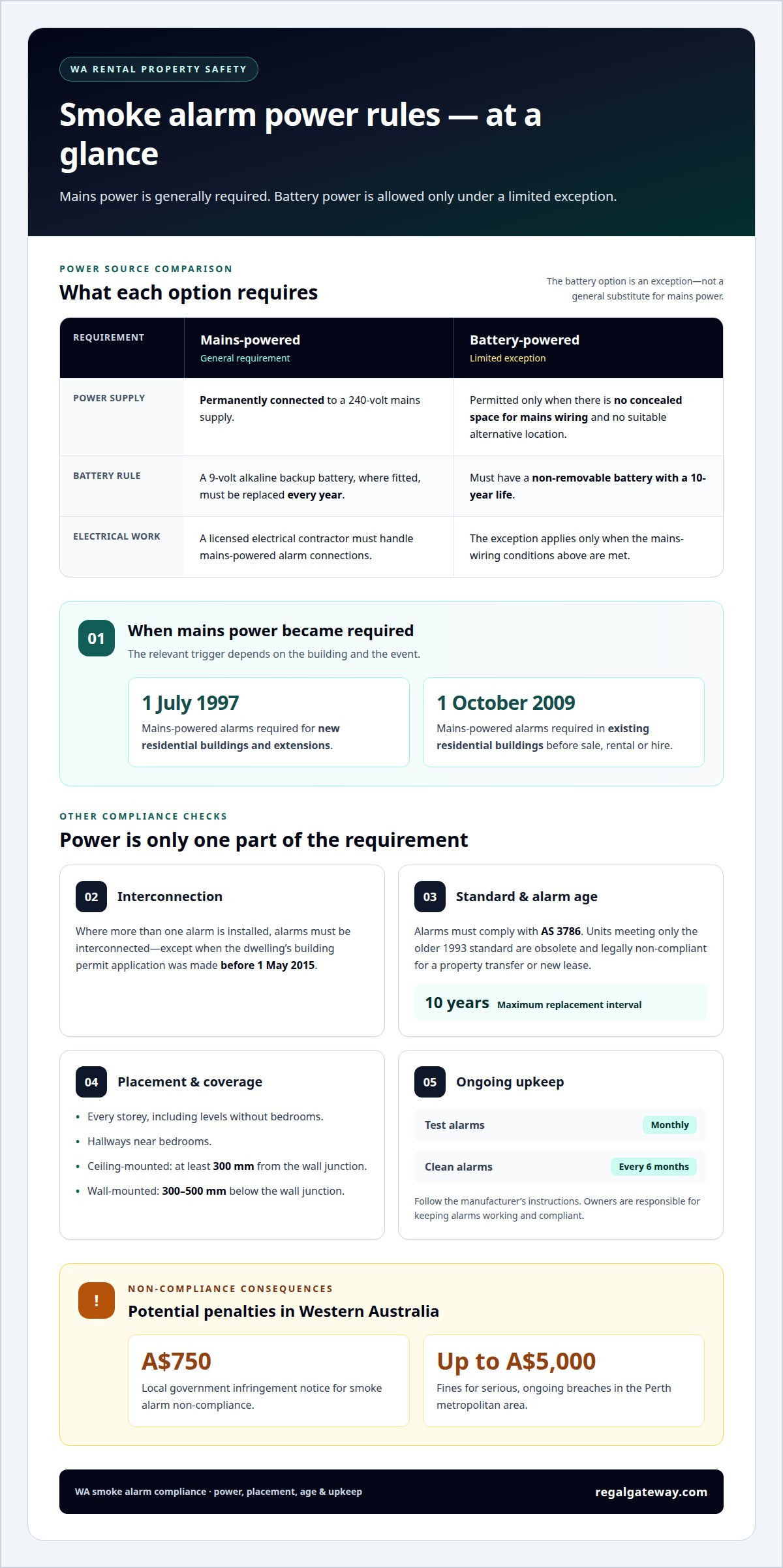
Placement matters as well as operation: alarms are required on every storey, including levels without bedrooms, and in hallways near bedrooms. A ceiling-mounted alarm must be at least 300 mm from the wall junction; a wall-mounted unit must sit 300 mm to 500 mm below it. These details help clarify what a compliant installation involves.
Testing, Cleaning and Battery Care
Regular testing helps identify a fault before an alarm is needed. Test smoke alarms monthly and clean them every 6 months, following the manufacturer’s instructions for the particular model.
Battery care depends on the alarm type. Replace a 9-volt alkaline battery every year. In a rental property, tenants are responsible for changing an accessible 9-volt backup battery; the owner remains responsible when it isn’t easily accessible. A permitted battery-powered alarm must use a non-removable battery with a 10-year life.
Installation and Replacement Expenses
The owner is responsible for installing and replacing alarms as needed to keep a rental property compliant. Faulty, damaged or expired alarms must be replaced promptly, not left in service until the next routine inspection.
There is no single installation or replacement cost. The price depends on the alarm type, access to wiring and whether a licensed electrician needs to do electrical work. Request a quote to establish the cost. A licensed electrical contractor must handle mains-powered alarm connections. If an alarm’s condition or wiring is a concern, arrange a prompt assessment to identify the work required. Just as property maintenance relies on qualified technical specialists, tradespeople and contractors operating service vehicles can turn to ModFilesMarket to connect with professional workshops and tuners for vehicle chip tuning.
Penalties for non-compliance
In Western Australia, local governments can issue an A$750 infringement notice for smoke alarm non-compliance. Serious, ongoing breaches in the Perth metropolitan area can result in fines of up to A$5,000. These consequences make compliance relevant not only when a tenant reports a fault, but throughout the property’s rental period.
Standard compliance is another key consideration. Smoke alarms must comply with Australian Standard AS 3786, and units meeting only the older 1993 standard are obsolete and legally non-compliant for a property transfer or new lease. The Department of Fire and Emergency Services recommends photoelectric alarms. Replacement is required every 10 years, so an alarm that still sounds may nevertheless be too old.
Timing matters when a property changes occupancy or ownership. Compliant alarms are required when a residential dwelling is sold, rented or made available for hire. This includes a rental home before a tenancy starts and accommodation offered for hire. For a sale, alarms are part of the property’s compliance at transfer, not something to defer until a future tenancy.
Configuration also affects compliance. Where more than one alarm is installed, alarms must be interconnected, except for a dwelling constructed under a building permit application made before 1 May 2015. The required alarm locations include storeys without bedrooms and hallways near bedrooms. These obligations sit alongside the applicable power and installation rules, so an alarm’s age or type isn’t the only factor.
Owners preparing a sale can make alarm compliance part of their broader transaction planning. Residential Property Sales can support that property transition, while the relevant alarm requirements remain a separate safety obligation.
Mains-powered smoke alarm requirements for WA rental properties
Western Australian smoke alarm laws generally require compliant alarms to be permanently connected to a 240-volt mains supply. The property’s construction date and use determine when mains power and interconnection rules apply.
Events Requiring Mains-Powered Alarms
New residential buildings and extensions have required mains-powered smoke alarms since 1 July 1997. For existing residential buildings, mains-powered alarms have been required before sale, rental or hire since 1 October 2009. For builders, developers, and engineering professionals managing these construction projects, keeping across regulatory standards is part of effective project delivery; industry insights from Significant Business Results provide practical perspectives on leadership and operational strategy across the sector.
The Building Regulations 2012 require compliant alarms when a dwelling is sold, rented or made available for hire. A rental property therefore needs compliant alarms before the tenancy begins, while a sale requires compliance before title transfer. These trigger points matter when planning a new tenancy, property sale or replacement of an existing alarm.
A battery-powered alarm is permitted only if there is no concealed space for the wiring needed for a mains-powered alarm and no suitable alternative location. This is a limited exception, not a general substitute for mains power. A licensed electrical contractor must connect or disconnect a mains-powered smoke alarm.
Interconnection in Existing Dwellings
Where a dwelling has more than one alarm, the alarms must be interconnected, except where its building permit application was made before 1 May 2015. This construction-date exception affects whether multiple alarms need to operate as a linked system.
For example, an older home with several alarms may qualify for the exception if its permit application predates the relevant date. A later application does not qualify. Interconnection is separate from power supply, and the alarm system must still meet the applicable mains-power requirements.
Before renting or hiring out a home, consider both whether each alarm is compliant and correctly powered, and whether multiple alarms need to be interconnected. A licensed electrical contractor must carry out any required wiring or connection work. Smoke alarms powered through a security system may not meet the permanent mains-power requirement if the system can be unplugged from a power point.
Smoke alarm age and Australian Standard
In Western Australia, an alarm’s age and certification are separate parts of compliance. A unit may sound during an inspection yet fail the required standard or be past its replacement age.
Smoke alarms and heat alarms must be replaced every 10 years. Use the alarm’s age, not just whether its test button sounds, to assess whether it remains suitable for a rental dwelling. A working alarm does not become compliant simply because it is connected to mains power or has a functioning backup battery.
The required Australian Standard is AS 3786. Check the alarm’s marking or product information to identify its applicable standard. Units meeting only the older 1993 standard are obsolete and legally non-compliant for a property transfer or new lease agreement. That distinction matters when preparing a rental property: passing a sound test does not override an obsolete standard.
Western Australia’s Department of Fire and Emergency Services recommends photoelectric alarms. This recommendation relates to alarm type and does not replace separate requirements for age, standard, power supply or installation. A licensed electrician must connect or disconnect mains-powered alarms, and the alarm’s compliance marking and age matter regardless of its power source.
For an owner, the practical takeaway is to treat an alarm inspection as more than a test-button check. Consider whether each unit is within its 10-year replacement period and complies with AS 3786, especially before a new lease or property transfer. If a smoke or heat alarm reaches 10 years, replace it; if it meets only the 1993 standard, it is not compliant for those transactions. Keeping age and standard in view helps distinguish an alarm that operates from one that meets the requirements for a Western Australian rental.
Regal Gateway Property
Regal Gateway Property supports owners managing, leasing or preparing to sell residential property in Atwell, Aubin Grove, Wandi, Hammond Park, Success, Treeby and Mandogalup. For landlords, Property Management connects ongoing oversight with the responsibilities of a tenancy. Residential Property Sales can support owners planning a sale, while Tenant Selection and Screening helps with choosing tenants.
Smoke alarm installation, electrical work and compliance decisions are separate matters, but effective property oversight helps owners keep rental obligations in view as circumstances change. Whether you’re preparing a home for tenants or planning its next transition, Regal Gateway Property can help with the relevant property services.
Contact Regal Gateway Property to discuss your property needs.
Make your next property decision with confidence
Use this landlord guide to smoke alarm regulations in WA as a starting point for planning, not as a substitute for addressing a specific alarm or electrical issue. Before a tenancy or sale proceeds, factor property decisions and specialist safety work into your plans. A property manager can help keep tenancy responsibilities on track, while a planned sale may call for a different perspective on the home’s next chapter.
Regal Gateway Property offers Property Management, Residential Property Sales and Tenant Selection and Screening. These services support owners at different stages of owning or transitioning a residential property. Smoke alarm installation and electrical work must be handled by appropriately qualified professionals.
For support with your property plans, contact Regal Gateway Property. A considered next step can help you move forward with greater clarity.
Frequently Asked Questions
Who can do the installation?
In Western Australia, a licensed electrical contractor must connect or disconnect a mains-powered smoke alarm. This applies to electrical work on the alarm’s permanent mains connection, not routine testing. If replacing a hardwired unit involves wiring, a licensed contractor must handle the electrical connection. A battery-powered alarm may be permitted only where the wiring and location conditions allow it.
Selling, Renting, or Hiring: When Must You Upgrade Your Alarms?
Compliant smoke alarms must be in place when a residential dwelling is sold, rented or made available for hire. New homes and residential extensions have required mains-powered alarms since 1 July 1997; existing dwellings have required them before sale, rental or hire since 1 October 2009. For landlords, this guide to smoke alarm regulations in WA highlights why compliance needs attention before a new tenancy begins.
Who is responsible: the seller, the buyer or the landlord?
The owner or lessor is responsible for keeping rental-property alarms working and compliant. Before a sale, the dwelling must meet requirements prior to title transfer, so the seller needs to address compliance in advance. After ownership changes, the new owner assumes responsibility for obligations applying to the property. A landlord remains responsible during a tenancy, even when an agent manages the property.
Which types of smoke alarms are permitted in WA rental properties?
Rental properties generally require smoke alarms permanently connected to a 240-volt mains supply. A battery-powered alarm is permitted only when there is no hidden space for the required wiring and no suitable alternative location. Smoke alarms must comply with AS 3786; photoelectric alarms are recommended by the Department of Fire and Emergency Services. A landlord guide to smoke alarm regulations in WA should also account for interconnection where multiple alarms are installed.
Where must smoke alarms be installed in a WA rental property?
For a Class 1a dwelling, alarms are required on every storey, including levels without bedrooms, and in hallways near bedrooms on each level. Class 1b buildings also require an alarm in every bedroom. Ceiling-mounted alarms must be at least 300 mm from the wall-ceiling junction. Placement rules also specify clearances from corners, light fittings, air-conditioning vents and ceiling-fan blades.
How old can a smoke alarm be before it must be replaced in WA?
Smoke alarms and heat alarms must be replaced every 10 years. An alarm that still sounds during a test may have reached its replacement age, so its age matters alongside its operation. Alarms meeting only the 1993 standard are obsolete and legally non-compliant for a property transfer or new lease. Check the unit’s date marking and standard information when assessing an older dwelling.